Introduction
The phrase not interested is used when someone does not feel curiosity, enthusiasm, attraction, or willingness toward something. It can describe a lack of interest in an activity, idea, offer, conversation, subject, or opportunity.
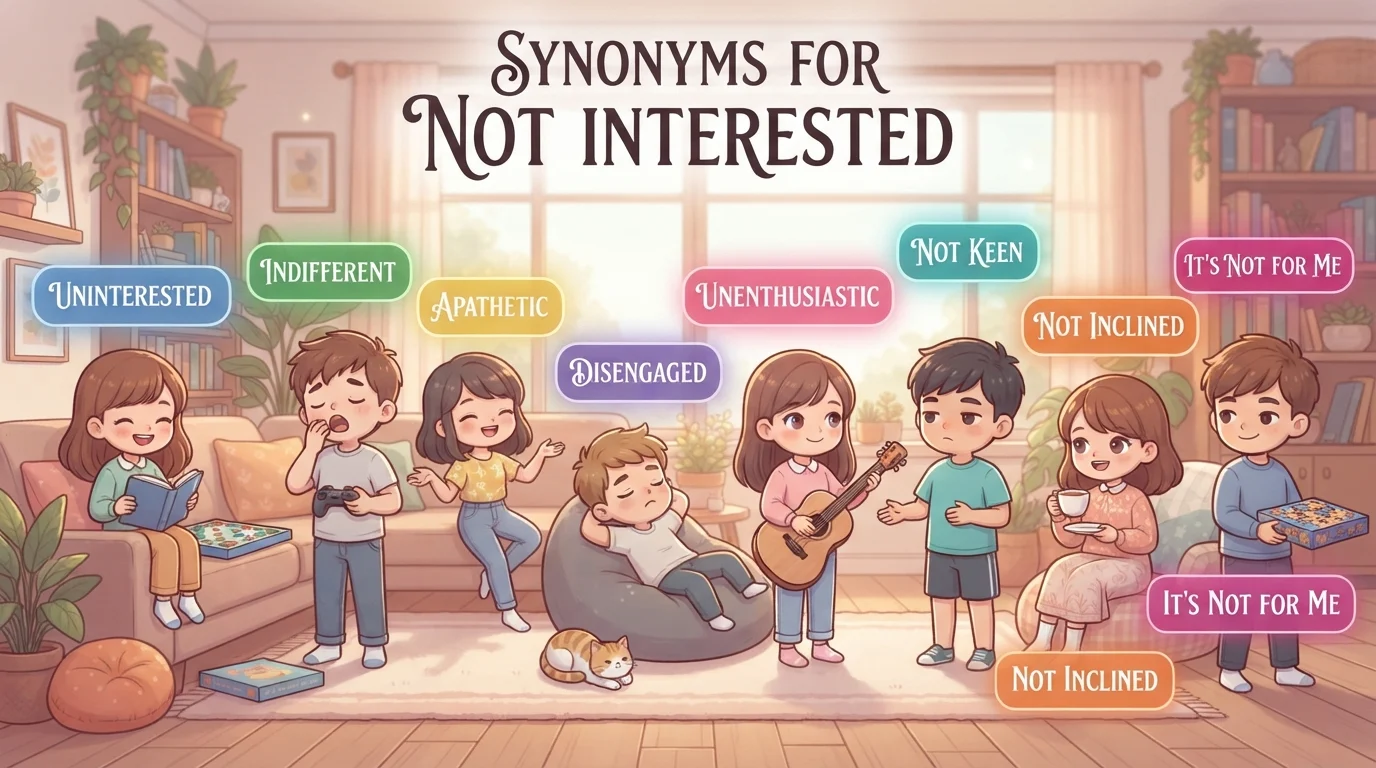
There are many alternatives to not interested, and the best choice depends on your tone. Words such as uninterested, indifferent, apathetic, unconcerned, reluctant, and disengaged can express a lack of interest, while phrases like not keen, not inclined, and I’d rather not sound more natural in everyday conversations.
Quick Answer: What Are Synonyms for Not Interested?
Common synonyms and related expressions include:
- Uninterested
- Indifferent
- Apathetic
- Unconcerned
- Disengaged
- Unenthusiastic
- Inattentive
- Reluctant
- Unwilling
- Unresponsive
- Detached
- Aloof
- Dispassionate
- Incurious
- Uninvolved
- Not keen
- Not enthusiastic
- Not inclined
- Not bothered
- Not invested
- I don’t care
- I’m not into it
- It’s not for me
- I’d rather not
- I’m not interested in that
- I don’t have much interest in it
- I’m not particularly interested
- I’m not drawn to it
- It doesn’t appeal to me
- I’m not feeling it
What Does “Not Interested” Mean?
Not interested means that someone does not have a desire, curiosity, enthusiasm, or willingness to engage with something.
Simple definition
Not interested = having little or no interest in something.
Examples
- I’m not interested in that offer.
- She is not interested in sports.
- He seemed not interested in the conversation.
30 Synonyms for Not Interested
Uninterested
Meaning: Having little or no interest in something.
Example: She seemed uninterested in the discussion.
Best usage: General English and formal writing.
Indifferent
Meaning: Having little concern, preference, or emotional response.
Example: He was indifferent to the criticism.
Best usage: Formal and descriptive writing.
Apathetic
Meaning: Showing little enthusiasm, concern, or motivation.
Example: The student appeared apathetic toward the assignment.
Best usage: Formal, academic, and psychological contexts.
Unconcerned
Meaning: Not worried about or interested in something.
Example: She seemed unconcerned about the outcome.
Best usage: General and formal English.
Disengaged
Meaning: Not actively involved or interested.
Example: The audience became disengaged during the long presentation.
Best usage: Education, business, and workplace contexts.
Unenthusiastic
Meaning: Showing little excitement or enthusiasm.
Example: He was unenthusiastic about the proposed changes.
Best usage: General and professional writing.
Inattentive
Meaning: Not paying attention.
Example: The student was inattentive during the lecture.
Best usage: School, work, and formal contexts.
Reluctant
Meaning: Unwilling or hesitant to do something.
Example: She was reluctant to join the activity.
Best usage: Situations involving hesitation or unwillingness.
Unwilling
Meaning: Not wanting to do something.
Example: He was unwilling to participate.
Best usage: General and formal English.
Unresponsive
Meaning: Showing little reaction or engagement.
Example: The audience remained unresponsive to the speaker’s questions.
Best usage: Communication and formal contexts.
Detached
Meaning: Emotionally uninvolved or distant.
Example: She appeared detached from the discussion.
Best usage: Formal and descriptive writing.
Aloof
Meaning: Emotionally distant or not showing interest in others.
Example: He seemed aloof during the social gathering.
Best usage: Personality and social descriptions.
Dispassionate
Meaning: Not emotionally involved or affected.
Example: She gave a dispassionate assessment of the situation.
Best usage: Formal and analytical writing.
Incurious
Meaning: Not curious or eager to learn more.
Example: He remained incurious about the new subject.
Best usage: Formal and literary writing.
Uninvolved
Meaning: Not participating or emotionally engaged.
Example: She remained uninvolved in the debate.
Best usage: General and formal writing.
Not Keen
Meaning: Not enthusiastic or eager about something.
Example: I’m not keen on going out tonight.
Best usage: Everyday English, especially British English.
Not Enthusiastic
Meaning: Not showing excitement or eagerness.
Example: They were not enthusiastic about the proposal.
Best usage: Professional and everyday English.
Not Inclined
Meaning: Not willing or likely to do something.
Example: I’m not inclined to accept the offer.
Best usage: Polite and somewhat formal English.
Not Bothered
Meaning: Not concerned or interested enough to care.
Example: He wasn’t bothered about missing the event.
Best usage: Casual English.
Not Invested
Meaning: Not emotionally or personally involved.
Example: She wasn’t invested in the outcome.
Best usage: Work, relationships, projects, and general discussion.
I Don’t Care
Meaning: Showing that something does not matter to you.
Example: I don’t care which option they choose.
Best usage: Casual English; can sound blunt.
I’m Not Into It
Meaning: Not interested in or enthusiastic about something.
Example: I’m not really into that type of music.
Best usage: Very casual conversation.
It’s Not for Me
Meaning: Something does not match your interests or preferences.
Example: Thanks for suggesting it, but it’s not for me.
Best usage: Polite everyday conversation.
I’d Rather Not
Meaning: A polite way of saying you do not want to do something.
Example: I’d rather not discuss that right now.
Best usage: Polite refusals.
I’m Not Particularly Interested
Meaning: Politely expressing limited interest.
Example: I’m not particularly interested in the proposal.
Best usage: Professional and polite communication.
I Don’t Have Much Interest in It
Meaning: You have little interest in something.
Example: I don’t have much interest in competitive sports.
Best usage: Neutral and conversational English.
I’m Not Drawn to It
Meaning: You do not feel naturally attracted or interested in something.
Example: I’m not really drawn to that style.
Best usage: Personal preferences and creative topics.
It Doesn’t Appeal to Me
Meaning: Something does not attract your interest or suit your preferences.
Example: The idea doesn’t really appeal to me.
Best usage: Polite and natural conversation.
I’m Not Feeling It
Meaning: You are not enthusiastic about or interested in something.
Example: I tried the activity, but I’m just not feeling it.
Best usage: Very casual English.
Comparison Table
| Expression | Meaning | Tone | Best Context |
|---|---|---|---|
| Uninterested | Having little interest | Neutral | General |
| Indifferent | Not concerned or affected | Formal | Writing |
| Apathetic | Lacking enthusiasm or concern | Strong | Academic |
| Unconcerned | Not worried or concerned | Neutral | General |
| Disengaged | Not actively involved | Professional | Work/school |
| Unenthusiastic | Lacking excitement | Neutral | General |
| Reluctant | Hesitant or unwilling | Neutral | Decisions |
| Detached | Emotionally uninvolved | Formal | Descriptions |
| Not keen | Not enthusiastic | Casual | Conversation |
| Not inclined | Not willing | Polite | Refusals |
| Not bothered | Not concerned | Casual | Conversation |
| It’s not for me | Doesn’t suit my interests | Polite | Preferences |
| I’d rather not | Prefer not to | Polite | Refusals |
| It doesn’t appeal to me | Doesn’t attract interest | Polite | Preferences |
| I’m not into it | Not interested in it | Casual | Conversation |
Polite Ways to Say “Not Interested”
If you want to reject an idea or offer without sounding rude, try:
- I’m not particularly interested, thank you.
- I appreciate the offer, but it’s not for me.
- Thanks, but I’ll pass.
- I don’t think that’s something I’d be interested in.
- It doesn’t really appeal to me.
- I’m not keen on that idea.
- I’d rather not, but thank you.
- I appreciate you asking, but I’m going to pass.
Casual Ways to Say “Not Interested”
For friends and informal conversations:
- I’m not into it.
- Not really my thing.
- I’m not feeling it.
- I’m good, thanks.
- I’ll pass.
- That’s not really for me.
- I’m not keen.
- I don’t really care about it.
Formal Ways to Say “Not Interested”
For professional or academic situations:
- I am not particularly interested in this opportunity.
- I do not have a strong interest in this subject.
- This does not align with my current interests.
- I am not inclined to pursue this option.
- I do not believe this is suitable for my current objectives.
- I appreciate the proposal, but I will not be pursuing it.
Not Interested vs. Uninterested
These words are often treated as synonyms, but there is a useful distinction.
Uninterested means having little or no interest.
Not interested is a broader everyday expression that can simply mean you do not want something or do not wish to participate.
- Uninterested: She seemed uninterested in the lecture.
- Not interested: I’m not interested in joining the club.
Not Interested vs. Indifferent
Indifferent usually means you do not have a strong preference or emotional response.
For example:
I’m not interested in buying the product.
means you do not want to buy it.
I’m indifferent about which product we choose.
means either option is acceptable to you.
Not Interested vs. Apathetic
Apathetic is stronger than not interested. It suggests a lack of enthusiasm, concern, or motivation.
- Not interested: He doesn’t want to participate.
- Apathetic: He shows little concern about participating or the outcome.
How to Choose the Right Synonym
Choose your expression according to your intended tone:
- Neutral: uninterested
- Formal: indifferent
- Strong: apathetic
- Professional: disengaged
- Polite: it’s not for me
- Casual: I’m not into it
- Gentle refusal: I’d rather not
- British/casual: not keen
- Preference: it doesn’t appeal to me
- Hesitation: reluctant
- Lack of willingness: unwilling
- Emotional distance: detached
- Lack of concern: unconcerned
Common Mistakes
Using “Apathetic” for Simple Lack of Interest
Apathetic often suggests a deeper lack of concern or motivation. It can sound stronger than simply saying someone is not interested.
Using “Indifferent” When You Mean “I Don’t Want It”
Indifferent often means you have no strong preference. It does not necessarily mean you actively reject something.
Saying “I’m Not Interested” Too Directly
In professional or social situations, “It’s not for me” or “I appreciate the offer, but I’ll pass” can sound softer and more polite.
Example Sentences
- She seemed uninterested in the conversation.
- He was indifferent to the criticism.
- The student appeared apathetic toward the assignment.
- They were unenthusiastic about the proposal.
- The audience became disengaged during the presentation.
- I’m not keen on that idea.
- I’m not inclined to accept the offer.
- It’s not for me, but thank you.
- I’m not into it.
- The idea doesn’t appeal to me.
- I’d rather not participate.
- He seemed detached from the discussion.
Frequently Asked Questions
What is the best synonym for not interested?
Uninterested is the closest general synonym. Depending on context, indifferent, unenthusiastic, disengaged, or not keen may be more natural.
What is a polite way to say “not interested”?
You can say “It’s not for me,” “I appreciate the offer, but I’ll pass,” or “I’m not particularly interested.”
What is a stronger word for not interested?
Apathetic can be stronger because it suggests a lack of enthusiasm, concern, or motivation.
Is “uninterested” the same as “not interested”?
They are very close. Uninterested is an adjective, while not interested is a phrase commonly used to describe a person’s current lack of interest or willingness.
What is a casual way to say “not interested”?
“I’m not into it,” “I’m not feeling it,” or “It’s not really my thing” are natural casual expressions.
What is the opposite of interested?
Common opposites include uninterested, indifferent, apathetic, disengaged, and unconcerned, depending on the intended meaning.
Final Verdict
The best synonym for not interested depends on what you want to communicate. Uninterested is the closest general alternative, while indifferent suggests a lack of concern or preference, and apathetic indicates a stronger lack of enthusiasm or motivation.
For polite conversations, phrases such as “It’s not for me,” “It doesn’t appeal to me,” and “I’d rather not” are useful. In casual speech, “I’m not into it” sounds natural, while disengaged and unenthusiastic work well in professional or formal writing.

I’m Joseph Davis, a language enthusiast passionate about synonyms and clear communication. I enjoy simplifying vocabulary, exploring word meanings, and creating helpful content that makes writing more engaging, accurate, and confident.