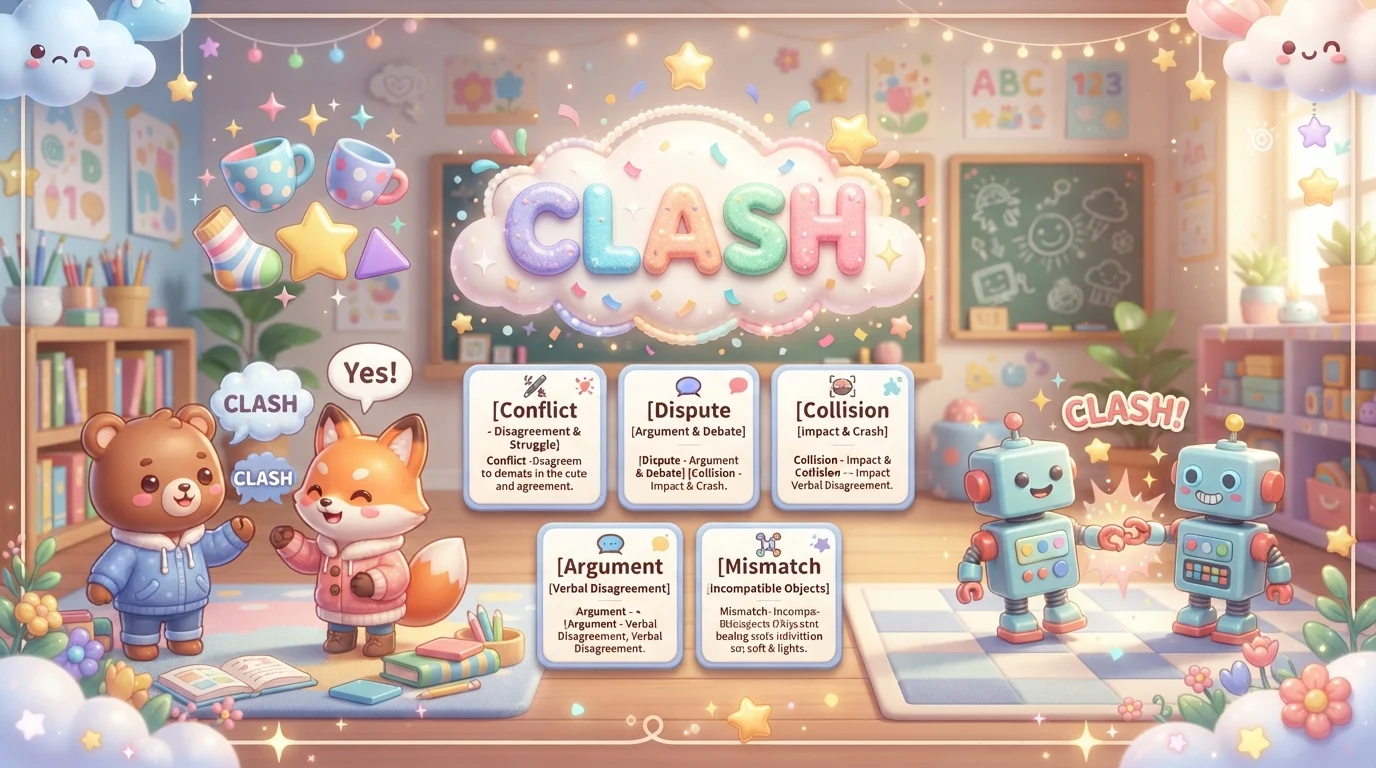
The word clash can describe several kinds of disagreement or physical impact. People can clash over opinions, groups can clash during conflicts, colors can clash visually, and two objects can clash when they collide.
Because clash has multiple meanings, choosing the right synonym depends on the situation. Words such as conflict, disagreement, dispute, collision, confrontation, quarrel, and incompatibility can express different shades of meaning.
Quick Answer
Common synonyms for clash include conflict, disagreement, dispute, confrontation, quarrel, argument, altercation, fight, struggle, collision, impact, encounter, opposition, friction, discord, disagreement, controversy, rivalry, incompatibility, and collision.
What Does Clash Mean?
Clash can function as both a noun and a verb.
As a noun, it can describe:
- A disagreement between people or groups.
- A physical collision.
- A conflict between ideas or interests.
- A visual mismatch, especially between colors or styles.
- A scheduling conflict.
As a verb, clash can mean:
- To disagree strongly.
- To fight or confront one another.
- To collide physically.
- To be incompatible.
- To happen at the same time.
30 Synonyms for Clash
Conflict
Meaning: A serious disagreement or struggle between people, groups, or ideas.
Example: The two teams were involved in a conflict over the rules.
Best usage: General, professional, social, and formal contexts.
Disagreement
Meaning: A difference of opinion.
Example: They had a disagreement about how to solve the problem.
Best usage: Everyday and professional communication.
Dispute
Meaning: A serious disagreement, often involving a specific issue.
Example: The neighbors were involved in a dispute over the property boundary.
Best usage: Legal, business, and formal contexts.
Confrontation
Meaning: A direct meeting or conflict between opposing sides.
Example: The disagreement eventually led to a confrontation.
Best usage: Serious interpersonal or group conflicts.
Quarrel
Meaning: An angry argument or disagreement.
Example: The friends had a brief quarrel.
Best usage: Personal and informal situations.
Argument
Meaning: A disagreement in which people express opposing opinions.
Example: They had an argument about the decision.
Best usage: Everyday conversation and general writing.
Altercation
Meaning: A heated or angry disagreement, sometimes involving physical aggression.
Example: The incident began with a verbal altercation.
Best usage: Formal reporting and serious incidents.
Fight
Meaning: A physical or verbal conflict.
Example: The two opponents got into a fight.
Best usage: Informal and general contexts.
Struggle
Meaning: A difficult effort or conflict between opposing forces.
Example: The organization faced a struggle over its future direction.
Best usage: Figurative, social, and general writing.
Opposition
Meaning: Resistance or disagreement against someone or something.
Example: The proposal faced strong opposition.
Best usage: Formal, professional, and general contexts.
Friction
Meaning: Tension or disagreement between people or groups.
Example: There has been friction between the two departments.
Best usage: Workplace, social, and figurative contexts.
Discord
Meaning: A lack of agreement or harmony.
Example: The disagreement created discord within the group.
Best usage: Formal and literary writing.
Controversy
Meaning: Public disagreement or debate about an issue.
Example: The decision caused considerable controversy.
Best usage: Media, academic, and public discussions.
Rivalry
Meaning: Competition or opposition between people or groups.
Example: The rivalry between the teams has lasted for years.
Best usage: Sports, business, and competition.
Tension
Meaning: A state of strained relations or potential conflict.
Example: Tension increased after the disagreement.
Best usage: Social, political, workplace, and interpersonal contexts.
Feud
Meaning: A prolonged and bitter disagreement.
Example: The two families were involved in a long-running feud.
Best usage: Long-term personal or group conflicts.
Hostility
Meaning: Unfriendly or antagonistic behavior.
Example: The conversation was marked by hostility.
Best usage: Formal and serious contexts.
Strife
Meaning: Serious conflict or struggle.
Example: The community experienced years of internal strife.
Best usage: Formal, historical, and literary writing.
Turmoil
Meaning: A state of confusion, disorder, or conflict.
Example: The organization went through a period of turmoil.
Best usage: Social, political, organizational, and literary contexts.
Antagonism
Meaning: Active opposition or hostility.
Example: There was growing antagonism between the competing groups.
Best usage: Formal and academic writing.
Collision
Meaning: The act of two physical objects hitting each other.
Example: The vehicles were damaged in the collision.
Best usage: Physical and technical contexts.
Impact
Meaning: The forceful contact between objects.
Example: The impact caused the structure to shake.
Best usage: Physical, scientific, and technical writing.
Contact
Meaning: Physical touching or meeting.
Example: The two objects came into contact.
Best usage: Neutral physical descriptions.
Encounter
Meaning: A meeting or confrontation between people or groups.
Example: The teams had an intense encounter.
Best usage: General, literary, and sports writing.
Incompatibility
Meaning: The inability of two things to exist or work well together.
Example: Their approaches revealed a fundamental incompatibility.
Best usage: Ideas, systems, personalities, and technology.
Mismatch
Meaning: A lack of compatibility or suitability.
Example: The colors created an obvious mismatch.
Best usage: Fashion, design, technology, and general writing.
Contradiction
Meaning: A situation in which two ideas or statements oppose each other.
Example: The two explanations contained a clear contradiction.
Best usage: Academic and analytical writing.
Contest
Meaning: A struggle or competition between opposing sides.
Example: The match was a close contest.
Best usage: Sports, competitions, and formal contexts.
Divergence
Meaning: A movement or development in different directions.
Example: Their opinions showed a growing divergence.
Best usage: Academic, analytical, and formal writing.
Opposition
Meaning: The act of resisting or opposing another position.
Example: The plan encountered strong opposition.
Best usage: Formal, political, business, and general contexts.
Synonyms for Clash at a Glance
| Synonym | Main Meaning | Best Context |
|---|---|---|
| Conflict | Serious disagreement | General |
| Disagreement | Difference of opinion | Everyday |
| Dispute | Serious disagreement | Legal/business |
| Confrontation | Direct conflict | Serious situations |
| Quarrel | Angry argument | Personal |
| Argument | Verbal disagreement | Everyday |
| Altercation | Heated dispute | Formal reporting |
| Fight | Physical or verbal conflict | Informal |
| Struggle | Difficult conflict | Figurative |
| Opposition | Resistance | Formal |
| Friction | Ongoing tension | Workplace/social |
| Discord | Lack of harmony | Formal |
| Controversy | Public disagreement | Media/academic |
| Rivalry | Competitive opposition | Sports/business |
| Tension | Strained relations | Social |
| Feud | Long-running conflict | Personal/group |
| Hostility | Unfriendliness | Formal |
| Strife | Serious conflict | Literary/formal |
| Collision | Physical impact | Physical |
| Mismatch | Lack of compatibility | Design/general |
Clash vs Conflict
Clash and conflict are closely related, but they are not always interchangeable.
- Clash often suggests a noticeable or direct disagreement.
- Conflict can describe a broader, deeper, or ongoing struggle.
Examples:
- The coworkers clashed over the new plan.
- The two departments were involved in a long-term conflict.
Clash vs Disagreement
A disagreement can be relatively mild, while a clash often suggests a stronger or more obvious difference.
- Disagreement: We had a disagreement about the schedule.
- Clash: Their opposing approaches caused a clash.
Clash vs Argument
An argument usually involves spoken disagreement.
A clash is broader and can describe disagreements between people, groups, ideas, schedules, colors, or styles.
Clash vs Collision
These words overlap only when clash refers to physical impact.
- Clash: The two objects clashed.
- Collision: The two objects collided.
Collision is more precise for a physical impact, while clash can be figurative.
Clash vs Dispute
A dispute usually centers on a particular issue or claim.
A clash can be more general and may describe opposing personalities, opinions, interests, or approaches.
Synonyms for Clash in Different Contexts
Clash of Opinions
Use:
- Disagreement
- Difference
- Conflict
- Opposition
- Divergence
- Contradiction
Clash Between People
Use:
- Argument
- Quarrel
- Confrontation
- Altercation
- Feud
- Conflict
Clash Between Groups
Use:
- Conflict
- Confrontation
- Strife
- Opposition
- Rivalry
- Hostility
Physical Clash
Use:
- Collision
- Impact
- Contact
- Encounter
Clash of Colors
Use:
- Mismatch
- Incompatibility
- Contrast
- Color conflict
- Visual discord
Schedule Clash
Use:
- Scheduling conflict
- Overlap
- Conflict
- Timing conflict
- Competing appointment
How to Choose the Right Synonym for Clash
Consider what kind of “clash” you mean.
- Choose disagreement for a difference of opinion.
- Choose conflict for a broader or more serious struggle.
- Choose dispute for a disagreement about a specific issue.
- Choose argument for a verbal disagreement.
- Choose quarrel for an angry personal disagreement.
- Choose confrontation for direct opposition.
- Choose friction for ongoing tension.
- Choose feud for a prolonged disagreement.
- Choose collision for physical impact.
- Choose mismatch for things that do not visually or functionally work together.
- Choose overlap for competing schedules or events.
Common Phrases With Clash
Some natural expressions include:
- Clash of opinions
- Clash of personalities
- Clash of cultures
- Clash of interests
- Clash of ideas
- Clash of styles
- Clash of colors
- Clash with someone
- Clash over an issue
- Clash between two groups
- Schedule clash
- Cultural clash
- Physical clash
- Ideological clash
Common Mistakes When Using Clash Synonyms
Using “collision” for every disagreement
Collision normally describes physical contact, so it is not appropriate for most disagreements.
Using “argument” for a visual mismatch
A color combination can clash, but calling it an “argument” would be incorrect.
Using “feud” for a minor disagreement
A feud generally suggests a prolonged or bitter conflict.
Using “controversy” for a private disagreement
A controversy often involves public attention or widespread disagreement, whereas a private disagreement may simply be a dispute or argument.
FAQs About Synonyms for Clash
What is the best synonym for clash?
The best synonym depends on the context. Conflict works for general disagreement, dispute for a specific issue, and collision for physical impact.
What is a synonym for clash between people?
Common alternatives include conflict, argument, quarrel, confrontation, altercation, and disagreement.
What is another word for a clash of opinions?
You can use disagreement, conflict, divergence, opposition, or difference of opinion.
What is the synonym of clash in physical terms?
Collision, impact, contact, and encounter can describe physical forms of a clash.
What is the opposite of clash?
Depending on context, opposites include agreement, harmony, cooperation, compatibility, unity, and peace.
Final Thoughts
The word clash is versatile because it can describe disagreements, physical impacts, incompatible styles, competing interests, and scheduling problems. The most accurate synonym depends on the exact situation.
For disagreements, consider conflict, dispute, disagreement, or confrontation. For physical impact, collision is more precise. For visual incompatibility, mismatch may be the better choice.

I’m Joseph Davis, a language enthusiast passionate about synonyms and clear communication. I enjoy simplifying vocabulary, exploring word meanings, and creating helpful content that makes writing more engaging, accurate, and confident.