Introduction
Colonialism refers to a system in which a powerful country establishes control over another territory and its people, often involving political domination, economic exploitation, settlement, and the extraction of resources. The term is especially important in history, politics, international relations, and social studies.
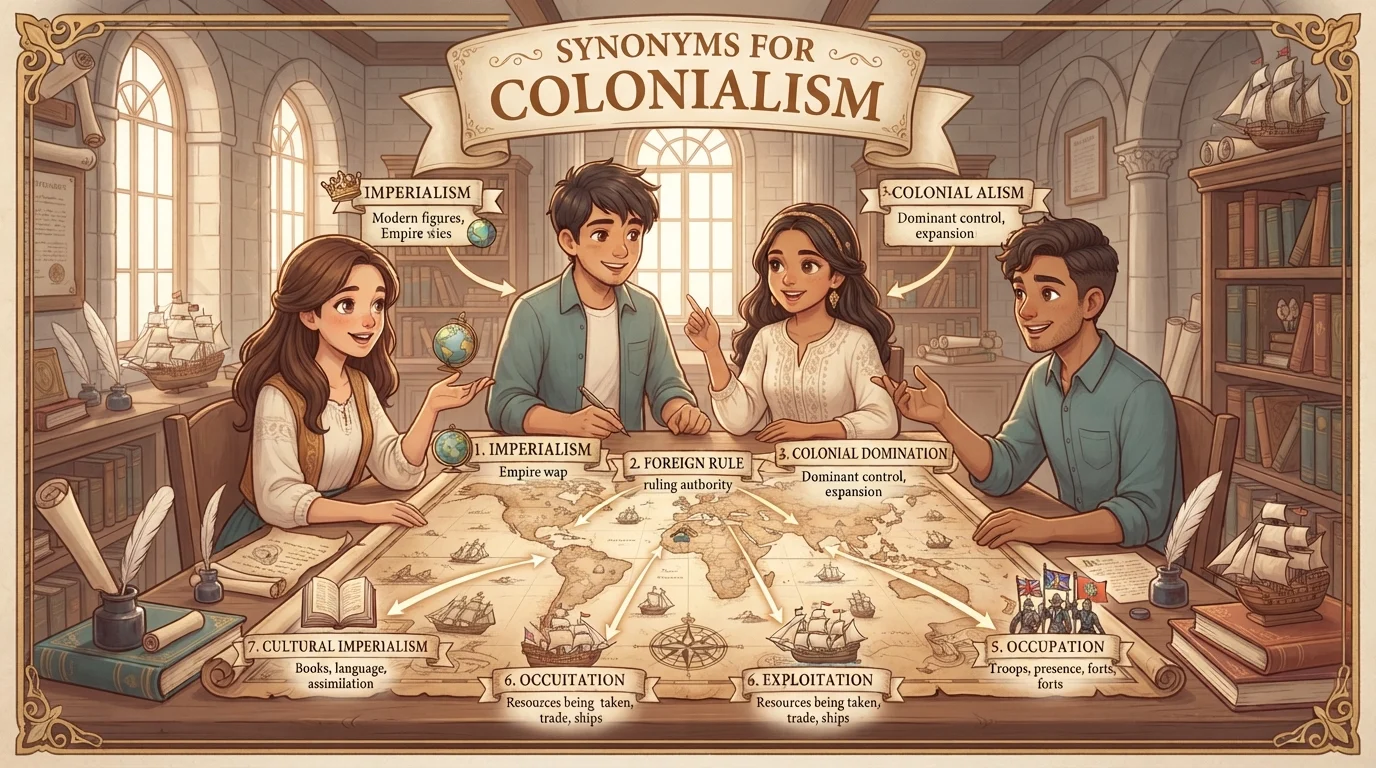
There is no single perfect synonym for colonialism, because different alternatives emphasize different aspects of the concept. Words such as imperialism, domination, occupation, subjugation, expansionism, and foreign rule may be appropriate depending on the context. Some are broader concepts, while others describe particular practices associated with colonial rule.
Quick Answer: What Are Synonyms for Colonialism?
Common synonyms and closely related terms include:
- Imperialism
- Colonial rule
- Colonial domination
- Foreign rule
- Territorial domination
- Political domination
- Subjugation
- Occupation
- Expansionism
- Conquest
- Annexation
- Exploitation
- Settlement
- Foreign domination
- External rule
- Empire-building
- Territorial expansion
- Political control
- Economic domination
- Resource extraction
- Cultural domination
- Cultural imperialism
- Settler colonialism
- Neocolonialism
- Imperial rule
- Colonial administration
- Overseas domination
- Territorial control
- Subordination
- Hegemony
What Does “Colonialism” Mean?
Colonialism is a system in which one country or power extends control over another territory and its population.
Colonial systems have historically involved combinations of:
- Political control
- Economic exploitation
- Military power
- Resource extraction
- Settlement
- Cultural influence
- Administrative control
- Suppression of local political authority
Example
- Colonialism reshaped the political and economic development of many regions around the world.
30 Synonyms and Related Terms for Colonialism
Imperialism
Meaning: A policy or practice of extending a country’s power and influence over other territories or peoples.
Example: Historians often examine the relationship between imperialism and colonial expansion.
Best usage: History, politics, and international relations.
Colonial Rule
Meaning: Government or control exercised by a colonial power over a territory.
Example: Colonial rule transformed the region’s political institutions.
Best usage: Historical writing.
Colonial Domination
Meaning: Political or economic control of one territory by an external colonial power.
Example: The movement challenged decades of colonial domination.
Best usage: History and political analysis.
Foreign Rule
Meaning: Governance by an outside or foreign power.
Example: The population resisted foreign rule.
Best usage: Historical and political contexts.
Territorial Domination
Meaning: Control over another territory.
Example: Territorial domination was a major feature of the empire’s expansion.
Best usage: History and geopolitics.
Political Domination
Meaning: Powerful control over another political community.
Example: Political domination limited the region’s ability to govern itself.
Best usage: Political and historical writing.
Subjugation
Meaning: Bringing a people or territory under control, often through force.
Example: The population resisted subjugation by an external power.
Best usage: History and formal writing.
Occupation
Meaning: Control of a territory by an outside military or political power.
Example: The occupation resulted in major changes to local administration.
Best usage: Military and historical contexts.
Expansionism
Meaning: A policy of extending a country’s territory, power, or influence.
Example: Expansionism contributed to competition among major powers.
Best usage: History and international relations.
Conquest
Meaning: Taking control of a territory or people through military victory.
Example: The conquest changed the political structure of the region.
Best usage: Historical writing.
Annexation
Meaning: The formal incorporation of territory into another state.
Example: The annexation of the territory was internationally disputed.
Best usage: International law and history.
Exploitation
Meaning: Using people, land, or resources unfairly for another power’s benefit.
Example: Economic exploitation was a major criticism of colonial systems.
Best usage: Economic and historical analysis.
Settlement
Meaning: Establishing communities in another territory.
Example: European settlement played a significant role in some colonial systems.
Best usage: Historical and demographic discussions.
Foreign Domination
Meaning: Control or influence imposed by an outside power.
Example: The movement sought independence from foreign domination.
Best usage: Political and historical writing.
External Rule
Meaning: Governance by a power outside the territory.
Example: The country eventually ended centuries of external rule.
Best usage: Formal historical writing.
Empire-Building
Meaning: The process of expanding political power and territory to create or strengthen an empire.
Example: Empire-building influenced European competition overseas.
Best usage: History and political studies.
Territorial Expansion
Meaning: Increasing the amount of territory controlled by a state.
Example: Territorial expansion changed the balance of power.
Best usage: History and geopolitics.
Political Control
Meaning: Authority over the government or political affairs of another territory.
Example: The colonial power maintained political control over the territory.
Best usage: General historical analysis.
Economic Domination
Meaning: Strong control over another region’s economic resources or activities.
Example: Economic domination continued even after political independence.
Best usage: Economics and history.
Resource Extraction
Meaning: Removing natural resources for economic use, often benefiting an outside power.
Example: Resource extraction was central to the colonial economy.
Best usage: History, economics, and environmental studies.
Cultural Domination
Meaning: The imposition or dominance of one culture over another.
Example: Cultural domination affected language and education.
Best usage: History, sociology, and cultural studies.
Cultural Imperialism
Meaning: The spread or imposition of one culture, values, or institutions over another.
Example: Scholars have studied cultural imperialism alongside political expansion.
Best usage: Sociology, history, and cultural studies.
Settler Colonialism
Meaning: A form of colonialism involving the establishment of permanent settler communities in another territory.
Example: Historians use the term settler colonialism to analyze particular forms of colonial settlement.
Best usage: Academic and historical writing.
Neocolonialism
Meaning: A situation in which powerful states or institutions exert indirect influence over formally independent countries.
Example: Critics used the concept of neocolonialism to describe continuing economic influence after independence.
Best usage: Political, economic, and academic writing.
Imperial Rule
Meaning: Governance or control exercised by an empire.
Example: The territory remained under imperial rule for decades.
Best usage: Historical writing.
Colonial Administration
Meaning: The governmental system established by a colonial power.
Example: The colonial administration introduced new legal institutions.
Best usage: History and government studies.
Overseas Domination
Meaning: Control exercised by a powerful state over territories beyond its own borders.
Example: Overseas domination became a central feature of the empire.
Best usage: Historical writing.
Territorial Control
Meaning: Authority or control over a particular geographical area.
Example: The empire sought greater territorial control.
Best usage: History and geopolitics.
Subordination
Meaning: Placing one group, territory, or political community in a lower or dependent position.
Example: Colonial systems often created political and economic subordination.
Best usage: Academic and historical writing.
Hegemony
Meaning: Dominance or leadership exercised by one power over others.
Example: The empire maintained regional hegemony for many years.
Best usage: Political science and international relations.
Comparison Table
| Term | Main Meaning | Best Context |
|---|---|---|
| Imperialism | Expansion of power over other territories | History/politics |
| Colonial rule | Governance by a colonial power | History |
| Foreign rule | Governance by an outside power | History/politics |
| Subjugation | Bringing people under control | History |
| Occupation | External control of territory | Military/history |
| Expansionism | Policy of territorial expansion | Politics/history |
| Conquest | Taking territory through victory | History |
| Annexation | Formal incorporation of territory | International law |
| Exploitation | Unfair use of people/resources | Economics/history |
| Empire-building | Creating or expanding an empire | History |
| Resource extraction | Removing resources for use | Economics/history |
| Cultural domination | Dominance over another culture | Sociology |
| Cultural imperialism | Imposition of cultural influence | Cultural studies |
| Settler colonialism | Colonialism involving permanent settlement | History |
| Neocolonialism | Indirect influence after formal colonialism | Politics/economics |
| Hegemony | Dominance or leadership | Political science |
Colonialism vs. Imperialism
These terms are closely related but not identical.
Colonialism generally involves establishing and maintaining control over another territory and its population, often through colonial administration or settlement.
Imperialism is broader. It describes the expansion of power or influence over other countries or territories and can occur through political, military, economic, or cultural means.
Therefore, imperialism can be used as a related synonym, but it is broader than colonialism.
Colonialism vs. Occupation
Occupation generally describes external control over territory, particularly through military presence.
Colonialism describes a broader system that can include administration, settlement, economic exploitation, political domination, and cultural transformation.
An occupation can therefore be part of a colonial system without being identical to colonialism.
Colonialism vs. Conquest
Conquest focuses on the process of taking control of territory or people, usually through military victory.
Colonialism focuses on the system of control established and maintained afterward.
Colonialism vs. Annexation
Annexation means formally incorporating territory into another state.
Colonialism does not always require formal annexation. A colonial power may control a territory without legally incorporating it into the controlling country.
Colonialism vs. Neocolonialism
Colonialism traditionally involves direct political or territorial control.
Neocolonialism refers to forms of indirect influence or dependency that may continue after formal political independence.
Colonialism vs. Cultural Imperialism
Cultural imperialism focuses specifically on cultural influence or domination.
Colonialism can involve cultural domination, but it also includes political, economic, and territorial dimensions.
Synonyms for Colonialism in Different Contexts
Historical Writing
Use:
- Colonial rule
- Imperial rule
- Foreign rule
- Colonial domination
- Empire-building
- Conquest
Political Writing
Use:
- Imperialism
- Political domination
- Foreign domination
- Territorial control
- Hegemony
- Subjugation
Economic Context
Use:
- Economic domination
- Exploitation
- Resource extraction
- Economic dependency
Cultural Context
Use:
- Cultural domination
- Cultural imperialism
- Cultural assimilation
- Colonial influence
Academic Writing
Use:
- Colonialism
- Imperialism
- Settler colonialism
- Neocolonialism
- Colonial domination
- Subordination
How to Choose the Right Alternative
Choose the term based on the specific aspect you want to emphasize:
- Broad expansion of power: imperialism
- Direct colonial government: colonial rule
- Control by an outside power: foreign rule
- Forced control: subjugation
- Military control: occupation
- Taking territory: conquest
- Formal territorial incorporation: annexation
- Expansion of territory: expansionism
- Unfair economic use: exploitation
- Taking natural resources: resource extraction
- Cultural dominance: cultural imperialism
- Permanent settlement: settler colonialism
- Indirect post-independence influence: neocolonialism
- Dominant regional influence: hegemony
Common Mistakes
Treating Every Related Term as an Exact Synonym
Terms such as imperialism, occupation, conquest, and annexation overlap with colonialism but emphasize different processes.
Confusing Colonialism With Imperialism
Imperialism is a broader concept involving the extension of power or influence. Colonialism is one important historical form of imperial expansion.
Using “Occupation” in Every Context
Occupation usually emphasizes control of territory, particularly by an external military power. It does not automatically describe the complete political and economic system of colonialism.
Confusing Colonialism With Neocolonialism
Neocolonialism generally describes indirect forms of influence or dependency rather than traditional direct colonial administration.
Example Sentences With Colonialism-Related Terms
- Imperialism shaped international relations during several historical periods.
- The region experienced decades of colonial rule.
- The population resisted foreign rule.
- The movement opposed political domination.
- The territory remained under occupation for a period of time.
- Military conquest changed the region’s political structure.
- The government disputed the proposed annexation.
- Economic exploitation affected local industries.
- Resource extraction played an important role in the colonial economy.
- Cultural imperialism influenced language and education.
- Settler colonialism is studied as a distinct form of colonialism.
- Scholars debate the meaning and effects of neocolonialism.
Frequently Asked Questions
What is the closest synonym for colonialism?
Imperialism is one of the closest broad alternatives, but it is not an exact synonym. Colonial rule is more precise when referring specifically to governance by a colonial power.
What is a simple word for colonialism?
A simple phrase is foreign rule or foreign domination, although these do not capture every aspect of colonialism.
What is the opposite of colonialism?
Depending on the context, concepts contrasting with colonialism include independence, self-government, sovereignty, and self-determination.
Is imperialism the same as colonialism?
Not exactly. Imperialism is broader and refers to extending power or influence over other territories or peoples. Colonialism is a specific system involving control over another territory and its population.
What is a synonym for colonial rule?
Useful alternatives include foreign rule, imperial rule, colonial domination, external rule, and foreign domination.
What is a synonym for cultural colonialism?
Related terms include cultural imperialism, cultural domination, cultural assimilation, and cultural subordination, depending on the specific context.
Final Verdict
Colonialism describes a complex system of territorial, political, economic, and sometimes cultural control. Because of its broad meaning, there is no single replacement that works perfectly in every sentence.
Imperialism is the closest broad related concept, while colonial rule is more precise for direct governance. Terms such as conquest, occupation, annexation, exploitation, cultural imperialism, settler colonialism, and neocolonialism are useful when discussing specific dimensions or forms of colonial power.

I’m Joseph Davis, a language enthusiast passionate about synonyms and clear communication. I enjoy simplifying vocabulary, exploring word meanings, and creating helpful content that makes writing more engaging, accurate, and confident.