The word desperation describes an intense feeling of having very little hope and being willing to take strong action because a situation feels extremely difficult. It can appear in everyday conversations, literature, academic writing, news reports, and emotional descriptions.
Learning different synonyms for desperation can help you express different shades of meaning. Some words emphasize a lack of hope, while others focus on urgency, distress, fear, or a strong need for something.
For students, ESL learners, writers, and content creators, understanding these differences is useful because similar words are not always interchangeable. Despair, for example, focuses strongly on hopelessness, while urgency emphasizes the need for immediate action. Choosing the right word makes your writing clearer and more natural.
What Does “Desperation” Mean?
Desperation is a strong feeling of hopelessness or extreme need that can make someone feel that they must act quickly or do something unusual.
Simple Definition
Desperation = an extreme feeling of hopelessness, urgency, or need.
Example
She searched everywhere in desperation after losing her important documents.
This sentence suggests that she felt extremely worried and urgently wanted to solve the problem.
The word can describe both an emotional state and a situation involving an urgent need.
Common Uses of Desperation
Desperation can appear in different situations:
- Financial difficulties
- Urgent problems
- Fear of failure
- Serious uncertainty
- Strong emotional distress
- Extreme need
- Difficult decisions
- Attempts to solve a serious problem
- Situations involving little hope
30 Synonyms for Desperation
Despair
Meaning: A complete or very strong loss of hope.
Example:
The long delay left him feeling a sense of despair.
Best usage: Use despair when hopelessness is the main idea.
Tone: Strong and emotional.
Hopelessness
Meaning: The feeling that a situation cannot improve.
Example:
The difficult circumstances created a feeling of hopelessness.
Best usage: Emotional writing and situations where there seems to be no solution.
Tone: Strong and serious.
Distress
Meaning: A feeling of great worry, sadness, or difficulty.
Example:
The unexpected news caused considerable distress.
Best usage: Emotional, medical, personal, and formal contexts.
Tone: Serious.
Urgency
Meaning: The need to act quickly because something is important or time-sensitive.
Example:
She contacted the office with a sense of urgency.
Best usage: Situations requiring immediate action.
Tone: Neutral to serious.
Panic
Meaning: A sudden feeling of extreme fear or anxiety.
Example:
He felt a moment of panic when he could not find his passport.
Best usage: Sudden fear or alarm.
Tone: Strong and emotional.
Anxiety
Meaning: A feeling of worry, nervousness, or concern about something uncertain.
Example:
The uncertainty created anxiety among the students.
Best usage: Worry about future events or uncertain situations.
Tone: Serious and common.
Need
Meaning: A strong requirement or lack of something important.
Example:
The family was in need of additional support.
Best usage: Situations involving necessities or serious requirements.
Tone: Neutral.
Urgent Need
Meaning: A strong need that requires immediate attention.
Example:
The organization responded to the community’s urgent need for supplies.
Best usage: Formal, humanitarian, and practical contexts.
Tone: Serious and professional.
Craving
Meaning: A very strong desire for something.
Example:
She had a strong craving for something sweet.
Best usage: Food, experiences, or strong personal desires.
Tone: Usually informal.
Longing
Meaning: A strong desire for something that may be difficult to obtain.
Example:
He felt a deep longing to return home.
Best usage: Emotional and literary writing.
Tone: Emotional and reflective.
Yearning
Meaning: A deep and persistent desire for something.
Example:
She felt a powerful yearning for a fresh start.
Best usage: Emotional, literary, and expressive writing.
Tone: Strong and poetic.
Eagerness
Meaning: Strong enthusiasm or desire to do or receive something.
Example:
His eagerness to find a solution was obvious.
Best usage: Positive situations involving enthusiasm or strong interest.
Tone: Usually positive.
Impatience
Meaning: A strong desire for something to happen quickly.
Example:
Her impatience grew as she waited for the results.
Best usage: Waiting, delays, and situations requiring quick results.
Tone: Neutral to negative.
Restlessness
Meaning: An inability to remain calm because of worry, uncertainty, or a desire for change.
Example:
He felt restless while waiting for an answer.
Best usage: Emotional uncertainty, waiting, or dissatisfaction.
Tone: Mild to serious.
Agitation
Meaning: A state of worry, nervousness, or emotional disturbance.
Example:
The unexpected announcement caused considerable agitation.
Best usage: Formal descriptions of emotional upset.
Tone: Formal and serious.
Despondency
Meaning: A deep feeling of sadness and loss of hope.
Example:
The repeated setbacks led to feelings of despondency.
Best usage: Formal and literary writing.
Tone: Very serious.
Desolation
Meaning: A profound feeling of emptiness, loneliness, or sadness.
Example:
The empty room created a sense of desolation.
Best usage: Literary and descriptive writing.
Tone: Poetic and emotional.
Misery
Meaning: Extreme unhappiness, suffering, or discomfort.
Example:
The difficult circumstances caused months of misery.
Best usage: Strong descriptions of unhappiness or suffering.
Tone: Strong and emotional.
Suffering
Meaning: Physical or emotional pain or difficulty.
Example:
The organization worked to reduce the suffering caused by the disaster.
Best usage: Serious personal, social, or humanitarian situations.
Tone: Serious.
Affliction
Meaning: Something that causes significant suffering or difficulty.
Example:
The community faced several serious afflictions after the storm.
Best usage: Formal or literary descriptions of hardship.
Tone: Formal.
Struggle
Meaning: A difficult situation requiring significant effort to overcome.
Example:
The family faced a financial struggle.
Best usage: Difficult personal, social, academic, or financial situations.
Tone: Neutral to serious.
Hardship
Meaning: A difficult condition that causes problems or suffering.
Example:
The community experienced severe economic hardship.
Best usage: Financial, social, and practical difficulties.
Tone: Serious and formal.
Adversity
Meaning: A difficult or unpleasant situation that must be faced.
Example:
She remained determined despite years of adversity.
Best usage: Formal, motivational, and literary writing.
Tone: Strong and formal.
Desperateness
Meaning: The state of being extremely urgent, serious, or hopeless.
Example:
The desperateness of the situation became clear as time ran out.
Best usage: Strong descriptive writing.
Tone: Serious.
Frenzy
Meaning: A state of intense excitement, activity, or emotional agitation.
Example:
The announcement caused a frenzy among the crowd.
Best usage: Situations involving chaotic or highly energetic behavior.
Tone: Dramatic.
Alarm
Meaning: A sudden feeling of fear or concern caused by danger or unexpected events.
Example:
The warning caused alarm among local residents.
Best usage: Emergencies, threats, and unexpected problems.
Tone: Serious.
Fear
Meaning: An emotional response to danger, uncertainty, or possible harm.
Example:
Fear spread through the community after the warning.
Best usage: Situations involving danger or uncertainty.
Tone: Strong and general.
Concern
Meaning: Worry about a person, situation, or possible problem.
Example:
There was growing concern about the delayed response.
Best usage: General worry and professional communication.
Tone: Neutral to serious.
Preoccupation
Meaning: A state of being deeply focused or worried about something.
Example:
His preoccupation with the problem made it difficult to concentrate.
Best usage: Formal and psychological descriptions of persistent concern.
Tone: Formal.
Solicitude
Meaning: Deep concern or care about someone’s needs or well-being.
Example:
She showed great solicitude toward the elderly residents.
Best usage: Formal and literary writing.
Tone: Formal.
Desirousness
Meaning: A strong state of wanting or desiring something.
Example:
His desirousness for success influenced his decisions.
Best usage: Formal or literary contexts.
Tone: Formal.
Quick Comparison of Synonyms for Desperation
| Synonym | Main Idea | Tone | Best Context |
|---|---|---|---|
| Despair | Loss of hope | Strong | Emotional writing |
| Hopelessness | Belief that things cannot improve | Serious | Difficult situations |
| Distress | Emotional suffering or worry | Serious | Personal and formal |
| Urgency | Need for immediate action | Neutral/Serious | Practical situations |
| Panic | Sudden extreme fear | Strong | Emergencies |
| Anxiety | Persistent worry | Neutral/Serious | Uncertainty |
| Need | Lack of something important | Neutral | General situations |
| Craving | Strong desire | Informal | Personal desires |
| Longing | Deep desire | Emotional | Literary writing |
| Yearning | Persistent deep desire | Poetic | Emotional writing |
| Eagerness | Strong enthusiasm | Positive | Goals and opportunities |
| Impatience | Desire for quick results | Neutral | Waiting |
| Restlessness | Inability to remain calm | Neutral | Uncertainty |
| Agitation | Emotional disturbance | Serious | Formal descriptions |
| Despondency | Deep sadness and hopelessness | Formal | Literary writing |
| Misery | Extreme unhappiness | Strong | Suffering |
| Struggle | Difficult effort or situation | Neutral | Life challenges |
| Hardship | Difficult living conditions | Serious | Social and financial issues |
| Adversity | Serious difficulties | Formal | Motivational writing |
| Alarm | Sudden fear or concern | Serious | Threats |
| Concern | Worry about something | Neutral | Everyday and professional |
| Frenzy | Chaotic emotional activity | Dramatic | Crowds and events |
Desperation vs. Despair
Desperation and despair are closely related but emphasize different ideas.
Desperation often suggests that someone feels an urgent need to act because the situation seems extremely difficult.
She searched everywhere in desperation.
Despair focuses more strongly on the loss of hope.
He felt despair after hearing the disappointing news.
A person can experience both at the same time, but the words highlight different aspects of the situation.
Desperation vs. Hopelessness
Hopelessness means feeling that there is little or no possibility of improvement.
Desperation can involve hopelessness, but it often adds urgency or a strong desire to find a solution.
The situation created a feeling of hopelessness.
This focuses on the lack of hope.
She acted in desperation to solve the problem.
This focuses on the urgent effort to find a solution.
Desperation vs. Urgency
These words are not exact synonyms.
Urgency means something needs attention quickly.
Desperation involves a much stronger emotional element, often involving fear, distress, or lack of hope.
The doctor emphasized the urgency of the situation.
This is professional and practical.
He searched for help in desperation.
This emphasizes emotional intensity.
Desperation vs. Panic
Panic is a sudden and intense reaction to fear or danger.
Desperation is broader and can develop from prolonged difficulty, need, or hopelessness.
She felt panic when she heard the alarm.
He acted in desperation after months of financial difficulty.
The first describes sudden fear. The second describes an extreme response to a difficult situation.
Desperation vs. Anxiety
Anxiety usually involves worry or nervousness, especially about uncertainty.
Desperation is generally stronger and can involve a feeling that urgent action is necessary.
He felt anxiety before the exam.
She searched for a solution in desperation.
The emotional intensity and context are different.
How to Choose the Right Synonym
The best synonym depends on the exact feeling or situation you want to describe.
When You Mean “Loss of Hope”
Choose:
- Despair
- Hopelessness
- Despondency
- Desolation
These words work well when the main idea is that someone feels little or no hope.
When You Mean “Strong Need”
Choose:
- Need
- Urgent need
- Craving
- Longing
- Yearning
These emphasize a powerful desire or requirement.
When You Mean “Immediate Action”
Choose:
- Urgency
- Impatience
- Alarm
These work when something needs attention quickly.
When You Mean “Fear or Worry”
Choose:
- Panic
- Anxiety
- Distress
- Concern
- Alarm
These emphasize emotional worry or fear rather than desire.
When You Mean “Difficult Circumstances”
Choose:
- Struggle
- Hardship
- Adversity
- Suffering
- Affliction
These are useful when describing challenging life circumstances.
When You Mean “Strong Desire”
Choose:
- Longing
- Yearning
- Craving
- Eagerness
These focus on wanting something strongly, although eagerness usually has a more positive tone.
Synonyms for Desperation in Academic Writing
Academic writing usually benefits from precise and neutral vocabulary.
Instead of:
The people acted out of desperation.
Depending on the intended meaning, you might write:
The people responded because of the urgency of the situation.
Or:
The circumstances created significant distress.
Or:
The community experienced considerable hardship.
The best choice depends on whether you are describing urgency, emotional suffering, or difficult circumstances.
Synonyms for Desperation in Creative Writing
Creative writing allows stronger emotional vocabulary.
Useful choices include:
- Despair
- Desolation
- Yearning
- Longing
- Misery
- Despondency
- Frenzy
For example:
The character’s sense of despair grew as every possible solution disappeared.
These words can create a more emotional or dramatic atmosphere.
Synonyms for Desperation in Everyday English
For everyday English, simpler words are usually more natural.
Useful choices include:
- Need
- Worry
- Anxiety
- Panic
- Urgency
- Distress
- Struggle
These words are easier for ESL learners and are common in conversations.
Common Mistakes When Using Desperation Synonyms
Using “Despair” for Every Situation
Despair strongly emphasizes hopelessness. If the main idea is simply that something needs immediate attention, urgency is usually better.
Using “Panic” When There Is No Sudden Fear
Panic normally describes an intense and often sudden fear response.
A long-term difficult situation may involve desperation or distress rather than panic.
Confusing “Longing” With “Urgency”
Longing describes a deep desire for something.
Urgency describes the need for immediate action.
For example:
She felt a longing for home.
She felt urgency about finishing the application.
These meanings are quite different.
Using “Eagerness” as a Strong Negative Synonym
Eagerness usually has a positive or neutral meaning.
His eagerness to learn was impressive.
It does not normally carry the same negative emotional intensity as desperation.
Ignoring Tone
Some alternatives sound much stronger than others.
- Concern → mild or moderate worry
- Anxiety → persistent worry
- Distress → serious emotional difficulty
- Desperation → extreme need or urgency
- Despair → profound loss of hope
Choosing the right level of intensity makes your writing more accurate.
Frequently Asked Questions
What is the closest synonym for desperation?
Some of the closest alternatives are despair, hopelessness, distress, urgency, and despondency, depending on the intended meaning.
What is a simple synonym for desperation?
For ESL learners, urgent need, distress, hopelessness, and strong need can help explain the meaning simply.
Is despair the same as desperation?
No. Despair focuses mainly on a loss of hope, while desperation can involve extreme need, urgency, or a strong attempt to solve a difficult situation.
Is desperation a positive or negative word?
Desperation generally has a negative or serious tone because it describes an extreme situation involving distress, urgency, or lack of hope.
What is the difference between desperation and urgency?
Urgency means something requires immediate attention. Desperation usually adds stronger emotional pressure, need, or hopelessness.
What is the opposite of desperation?
Depending on the context, possible opposites include calmness, confidence, hope, contentment, security, and patience.
Conclusion
Understanding synonyms for desperation can help you express emotions, difficult situations, and urgent needs with greater precision. Although words such as despair, hopelessness, distress, urgency, anxiety, and panic are related, each one emphasizes something different.
Use despair when the main idea is loss of hope, urgency when immediate action is needed, anxiety when worry is central, and hardship when describing difficult circumstances. For strong desires, words such as longing, yearning, and craving may be more appropriate.
The key is to consider meaning, emotional intensity, context, and tone before choosing a synonym. The more carefully you select your words, the clearer and more expressive your English writing becomes.
Cute Kawaii Image Prompt
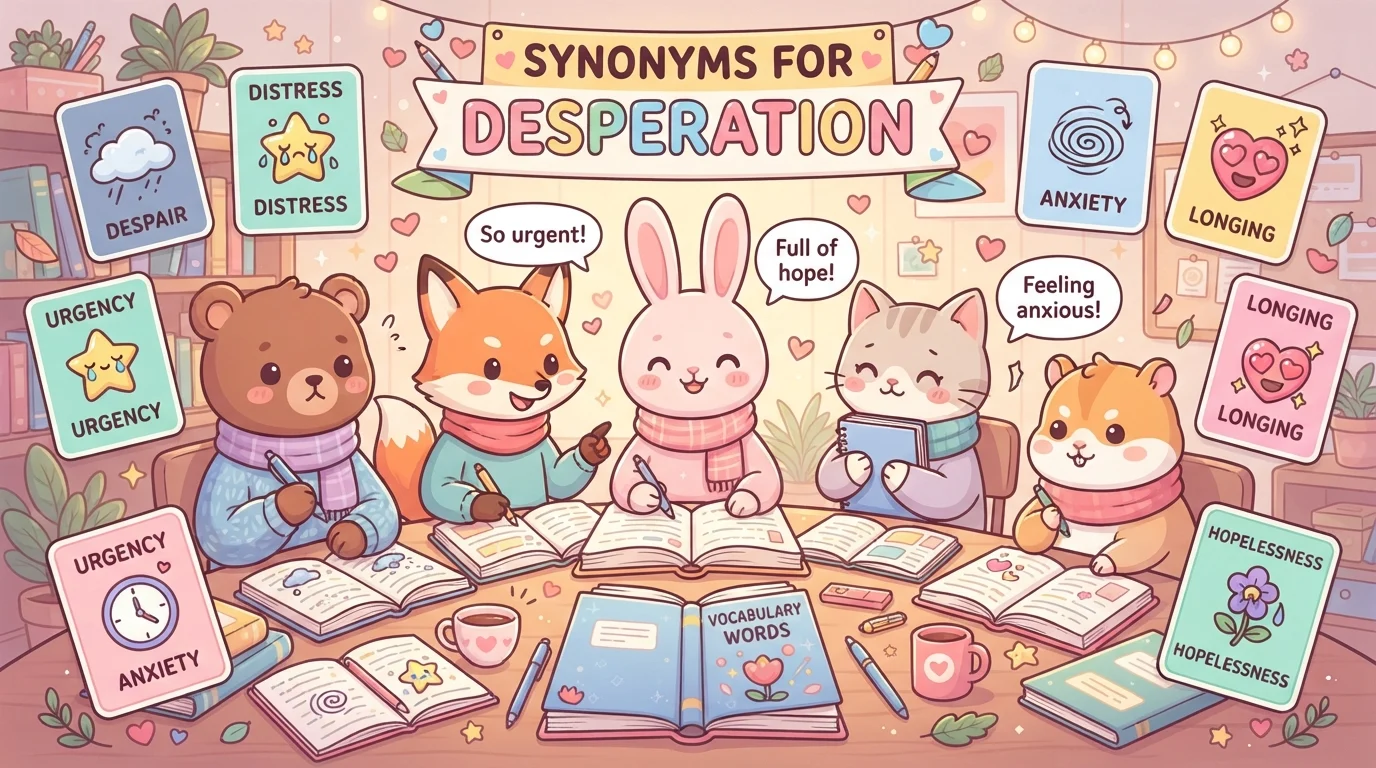
Create a cute, beautiful, kawaii educational illustration about “Synonyms for Desperation”, featuring adorable cartoon students studying vocabulary around colorful books, notebooks, speech bubbles, and expressive little characters showing different emotions such as worry, urgency, hope, concern, and determination. Add cute vocabulary cards displaying “Despair,” “Distress,” “Urgency,” “Anxiety,” “Longing,” and “Hopelessness.” Use soft pastel colors, charming kawaii faces, tiny stars and hearts, cozy study atmosphere, elegant composition, polished digital illustration, eye-catching educational blog aesthetic, warm gentle lighting, premium quality, highly detailed, 4K, 16:9.

Hi, I’m Ellie Clark. I love exploring synonyms and making language easier to understand. I create simple, accurate content that helps readers improve vocabulary, writing skills, and everyday communication with confidence.