Introduction
An emergency is a sudden and serious situation that requires immediate attention or action. The word is common in everyday English, healthcare, public safety, workplaces, travel, and official communication.
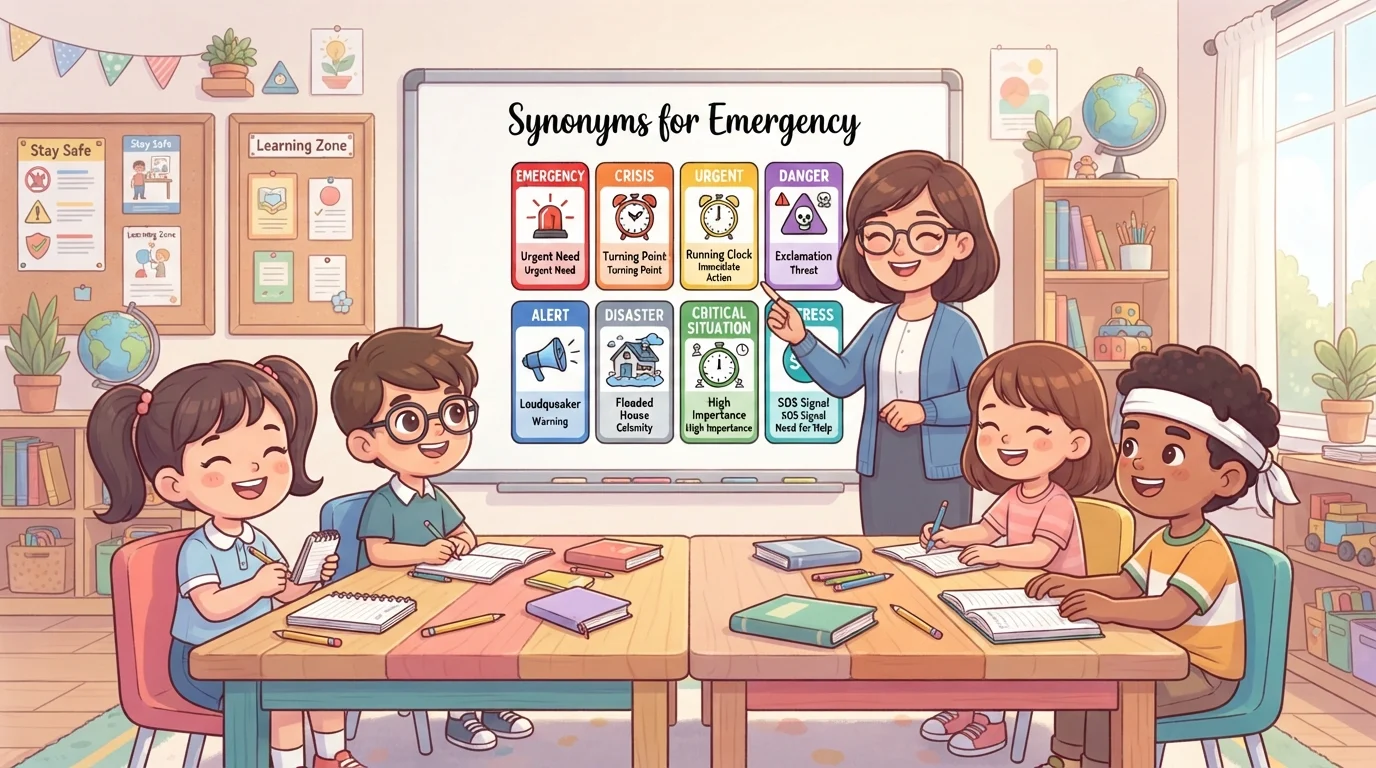
Depending on the situation, words such as crisis, urgent situation, critical situation, disaster, predicament, alarm, and contingency can communicate related ideas. However, these alternatives are not always exact replacements, so choosing the right word depends on meaning and context.
What Does Emergency Mean?
Emergency refers to an unexpected situation that requires immediate action because it may involve danger, serious difficulty, or an urgent need for help.
Simple definition
Emergency = a serious or unexpected situation that needs immediate attention.
Examples
- The hospital prepared for a medical emergency.
- Please call for help in an emergency.
- The team created an emergency plan.
- The firefighters responded quickly to the emergency.
30 Synonyms for Emergency
Crisis
Meaning: A serious situation that requires immediate attention or difficult decisions.
Example: The company faced a financial crisis.
Best usage: Business, politics, personal situations, and serious events.
Urgent Situation
Meaning: A situation that needs immediate attention.
Example: The staff responded to the urgent situation quickly.
Best usage: Everyday, professional, and official communication.
Critical Situation
Meaning: A situation that is extremely serious and requires prompt action.
Example: The rescue team was called to a critical situation.
Best usage: Medical, technical, professional, and safety contexts.
Predicament
Meaning: A difficult or unpleasant situation from which it is hard to escape.
Example: The travelers found themselves in a difficult predicament.
Best usage: Personal, literary, and descriptive writing.
Calamity
Meaning: A serious event that causes major damage, suffering, or loss.
Example: The earthquake was a devastating calamity.
Best usage: Formal and descriptive writing.
Disaster
Meaning: A very serious event that causes widespread damage or disruption.
Example: The organization developed a plan for responding to a natural disaster.
Best usage: Natural events, accidents, and major failures.
Crisis Situation
Meaning: A serious situation requiring immediate management or intervention.
Example: The team met to discuss the crisis situation.
Best usage: Business, government, organizations, and formal writing.
Danger
Meaning: The possibility of harm, injury, or loss.
Example: The hikers realized they were in danger.
Best usage: Safety and everyday communication.
Peril
Meaning: Serious and immediate danger.
Example: The explorers were placed in great peril.
Best usage: Formal, literary, and dramatic writing.
Threat
Meaning: A person, event, or circumstance that could cause harm or damage.
Example: The authorities responded to the potential threat.
Best usage: Security, safety, business, and general writing.
Trouble
Meaning: A difficult or problematic situation.
Example: The travelers called for assistance when they encountered trouble.
Best usage: Informal and everyday English.
Difficulty
Meaning: A problem or situation that makes something hard to accomplish.
Example: The team experienced unexpected difficulties.
Best usage: General, academic, and professional writing.
Problem
Meaning: Something that causes difficulty and needs to be solved.
Example: The technician quickly identified the problem.
Best usage: Everyday and professional English.
Complication
Meaning: An unexpected problem that makes a situation more difficult.
Example: A technical complication delayed the operation.
Best usage: Medical, technical, professional, and formal contexts.
Adversity
Meaning: A difficult or challenging condition.
Example: The community showed resilience during adversity.
Best usage: Formal, motivational, and literary writing.
Hardship
Meaning: A condition involving serious difficulty or suffering.
Example: The family experienced financial hardship.
Best usage: Social, economic, personal, and formal contexts.
Distress
Meaning: A state of serious physical, emotional, or practical difficulty.
Example: The vessel sent a distress signal.
Best usage: Emergency services, maritime contexts, and formal communication.
Alarm
Meaning: A warning of danger or an urgent situation.
Example: The alarm alerted everyone to the potential danger.
Best usage: Safety systems, buildings, and warning situations.
Alert
Meaning: A warning or notification about possible danger or an important event.
Example: Residents received an emergency alert.
Best usage: Public safety, technology, weather, and official communication.
Warning
Meaning: Information telling someone about possible danger or a problem.
Example: Officials issued a warning before the storm arrived.
Best usage: Safety, weather, travel, and public communication.
Evacuation
Meaning: The organized movement of people away from a dangerous area.
Example: The authorities ordered an evacuation.
Best usage: Fires, storms, natural disasters, and safety situations.
Disaster Situation
Meaning: A serious event involving significant damage, danger, or disruption.
Example: Volunteers helped communities affected by the disaster situation.
Best usage: Humanitarian, environmental, and organizational contexts.
Emergency Event
Meaning: An unexpected event requiring immediate action.
Example: Staff members received training for an emergency event.
Best usage: Professional, safety, and planning contexts.
Urgency
Meaning: The need for immediate action.
Example: The doctor recognized the urgency of the situation.
Best usage: Medical, professional, academic, and general English.
Immediate Need
Meaning: Something that must be addressed without delay.
Example: Providing clean water became an immediate need.
Best usage: Humanitarian, personal, and professional contexts.
Contingency
Meaning: A possible future event that requires preparation or a backup plan.
Example: The company created a contingency plan for unexpected disruptions.
Best usage: Business, planning, management, and formal writing.
Unexpected Situation
Meaning: An event or circumstance that was not anticipated.
Example: The staff knew how to respond to an unexpected situation.
Best usage: General and professional English.
Serious Situation
Meaning: A situation involving significant difficulty, danger, or consequences.
Example: The team recognized that it was a serious situation.
Best usage: Everyday, professional, and formal writing.
Emergency Condition
Meaning: A state requiring immediate attention or intervention.
Example: The equipment was shut down because of an emergency condition.
Best usage: Technical, industrial, medical, and safety contexts.
State of Crisis
Meaning: A condition involving serious difficulty or instability.
Example: The organization developed procedures for operating during a state of crisis.
Best usage: Formal, organizational, and analytical writing.
Quick Comparison of Emergency Synonyms
| Synonym | Main Meaning | Common Context |
|---|---|---|
| Crisis | Serious situation requiring action | Business, society, personal |
| Urgent situation | Situation needing immediate attention | General |
| Critical situation | Extremely serious situation | Medical, safety, technical |
| Disaster | Major destructive event | Natural events, accidents |
| Calamity | Serious event causing major suffering | Formal writing |
| Predicament | Difficult situation | Personal, literary |
| Danger | Possibility of harm | Safety |
| Peril | Serious danger | Formal, literary |
| Threat | Potential source of harm | Security, safety |
| Distress | Serious difficulty or suffering | Safety, maritime, formal |
| Alarm | Warning of danger | Buildings, safety |
| Alert | Official warning or notification | Public safety, technology |
| Urgency | Need for immediate action | Professional, medical |
| Contingency | Possible event requiring preparation | Business, planning |
| Complication | Unexpected problem | Medical, technical |
Emergency vs. Crisis
Emergency usually emphasizes the need for immediate action.
Crisis generally describes a serious situation involving instability, difficulty, or a major problem.
Examples:
- The hospital responded to a medical emergency.
- The company entered a financial crisis.
The two words can overlap, but they are not always interchangeable.
Emergency vs. Disaster
An emergency can be relatively limited and may require immediate intervention.
A disaster usually refers to a major event that causes extensive damage, disruption, or suffering.
For example:
- A serious workplace accident can be an emergency.
- A major earthquake can be a disaster.
Emergency vs. Urgency
These words are closely related but grammatically different.
Emergency is usually a noun referring to the situation itself.
Urgency describes the need for immediate action.
Examples:
- The ambulance was called because of an emergency.
- The doctor emphasized the urgency of treatment.
Emergency vs. Contingency
An emergency is an actual urgent situation.
A contingency is a possible event that people prepare for in advance.
Examples:
- The team responded to the emergency.
- The company created a contingency plan for possible disruptions.
Formal Synonyms for Emergency
For professional, academic, or official writing, these alternatives may be useful depending on context:
- Critical situation
- Crisis
- Urgent situation
- Emergency condition
- State of crisis
- Calamity
- Distress
- Complication
- Urgency
- Contingency
Always check the exact meaning before substituting one word for another.
Synonyms for Emergency in Everyday English
In casual conversation, simpler expressions are often more natural:
- Problem
- Trouble
- Danger
- Urgent situation
- Serious situation
- Unexpected situation
- Crisis
- Emergency
For example:
Natural: “Call me if there is an emergency.”
More formal: “Please notify the appropriate personnel if a critical situation occurs.”
Synonyms for Emergency in Academic Writing
Academic writing often requires precise vocabulary. Depending on the subject, you might use:
- Crisis
- Critical situation
- Disaster
- Adversity
- Urgency
- Complication
- Contingency
- Serious situation
The best word depends on what you are describing. A natural disaster, financial crisis, medical emergency, and technical complication are different types of situations.
How to Choose the Right Synonym
Before replacing emergency, consider what you actually mean.
- Use crisis for a serious period of instability or difficulty.
- Use disaster for a major destructive event.
- Use danger when emphasizing possible harm.
- Use peril for serious danger, especially in formal or literary writing.
- Use urgency when emphasizing the need for immediate action.
- Use alert for a warning or notification.
- Use alarm for a warning signal or state of concern.
- Use contingency when discussing preparation for a possible future event.
- Use predicament for a difficult situation rather than an immediate danger.
- Use complication when an unexpected problem makes a situation more difficult.
Common Mistakes With Emergency Synonyms
Treating Every Synonym as Identical
Words with related meanings can have different uses. “Emergency” and “contingency,” for example, describe different concepts.
Using Disaster for Every Emergency
Not every emergency is a disaster. A small but urgent situation can still be an emergency.
Confusing Urgency With Emergency
“Urgency” describes the need for quick action, while “emergency” generally refers to the serious situation itself.
Using Very Formal Words in Casual Conversation
Words such as peril and calamity can sound literary or formal. In everyday speech, “danger,” “problem,” or “emergency” may sound more natural.
Ignoring Context
A medical emergency, financial crisis, natural disaster, and security threat require different vocabulary even though they can all involve serious situations.
Frequently Asked Questions
What is the best synonym for emergency?
There is no single synonym that works in every context. Crisis, urgent situation, critical situation, and disaster can all be appropriate depending on the meaning.
What is a simple synonym for emergency?
Simple alternatives include urgent situation, crisis, danger, problem, and serious situation.
What is a formal synonym for emergency?
Depending on context, formal alternatives include critical situation, crisis, emergency condition, calamity, and state of crisis.
What is the difference between emergency and crisis?
An emergency generally requires immediate action, while a crisis usually refers to a serious situation involving significant difficulty or instability.
What is the opposite of emergency?
There is no single perfect antonym. Depending on context, possible contrasts include normal situation, stability, routine, or safety.
Can “urgent” replace “emergency”?
Not always. Urgent describes something that needs immediate attention, while emergency usually refers to the serious situation requiring that attention.
Final Thoughts
The word emergency describes a serious or unexpected situation that requires immediate attention. Its alternatives include crisis, urgent situation, critical situation, danger, disaster, distress, urgency, and contingency, but each carries its own meaning and tone.
The most effective vocabulary choice depends on the situation. Use simple words for everyday communication and more specific alternatives when writing academically, professionally, or formally. Understanding these differences will make your English clearer and more precise.

I’m Joseph Davis, a language enthusiast passionate about synonyms and clear communication. I enjoy simplifying vocabulary, exploring word meanings, and creating helpful content that makes writing more engaging, accurate, and confident.