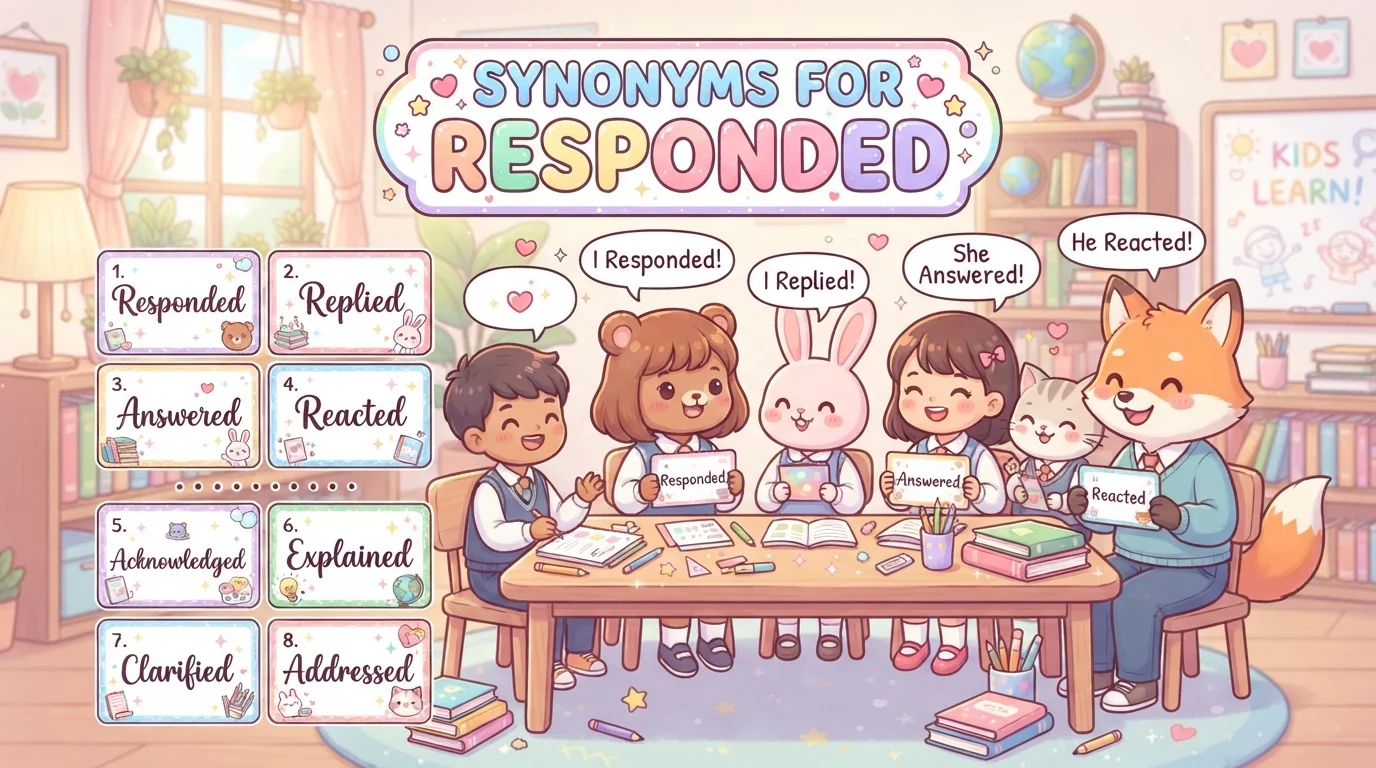
The word responded is the past tense of respond and is commonly used when someone answers, reacts, replies, or takes action after something happens. It appears frequently in conversations, emails, stories, news reports, academic writing, and everyday English.
Learning synonyms for responded can make your writing more precise and expressive. For example, replied is usually best when someone answers a question, while reacted focuses more on someone’s emotional or physical response. Answered works naturally when responding to a question, while acknowledged suggests recognizing or accepting something.
This guide provides 30 useful alternatives with simple meanings, example sentences, and notes explaining when each word works best.
What Does “Responded” Mean?
Responded means answered, replied, or reacted to something that was said, asked, done, or experienced.
Simple Definition
Responded = gave an answer or reaction to something.
Examples
She responded to my message quickly.
Here, responded means replied.
He responded calmly to the criticism.
Here, responded means reacted.
Because responded has several meanings, the best synonym depends on the situation.
30 Synonyms for Responded
Replied
Meaning: Gave an answer to someone who spoke or wrote.
Example:
She replied to my email the same afternoon.
Best usage: Messages, emails, conversations, and questions.
Tone: Neutral and natural.
Answered
Meaning: Gave information or a response to a question.
Example:
He answered the teacher’s question correctly.
Best usage: Questions and requests for information.
Tone: Neutral.
Reacted
Meaning: Showed a response to something that happened.
Example:
She reacted calmly to the unexpected news.
Best usage: Emotions, events, situations, and behavior.
Tone: Neutral.
Acknowledged
Meaning: Showed that you noticed, received, or recognized something.
Example:
He acknowledged the message with a brief reply.
Best usage: Formal communication and professional settings.
Tone: Formal.
Retorted
Meaning: Answered quickly, often in a sharp or argumentative way.
Example:
“That’s not what I said,” she retorted.
Best usage: Arguments and dialogue.
Tone: Strong or confrontational.
Rejoined
Meaning: Replied to something, especially during a conversation or argument.
Example:
“Perhaps you’re right,” he rejoined.
Best usage: Literary writing and formal dialogue.
Tone: Formal or literary.
Countered
Meaning: Responded by presenting an opposing argument or idea.
Example:
The manager countered the proposal with another suggestion.
Best usage: Debates, negotiations, and arguments.
Tone: Professional.
Answered Back
Meaning: Replied, sometimes in a challenging or disrespectful way.
Example:
The child answered back when asked to clean the room.
Best usage: Informal conversations.
Tone: Informal and sometimes negative.
Acknowledged
Meaning: Accepted or recognized that something was true or had been received.
Example:
The company acknowledged the customer’s complaint.
Best usage: Business, official communication, and formal writing.
Tone: Formal.
Addressed
Meaning: Responded to or dealt with an issue, question, or concern.
Example:
The director addressed the concerns raised by the employees.
Best usage: Problems, concerns, questions, and public issues.
Tone: Professional.
Dealt With
Meaning: Took action in response to a situation or problem.
Example:
The team dealt with the issue immediately.
Best usage: Problems, challenges, and situations.
Tone: Neutral.
Handled
Meaning: Managed or dealt with something effectively.
Example:
She handled the difficult situation professionally.
Best usage: Problems, responsibilities, and challenging situations.
Tone: Professional.
Reassured
Meaning: Responded in a way that made someone feel less worried.
Example:
The teacher reassured the student after hearing the concern.
Best usage: Emotional or supportive situations.
Tone: Warm and caring.
Clarified
Meaning: Responded by making something easier to understand.
Example:
The manager clarified the instructions after several questions.
Best usage: Confusion, explanations, and professional communication.
Tone: Professional.
Explained
Meaning: Responded by giving reasons or information.
Example:
She explained why the meeting had been delayed.
Best usage: Questions, misunderstandings, and explanations.
Tone: Neutral.
Commented
Meaning: Expressed an opinion or observation about something.
Example:
He commented on the changes during the meeting.
Best usage: Discussions, articles, meetings, and conversations.
Tone: Neutral.
Remarked
Meaning: Said something as a comment or observation.
Example:
“This place is beautiful,” she remarked.
Best usage: Stories, dialogue, and formal writing.
Tone: Literary or formal.
Observed
Meaning: Made a comment based on what someone noticed.
Example:
The researcher observed that the results were different.
Best usage: Academic, professional, and analytical writing.
Tone: Formal.
Stated
Meaning: Expressed something clearly and directly.
Example:
The spokesperson stated that the report was inaccurate.
Best usage: Formal statements and professional communication.
Tone: Formal.
Expressed
Meaning: Communicated a thought, feeling, or opinion.
Example:
She expressed concern about the decision.
Best usage: Feelings, opinions, concerns, and ideas.
Tone: Neutral to formal.
Communicated
Meaning: Shared information, thoughts, or feelings.
Example:
He communicated his concerns clearly.
Best usage: Professional and academic writing.
Tone: Formal.
Responded Positively
Meaning: Reacted in a favorable way.
Example:
The audience responded positively to the presentation.
Best usage: Reviews, reactions, feedback, and events.
Tone: Neutral.
Responded Negatively
Meaning: Reacted unfavorably or critically.
Example:
Customers responded negatively to the new policy.
Best usage: Feedback, opinions, and public reactions.
Tone: Neutral.
Reacted to
Meaning: Showed a response to something.
Example:
The audience reacted enthusiastically to the performance.
Best usage: Events, news, performances, and emotional responses.
Tone: Neutral.
Took Action
Meaning: Did something in response to a situation.
Example:
The organization took action after receiving several complaints.
Best usage: Problems, emergencies, and professional situations.
Tone: Professional.
Followed Up
Meaning: Responded later with additional information or action.
Example:
She followed up with an email the next morning.
Best usage: Business, emails, applications, and professional communication.
Tone: Professional.
Returned the Message
Meaning: Replied to someone who contacted you.
Example:
He returned the message as soon as he was available.
Best usage: Phone calls, messages, and casual communication.
Tone: Neutral.
Engaged
Meaning: Participated actively in a conversation, discussion, or activity.
Example:
The students engaged with the speaker’s questions.
Best usage: Discussions, education, meetings, and social interaction.
Tone: Professional.
Participated
Meaning: Took part in an activity or discussion.
Example:
She participated in the discussion and shared her ideas.
Best usage: Meetings, classes, events, and group activities.
Tone: Neutral and formal.
Countered
Meaning: Responded to an argument or action with an opposing one.
Example:
The lawyer countered the claim with new evidence.
Best usage: Debates, arguments, negotiations, and legal contexts.
Tone: Formal.
Quick Comparison of Synonyms for Responded
| Synonym | Main Meaning | Best Context |
|---|---|---|
| Replied | Gave an answer | Messages and conversations |
| Answered | Responded to a question | Questions |
| Reacted | Showed a response | Events and emotions |
| Acknowledged | Recognized or confirmed | Formal communication |
| Retorted | Replied sharply | Arguments |
| Countered | Gave an opposing response | Debates |
| Addressed | Dealt with an issue | Problems and concerns |
| Handled | Managed a situation | Work and challenges |
| Reassured | Reduced someone’s worry | Supportive situations |
| Clarified | Made something clearer | Questions and confusion |
| Explained | Gave reasons or information | Discussions |
| Commented | Gave an observation | Conversations |
| Remarked | Made a comment | Dialogue and writing |
| Stated | Expressed clearly | Formal communication |
| Expressed | Communicated a thought or feeling | Emotions and opinions |
| Communicated | Shared information | Professional contexts |
| Followed up | Responded later | Emails and business |
| Engaged | Participated actively | Discussions |
| Participated | Took part | Meetings and activities |
| Took action | Acted in response | Problems and situations |
Responded vs. Replied
Responded and replied are often interchangeable, but replied usually focuses on answering someone directly.
She responded to my email.
She replied to my email.
Both sound natural.
However, responded can also describe a reaction to an event:
He responded calmly to the criticism.
Here, reacted may be a better alternative than replied.
Responded vs. Answered
Answered is especially common when someone responds to a question.
The student answered the question.
Responded is broader:
The student responded to the teacher.
The second sentence does not necessarily mean the teacher asked a question.
Responded vs. Reacted
This is one of the most important distinctions.
Responded can mean either answering or reacting.
Reacted specifically emphasizes a person’s reaction to something.
She responded to the message.
This usually means she replied.
She reacted to the message.
This focuses more on her emotional or behavioral response.
Responded vs. Acknowledged
Acknowledged means someone recognized, accepted, or confirmed something.
He acknowledged receipt of the document.
This does not necessarily mean he gave a detailed answer.
Responded vs. Addressed
Addressed is useful when someone responds to a particular issue, concern, or problem.
The manager addressed the customer’s complaint.
This suggests the manager dealt with the issue rather than simply sending a reply.
How to Choose the Right Synonym
The best alternative depends on the kind of response you mean.
When Someone Answers a Message
Choose:
- Replied
- Answered
- Followed up
- Returned the message
Example:
She replied to my text.
When Someone Answers a Question
Choose:
- Answered
- Explained
- Clarified
- Replied
Example:
The teacher answered the student’s question.
When Someone Shows an Emotional Reaction
Choose:
- Reacted
- Responded
- Expressed
- Commented
Example:
He reacted positively to the news.
When Someone Deals With a Problem
Choose:
- Addressed
- Handled
- Dealt with
- Took action
Example:
The company addressed the customer’s concerns.
When Someone Gives an Opposing Argument
Choose:
- Countered
- Retorted
- Rejoined
Example:
The speaker countered the criticism with new evidence.
When Someone Responds Formally
Choose:
- Acknowledged
- Stated
- Addressed
- Communicated
- Explained
These words are particularly useful in professional and academic writing.
Synonyms for Responded in Academic Writing
Academic writing often benefits from precise alternatives such as:
- Addressed
- Observed
- Stated
- Explained
- Acknowledged
- Communicated
- Commented
- Countered
For example:
The researcher addressed the limitations of the study.
Or:
The participants responded positively to the proposed changes.
Synonyms for Responded in Professional Writing
Useful workplace alternatives include:
- Replied
- Acknowledged
- Addressed
- Followed up
- Clarified
- Explained
- Communicated
- Handled
For example:
The customer service team responded to the complaint within 24 hours.
You could write:
The customer service team addressed the complaint within 24 hours.
Synonyms for Responded in Storytelling
Writers often use more descriptive verbs in dialogue:
- Replied
- Answered
- Remarked
- Retorted
- Rejoined
- Commented
- Stated
- Observed
For example:
“I understand,” she replied.
Or:
“That’s impossible,” he retorted.
The choice of verb can communicate the speaker’s attitude without lengthy explanation.
Common Mistakes When Using Synonyms for Responded
Using “Replied” for Every Situation
Replied usually involves answering someone directly. It is not always suitable for physical or emotional reactions.
Confusing “Answered” With “Reacted”
Answered normally suggests responding to a question, while reacted emphasizes a response to an event or stimulus.
Using “Retorted” for a Neutral Reply
Retorted often suggests a sharp, challenging, or argumentative response. It should not be used for every ordinary reply.
Using “Acknowledged” to Mean “Fully Answered”
Acknowledging something simply means recognizing or confirming it. It does not necessarily mean providing a complete response.
Overusing Formal Words
Words such as rejoined, observed, and acknowledged can sound formal. In everyday conversation, replied, answered, or responded is often more natural.
Frequently Asked Questions
What is the closest synonym for responded?
The closest alternatives are replied, answered, reacted, and acknowledged, depending on the context.
What is a simple synonym for responded?
Replied is one of the simplest alternatives when talking about a conversation or message.
What is a synonym for responded to a question?
The best choices are answered, replied, explained, and clarified.
What is another word for responded positively?
You can use reacted favorably, welcomed, embraced, approved, or reacted positively, depending on the sentence.
What is the opposite of responded?
Possible opposites include ignored, remained silent, disregarded, or did not reply, depending on the context.
Is replied the same as responded?
Often, yes. However, responded has a broader meaning and can describe reactions to events, situations, or actions, while replied usually refers to answering someone.
Conclusion
Understanding synonyms for responded helps you describe answers and reactions with greater accuracy. Replied is excellent for messages and conversations, answered works best for questions, and reacted focuses on emotional or behavioral responses.
For professional writing, addressed, acknowledged, clarified, explained, and followed up can provide greater precision. In storytelling, words such as remarked, retorted, and rejoined can reveal the tone or attitude behind a character’s response.
The key is to choose a synonym based on what kind of response occurred. A person can reply to a message, answer a question, react to news, address a concern, or counter an argument. Knowing these distinctions makes your English clearer, stronger, and more natural.

Hi, I’m Ellie Clark. I love exploring synonyms and making language easier to understand. I create simple, accurate content that helps readers improve vocabulary, writing skills, and everyday communication with confidence.