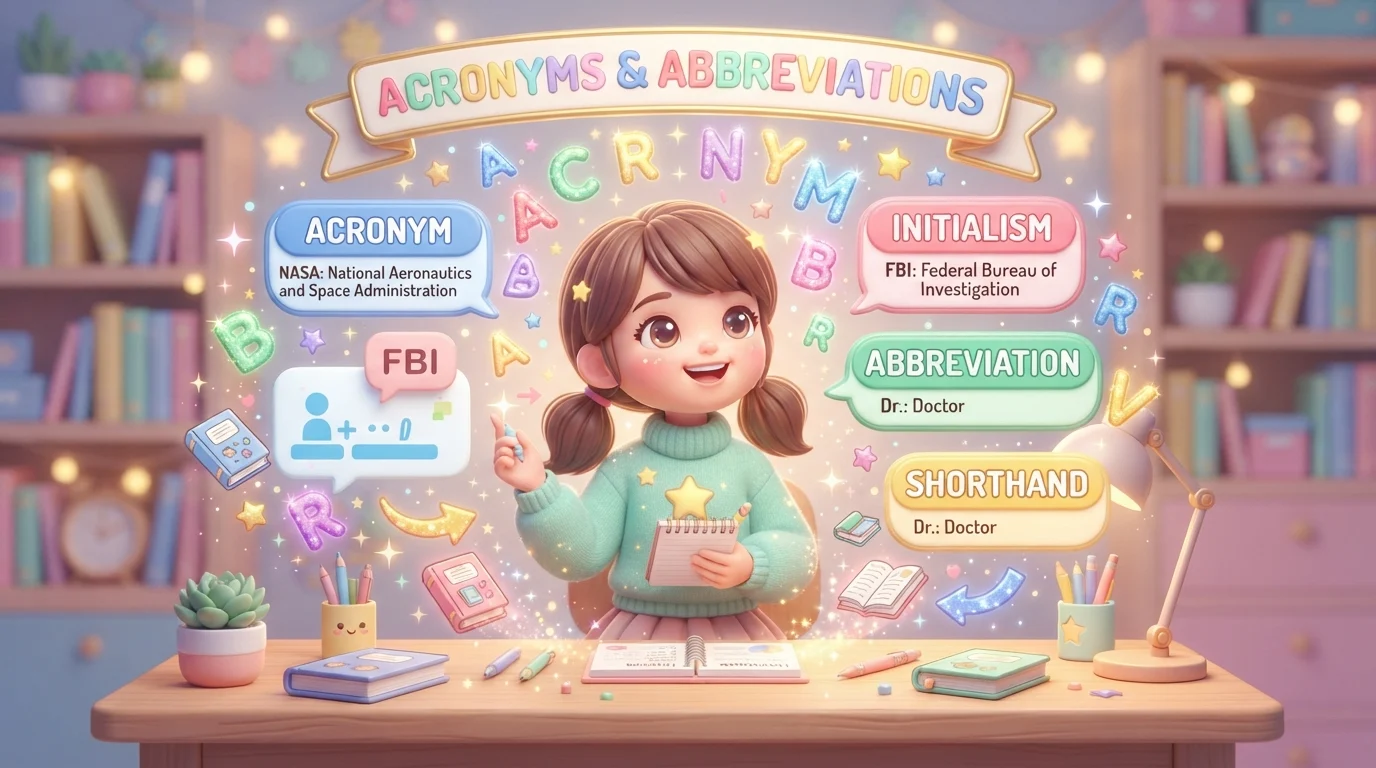
An acronym is a shortened form created from the initial letters or parts of a longer name or phrase. Acronyms are common in everyday communication, business, technology, education, science, and government. Examples include NASA, UNESCO, and radar.
Depending on the context, you may need a different word instead of acronym. Terms such as abbreviation, initialism, shorthand, short form, contraction, symbol, and designation can describe related ideas, although they are not always exact synonyms.
Quick Answer
The closest synonyms and related terms for acronym include abbreviation, initialism, shorthand, short form, shortened term, contraction, symbol, code, designation, and monogram.
What Does Acronym Mean?
An acronym is a word formed from letters or parts of a longer expression, usually from the beginning of several words.
For example:
- NASA comes from National Aeronautics and Space Administration.
- UNESCO comes from United Nations Educational, Scientific and Cultural Organization.
- radar comes from “radio detection and ranging.”
An important distinction is that an acronym is generally pronounced as a word, while an initialism is pronounced letter by letter.
30 Synonyms and Related Words for Acronym
Abbreviation
Meaning: A shortened version of a word or phrase.
Example: “Dr.” is an abbreviation of “Doctor.”
Best usage: General writing and everyday communication.
Initialism
Meaning: A shortened expression formed from initial letters and pronounced separately.
Example: “FBI” is an initialism.
Best usage: Technical discussions about shortened names and expressions.
Shorthand
Meaning: A shortened or simplified way of writing or expressing something.
Example: “ASAP” is commonly used as shorthand for “as soon as possible.”
Best usage: Informal writing, notes, and communication.
Short Form
Meaning: A shorter version of a word, name, or phrase.
Example: “Prof.” is the short form of “Professor.”
Best usage: Everyday explanations.
Shortened Term
Meaning: A word or expression made shorter for convenience.
Example: “app” is a shortened term for “application.”
Best usage: General and technical writing.
Initial Letters
Meaning: The first letters of words used to represent a longer expression.
Example: “UN” uses the initial letters of United Nations.
Best usage: Explaining how abbreviations are formed.
Contraction
Meaning: A shortened form created by reducing a word or phrase.
Example: “can’t” is a contraction of “cannot.”
Best usage: Grammar and language discussions.
Shortening
Meaning: The process or result of making a word or phrase shorter.
Example: “advertisement” becoming “ad” is a form of shortening.
Best usage: Linguistics and language studies.
Code
Meaning: A set of letters, numbers, or symbols representing something.
Example: An airport code can represent a particular city or airport.
Best usage: Technology, transportation, and identification systems.
Symbol
Meaning: A character, sign, or representation standing for something else.
Example: Chemical symbols represent elements.
Best usage: Science, mathematics, and technical communication.
Designation
Meaning: A name, title, or identifying label.
Example: “CEO” is a common professional designation.
Best usage: Business, organizations, and official writing.
Label
Meaning: A word or expression used to identify something.
Example: “FAQ” is a familiar label for frequently asked questions.
Best usage: General communication and organization.
Initial-Letter Word
Meaning: A word created from the initial letters of several words.
Example: “laser” is an initial-letter word.
Best usage: Linguistics and educational explanations.
Initial-Letter Abbreviation
Meaning: A shortened expression based on the first letters of words.
Example: “UN” is an initial-letter abbreviation.
Best usage: Formal explanations.
Alias
Meaning: An alternative name used to identify something or someone.
Example: A project may have an internal alias.
Best usage: Technology, organizations, and informal naming.
Monogram
Meaning: A design made by combining letters, usually initials.
Example: A person’s initials may appear as a monogram on clothing.
Best usage: Names, branding, and decorative design.
Nickname
Meaning: An informal or shortened name.
Example: “NASA” can function as a familiar shortened name for the agency.
Best usage: Informal naming, though it is not an exact synonym for acronym.
Initial
Meaning: The first letter of a word or name.
Example: “J” is the initial of “James.”
Best usage: Names and personal identification.
Letter Combination
Meaning: A group of letters used together to represent something.
Example: “AI” is a familiar letter combination.
Best usage: General explanations of abbreviations.
Letter Form
Meaning: A representation made using letters instead of a longer expression.
Example: “UK” is a short letter form for United Kingdom.
Best usage: General and formal writing.
Short Name
Meaning: A briefer name used instead of a full name.
Example: “UN” is commonly used as a short name for the United Nations.
Best usage: Organizations, places, and institutions.
Compact Form
Meaning: A shorter and more concise representation.
Example: “etc.” provides a compact form of “et cetera.”
Best usage: Formal and academic writing.
Brevity
Meaning: The quality of expressing something in few words.
Example: Acronyms are often used for brevity.
Best usage: Writing and communication discussions.
Concise Form
Meaning: A brief way of expressing an idea or phrase.
Example: “info” is a concise form of “information.”
Best usage: Informal and digital communication.
Reduced Form
Meaning: A form that has been shortened from its original version.
Example: “math” is a reduced form of “mathematics” in American English.
Best usage: Linguistics and general language discussions.
Substitute Term
Meaning: A shorter or alternative expression used instead of a longer one.
Example: “CEO” can serve as a substitute term for “chief executive officer.”
Best usage: General professional communication.
Representative Letters
Meaning: Letters that stand for words in a longer expression.
Example: “DIY” uses representative letters for “do it yourself.”
Best usage: Explaining abbreviations to beginners.
Word Initialism
Meaning: A shortened expression based on the first letters of words.
Example: “BBC” is formed from the initials of British Broadcasting Corporation.
Best usage: Linguistics and language education.
Verbal Shortcut
Meaning: A shortened expression used to communicate an idea quickly.
Example: “ASAP” acts as a verbal shortcut in informal messages.
Best usage: Casual communication.
Abbreviated Name
Meaning: A shortened version of a complete name.
Example: “MIT” is an abbreviated name for Massachusetts Institute of Technology.
Best usage: Institutions, organizations, and brands.
Acronym vs Abbreviation
These terms are closely related, but they are not identical.
| Term | Meaning | Example |
|---|---|---|
| Acronym | Shortened expression pronounced as a word | NASA |
| Abbreviation | Any shortened form | Dr. |
| Initialism | Initial letters pronounced separately | FBI |
| Shorthand | Concise replacement for longer wording | ASAP |
| Short form | General shortened version | info |
| Symbol | Sign representing something | $ |
Key point: An acronym is a type of abbreviation, but not every abbreviation is an acronym.
Acronym vs Initialism
This is one of the most important distinctions.
An acronym is normally pronounced as a word. For example, NASA is commonly pronounced as one word.
An initialism is pronounced by saying each letter separately. For example, FBI is pronounced “F-B-I.”
So, when discussing language precisely, initialism is often a better term when the letters are spoken individually.
Acronym vs Shorthand
Shorthand is a broader concept. It means using a shorter way to communicate something.
An acronym can be a form of shorthand, but shorthand can also include symbols, shortened words, abbreviations, or other techniques.
Acronym vs Contraction
A contraction reduces a word or phrase by removing letters, often using an apostrophe.
Examples include:
- cannot → can’t
- they are → they’re
- I will → I’ll
An acronym instead generally uses letters or parts of multiple words to create a shortened expression.
Common Types of Acronyms
Acronyms and related shortened forms appear in many areas:
- Business: CEO, CFO, HR
- Technology: AI, HTML, CAPTCHA
- Science: DNA, AIDS, radar
- Education: GPA, SAT
- Government: NATO, UNESCO
- Communication: ASAP, FYI
- Transportation: GPS, PIN
- Internet culture: FAQ, DM, GIF
How to Choose the Right Synonym for Acronym
Choose your replacement based on what you actually mean.
- Use abbreviation for a general shortened form.
- Use initialism when the letters are pronounced individually.
- Use shorthand for a convenient shortened expression.
- Use short form when you want simple, everyday language.
- Use symbol when a sign represents a concept or object.
- Use code when letters or numbers identify something.
- Use designation when the shortened expression functions as a title or official label.
- Use abbreviated name when discussing a shortened organization or place name.
Common Mistakes About Acronyms
One common mistake is treating every abbreviation as an acronym. The terms are related, but they have different meanings.
Another mistake is confusing acronyms with initialisms. If the letters are spoken individually, “initialism” is usually the more precise term.
It is also important to avoid assuming that every shortened word is an acronym. Words such as “ad,” “exam,” and “info” are shortened forms, but they do not necessarily meet the technical definition of an acronym.
Why Are Acronyms Used?
Acronyms make communication shorter and easier, particularly when a long name or phrase appears repeatedly.
They are especially useful when:
- A phrase is frequently repeated.
- A technical term has a long name.
- A company or organization has a lengthy official title.
- Writers need to save space.
- Readers are already familiar with the shortened form.
- Communication needs to be quick and efficient.
FAQs About Synonyms of Acronym
What is the closest synonym for acronym?
Abbreviation is usually the closest broad synonym. However, initialism is more precise when the shortened form is pronounced letter by letter.
Is abbreviation the same as acronym?
Not exactly. An acronym is a type of abbreviation, while abbreviation is a broader term covering many kinds of shortened forms.
What is another word for acronym in simple English?
You can use short form, abbreviation, or shortened term when speaking in simple English.
What is the difference between acronym and initialism?
An acronym is generally pronounced as a word, while an initialism is pronounced by saying its individual letters.
Can shorthand mean acronym?
Yes. Acronyms can function as shorthand because they provide shorter ways to communicate longer expressions. However, shorthand is a broader category.
Final Thoughts
The best synonym for acronym depends on the context. Abbreviation works as a broad alternative, while initialism is more precise for letter-by-letter expressions. Words such as shorthand, short form, code, symbol, and abbreviated name can also work when their specific meanings match your sentence.
Understanding these distinctions helps you write more accurately and choose the right vocabulary for academic, professional, technical, and everyday communication.

I’m Joseph Davis, a language enthusiast passionate about synonyms and clear communication. I enjoy simplifying vocabulary, exploring word meanings, and creating helpful content that makes writing more engaging, accurate, and confident.