Introduction
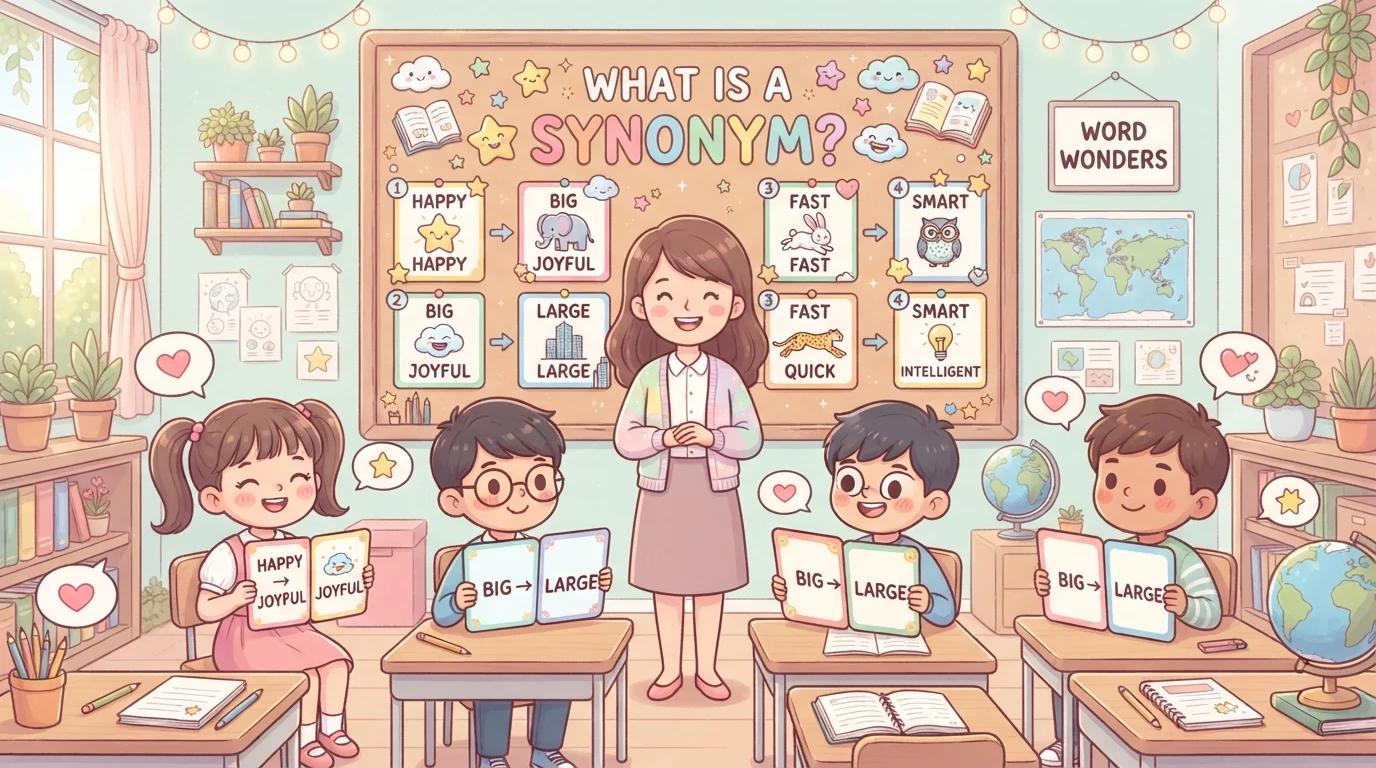
A synonym is a word that has the same or a very similar meaning as another word. Synonyms help writers and speakers express ideas in different ways without repeating the same vocabulary. They are useful in everyday conversations, academic writing, professional communication, creative writing, and English learning.
For example, happy, joyful, cheerful, and glad have similar meanings. However, they may not always work in exactly the same sentence because each word can have a slightly different tone or context.
Learning synonyms can improve your vocabulary, make your writing more interesting, and help you choose words that communicate your meaning more precisely.
What Does Synonym Mean?
The word synonym refers to a word or expression that has the same or nearly the same meaning as another word or expression.
For example:
- Big → large
- Small → tiny
- Happy → cheerful
- Fast → quick
- Smart → intelligent
- Beautiful → lovely
- Begin → start
- End → finish
Synonyms do not always have completely identical meanings. Often, they are similar enough to be used interchangeably in certain contexts.
Simple Definition of Synonym
The easiest definition is:
A synonym is a word that has the same or a similar meaning as another word.
For example, “quick” and “fast” are synonyms because both describe something happening at a high speed.
Why Are Synonyms Important?
Synonyms are important because they make communication more flexible and effective.
They can help you:
- Improve your vocabulary
- Avoid unnecessary repetition
- Make writing more interesting
- Express ideas more precisely
- Develop stronger English skills
- Make essays sound more natural
- Improve creative writing
- Choose words appropriate for different situations
- Understand unfamiliar words while reading
Using the right synonym can also change the tone of a sentence. A casual word may sound natural in conversation, while a more formal alternative may work better in academic or professional writing.
Common Examples of Synonyms
Here are some easy synonym pairs:
| Word | Synonym |
|---|---|
| Happy | Cheerful |
| Sad | Unhappy |
| Big | Large |
| Small | Little |
| Fast | Quick |
| Smart | Intelligent |
| Beautiful | Attractive |
| Easy | Simple |
| Difficult | Hard |
| Begin | Start |
| End | Finish |
| Angry | Furious |
| Quiet | Silent |
| Help | Assist |
| Buy | Purchase |
30 Common Synonym Examples
Happy → Joyful
Meaning: Feeling pleasure or happiness.
Example: She was joyful after receiving the good news.
Best usage: Everyday, emotional, and descriptive writing.
Big → Large
Meaning: Greater than average in size.
Example: They live in a large house.
Best usage: Everyday and formal English.
Small → Tiny
Meaning: Very small in size.
Example: A tiny bird sat on the branch.
Best usage: Descriptive and everyday writing.
Fast → Quick
Meaning: Moving or happening with speed.
Example: He gave me a quick answer.
Best usage: Everyday conversation and general writing.
Smart → Intelligent
Meaning: Having a high ability to learn, understand, or think.
Example: She is an intelligent student.
Best usage: Academic and professional contexts.
Beautiful → Lovely
Meaning: Pleasant or attractive in appearance.
Example: What a lovely garden!
Best usage: Friendly, descriptive, and conversational English.
Difficult → Challenging
Meaning: Requiring effort or skill.
Example: The examination was challenging.
Best usage: Academic, professional, and positive contexts.
Easy → Simple
Meaning: Not difficult to understand or do.
Example: The instructions are simple.
Best usage: Everyday and instructional writing.
Begin → Start
Meaning: To commence or begin something.
Example: The meeting will start at nine.
Best usage: Everyday English.
End → Finish
Meaning: To bring something to a conclusion.
Example: Please finish your homework.
Best usage: Everyday and academic English.
Angry → Furious
Meaning: Extremely angry.
Example: He was furious about the mistake.
Best usage: Strong emotional descriptions.
Quiet → Silent
Meaning: Making little or no noise.
Example: The classroom became silent.
Best usage: Descriptive and formal writing.
Help → Assist
Meaning: To give someone support.
Example: The staff will assist you with your request.
Best usage: Formal and professional communication.
Buy → Purchase
Meaning: To obtain something by paying for it.
Example: She decided to purchase a new laptop.
Best usage: Formal, business, and commercial contexts.
Ask → Inquire
Meaning: To request information.
Example: I would like to inquire about the schedule.
Best usage: Formal and professional communication.
Show → Demonstrate
Meaning: To make something clear by showing it.
Example: The teacher demonstrated how the experiment worked.
Best usage: Academic and professional writing.
Need → Require
Meaning: To need something.
Example: This project requires careful planning.
Best usage: Formal and professional English.
Use → Utilize
Meaning: To use something for a particular purpose.
Example: The program utilizes modern technology.
Best usage: Technical and formal contexts.
Tell → Inform
Meaning: To give someone information.
Example: Please inform me about any changes.
Best usage: Formal and professional communication.
Keep → Retain
Meaning: To continue having or holding something.
Example: The company decided to retain its existing employees.
Best usage: Formal and business writing.
Get → Obtain
Meaning: To receive or acquire something.
Example: Students can obtain additional information from the library.
Best usage: Formal and academic writing.
Give → Provide
Meaning: To supply or make something available.
Example: The school provides students with useful resources.
Best usage: Academic, professional, and formal writing.
Think → Consider
Meaning: To carefully think about something.
Example: Please consider all the available options.
Best usage: Professional and academic contexts.
Change → Alter
Meaning: To make something different.
Example: We may need to alter the original plan.
Best usage: Formal and professional writing.
Improve → Enhance
Meaning: To make something better.
Example: These exercises can enhance your vocabulary.
Best usage: Academic, professional, and descriptive writing.
Show → Reveal
Meaning: To make something previously unknown or hidden known.
Example: The results revealed an unexpected pattern.
Best usage: Academic, journalistic, and descriptive writing.
Important → Significant
Meaning: Having considerable importance or meaning.
Example: The study produced significant results.
Best usage: Academic and formal writing.
Correct → Accurate
Meaning: Free from mistakes or errors.
Example: Make sure your information is accurate.
Best usage: Academic, technical, and professional contexts.
Safe → Secure
Meaning: Protected from danger or harm.
Example: Your information is stored in a secure system.
Best usage: Technical, professional, and everyday contexts.
Synonyms vs. Antonyms
Synonyms and antonyms are different types of vocabulary relationships.
| Term | Meaning | Example |
|---|---|---|
| Synonym | Similar meaning | Happy → Joyful |
| Antonym | Opposite meaning | Happy → Sad |
| Homonym | Same spelling or sound but different meaning | Bat → animal / sports equipment |
Understanding these differences can make vocabulary learning much easier.
Are Synonyms Always Interchangeable?
No. Synonyms can have similar meanings without being interchangeable in every situation.
For example, big and large are usually interchangeable:
- A big house.
- A large house.
But purchase and buy differ in tone. “Buy” is very common in everyday conversation, while “purchase” often sounds more formal.
Similarly, angry and furious are related, but furious describes a much stronger emotion.
This is why understanding context, tone, strength, and grammar is important when choosing a synonym.
Types of Synonyms
Exact Synonyms
These have almost exactly the same meaning and can often replace each other.
Examples:
- Begin → Start
- End → Finish
True exact synonyms are relatively uncommon.
Near Synonyms
These words have similar meanings but may differ slightly in strength, tone, or usage.
Examples:
- Happy → Joyful
- Angry → Furious
- Difficult → Challenging
Contextual Synonyms
These words can have similar meanings only in particular situations.
For example, assist and help can often be used similarly, but “assist” usually has a more formal tone.
How to Choose the Right Synonym
Choosing the right synonym is more than replacing one word with another.
Consider:
- Meaning: Does the alternative actually express the same idea?
- Context: Is the word appropriate for the situation?
- Tone: Does it sound casual, formal, academic, or professional?
- Strength: Does it express the same level of emotion or intensity?
- Grammar: Can the word be used in the same grammatical position?
- Audience: Will your readers understand it easily?
- Naturalness: Does the sentence sound natural to English speakers?
The best synonym is not always the most complicated word. The best choice is the word that communicates your intended meaning clearly.
Synonyms in Academic Writing
Synonyms can make academic writing more varied and precise.
Instead of repeatedly using important, you might use:
- Significant
- Essential
- Valuable
- Relevant
- Crucial
However, avoid replacing familiar words with unnecessarily complicated vocabulary. Academic writing should prioritize clarity and precision rather than difficult words.
Synonyms in Professional Writing
Professional communication often benefits from precise vocabulary.
For example:
- Help → Assist
- Tell → Inform
- Get → Obtain
- Give → Provide
- Change → Modify
- Improve → Enhance
These alternatives can make formal documents sound polished, but they should still feel natural.
Synonyms in Everyday English
Everyday conversations usually favor simple and familiar vocabulary.
For example:
- Purchase → Buy
- Assist → Help
- Commence → Start
- Inquire → Ask
- Obtain → Get
Using the simpler word is often better when speaking casually.
Common Mistakes When Using Synonyms
Assuming Every Similar Word Has the Same Meaning
Two words may be related without being exact synonyms. Always check their specific meanings.
Choosing a Word That Sounds Too Formal
Words such as commence may be correct, but “start” is usually more natural in casual conversation.
Ignoring Word Strength
“Angry” and “furious” are not equal in intensity. Furious describes a stronger feeling.
Using a Thesaurus Without Checking Context
A thesaurus can suggest related words, but not every suggestion will fit your sentence.
Replacing Every Repeated Word
Repetition is not always bad. Sometimes repeating a precise word is clearer than using an unfamiliar synonym.
Quick Synonym Comparison
| Original Word | Common Synonym | Formal Alternative | Main Difference |
|---|---|---|---|
| Help | Assist | Assist | More formal |
| Buy | Purchase | Purchase | More formal |
| Ask | Inquire | Inquire | More formal |
| Start | Begin | Commence | Formal |
| Get | Obtain | Obtain | Formal |
| Tell | Inform | Inform | Formal |
| Improve | Enhance | Enhance | Often emphasizes making better |
| Important | Significant | Significant | Often used in academic contexts |
| Difficult | Challenging | Challenging | Can sound more positive |
| Angry | Furious | Furious | Stronger emotion |
Frequently Asked Questions
What is a synonym in simple words?
A synonym is a word that has the same or a similar meaning as another word. For example, happy and joyful are synonyms.
What is an example of a synonym?
An example is big → large. Both words describe something that has considerable size.
Are synonyms exactly the same?
Not always. Some synonyms have nearly identical meanings, while others differ in tone, intensity, or context.
Why do writers use synonyms?
Writers use synonyms to avoid unnecessary repetition, improve vocabulary, create variety, and express ideas more precisely.
What is the opposite of a synonym?
The opposite relationship is an antonym, which involves words with opposite meanings, such as hot and cold.
How can I learn synonyms easily?
Learn synonyms in groups, study example sentences, compare their contexts, and practice using them in your own writing.
Final Thoughts
Synonyms are an essential part of strong English vocabulary. They allow you to communicate the same general idea in different ways while choosing words that match your meaning, audience, and tone.
The key is not to use the most complicated synonym available. Instead, choose the word that sounds natural and communicates your idea accurately. With regular reading and practice, recognizing and using synonyms becomes much easier.

I’m Joseph Davis, a language enthusiast passionate about synonyms and clear communication. I enjoy simplifying vocabulary, exploring word meanings, and creating helpful content that makes writing more engaging, accurate, and confident.