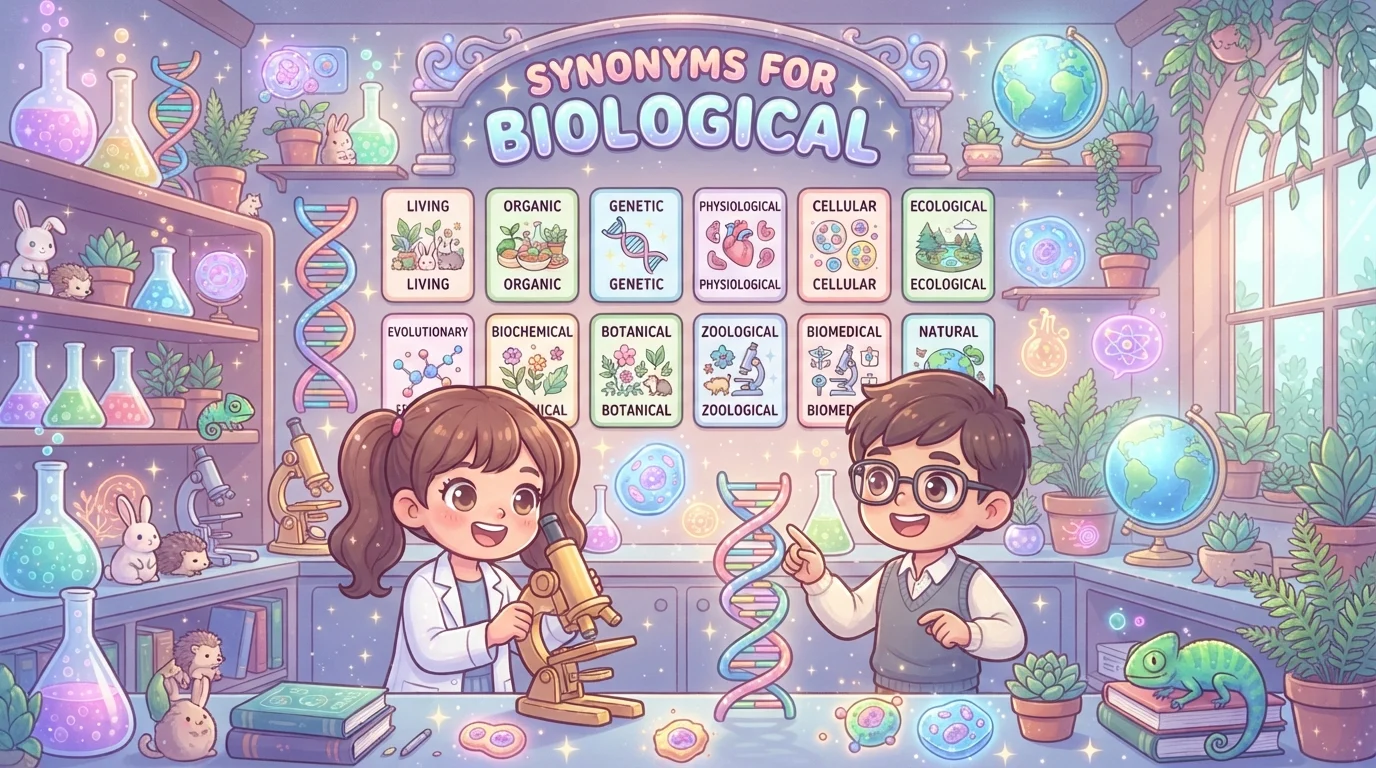
The word biological is commonly used to describe something connected with living organisms, life processes, genetics, or the natural functions of living things. It appears frequently in science, medicine, psychology, environmental studies, and everyday discussions.
Finding the right synonym for biological depends heavily on context. Sometimes you may mean related to life, while in other situations you may mean genetic, organic, natural, physiological, or living.
This guide explores 30 useful synonyms and closely related alternatives for biological, with simple meanings, example sentences, and the best context for each word.
What Does “Biological” Mean?
Biological means connected with living organisms or the science of life.
It can refer to plants, animals, humans, microorganisms, cells, genes, body functions, or natural life processes.
Example:
Scientists studied the biological effects of the new environment.
Depending on the sentence, “biological” may relate to:
- Living organisms
- Life processes
- Genetics
- Human or animal physiology
- Natural processes
- Cells and microorganisms
- Evolution
- Ecology
30 Synonyms for Biological
Living
Meaning: Existing as an organism or being alive.
Example:
The forest contains many living organisms.
Best usage: General descriptions of organisms and life.
Organic
Meaning: Relating to living matter or derived from living organisms.
Example:
The researchers examined organic material found in the soil.
Best usage: Biology, chemistry, agriculture, and environmental science.
Natural
Meaning: Existing in nature rather than being artificially created.
Example:
The study examined natural processes affecting plant growth.
Best usage: General, scientific, and environmental writing.
Life-Related
Meaning: Connected with life or living organisms.
Example:
The course introduces students to important life-related processes.
Best usage: Simple explanations and educational writing.
Physiological
Meaning: Related to the normal functions of living organisms, especially the body.
Example:
The researchers measured physiological responses to exercise.
Best usage: Biology, medicine, health science, and physiology.
Genetic
Meaning: Related to genes, heredity, or inherited characteristics.
Example:
The researchers identified a genetic factor associated with the condition.
Best usage: Genetics, medicine, biology, and heredity.
Hereditary
Meaning: Passed from parents to offspring through genetic inheritance.
Example:
Some characteristics are hereditary.
Best usage: Genetics, medicine, and family traits.
Cellular
Meaning: Related to cells or their structures and functions.
Example:
The researchers studied cellular responses to environmental changes.
Best usage: Cell biology, medicine, and laboratory research.
Anatomical
Meaning: Related to the structure of a living organism or body.
Example:
The doctor examined the anatomical structure of the joint.
Best usage: Anatomy, medicine, biology, and healthcare.
Biotic
Meaning: Related to living organisms or components of an ecosystem.
Example:
Temperature can influence both biotic and physical conditions in an ecosystem.
Best usage: Ecology and environmental science.
Biogenic
Meaning: Produced or caused by living organisms.
Example:
The researchers investigated biogenic compounds in the sample.
Best usage: Biology, geology, chemistry, and environmental science.
Biotic-Origin
Meaning: Originating from living organisms.
Example:
The scientists identified material of biotic origin.
Best usage: Scientific and technical writing.
Microbiological
Meaning: Relating to microorganisms such as bacteria, fungi, and some other microscopic life forms.
Example:
The laboratory conducted microbiological tests on the water.
Best usage: Microbiology, medicine, food science, and environmental studies.
Ecological
Meaning: Relating to organisms and their relationships with their environment.
Example:
The project examined the ecological effects of pollution.
Best usage: Environmental science and ecology.
Evolutionary
Meaning: Relating to biological evolution and changes in organisms over generations.
Example:
The researchers explored the evolutionary history of the species.
Best usage: Evolutionary biology, genetics, anthropology, and science.
Zoological
Meaning: Relating specifically to animals and their biology.
Example:
The museum contains an extensive zoological collection.
Best usage: Animal science, biology, and zoology.
Botanical
Meaning: Relating specifically to plants.
Example:
The researchers conducted a botanical survey of the region.
Best usage: Botany, plant science, agriculture, and ecology.
Biochemical
Meaning: Relating to the chemical processes occurring in living organisms.
Example:
The study examined biochemical changes in cells.
Best usage: Biology, chemistry, medicine, and laboratory science.
Biophysical
Meaning: Relating to the physical principles and processes of living organisms.
Example:
The research investigated the biophysical properties of cell membranes.
Best usage: Biology, physics, medicine, and scientific research.
Bioscientific
Meaning: Relating to the biological sciences.
Example:
The university expanded its bioscientific research facilities.
Best usage: Academic and scientific writing.
Biomedical
Meaning: Relating to biology and medicine, particularly research concerning health and disease.
Example:
The university has developed a new biomedical research program.
Best usage: Medicine, healthcare, biotechnology, and research.
Biotechnological
Meaning: Relating to biotechnology and the use of biological systems for practical purposes.
Example:
The company developed a biotechnological method for producing enzymes.
Best usage: Biotechnology, medicine, agriculture, and industry.
Organismic
Meaning: Relating to an entire organism rather than an individual part or component.
Example:
The researchers examined organismic responses to environmental stress.
Best usage: Specialized biological and academic writing.
Morphological
Meaning: Relating to the form, shape, or structure of an organism or biological feature.
Example:
The scientists compared morphological differences between the species.
Best usage: Biology, zoology, botany, and anatomy.
Reproductive
Meaning: Relating to the process by which organisms produce offspring.
Example:
The study examined reproductive behavior in birds.
Best usage: Biology, zoology, medicine, and ecology.
Developmental
Meaning: Relating to growth and changes that occur as an organism develops.
Example:
The scientists investigated developmental changes in the organism.
Best usage: Developmental biology, psychology, medicine, and education.
Environmental
Meaning: Relating to the surroundings and conditions that affect living organisms.
Example:
Environmental factors can influence the growth of plants.
Best usage: Ecology, biology, climate, and environmental science.
Physiological-Natural
Meaning: Describing natural functions and processes within living organisms.
Example:
The experiment examined physiological-natural responses to changes in temperature.
Best usage: Limited and highly contextual; “physiological” is generally more natural.
Organic-Life
Meaning: Connected with living matter or life forms.
Example:
The researchers investigated the development of organic life in the ecosystem.
Best usage: Educational and descriptive writing rather than technical terminology.
Life Sciences
Meaning: Scientific fields that study living organisms and life processes.
Example:
She plans to study the life sciences at university.
Best usage: Academic and educational contexts.
Quick Comparison of Biological Synonyms
| Word | Main Meaning | Best Context |
|---|---|---|
| Living | Being alive | General |
| Organic | Related to living matter | Science, agriculture |
| Natural | Existing in nature | General, environmental |
| Physiological | Body functions | Medicine, biology |
| Genetic | Genes and heredity | Genetics, medicine |
| Hereditary | Passed through inheritance | Genetics |
| Cellular | Related to cells | Cell biology |
| Anatomical | Body structure | Medicine, anatomy |
| Biotic | Living part of an ecosystem | Ecology |
| Ecological | Organisms and environment | Environmental science |
| Evolutionary | Evolution over generations | Biology |
| Zoological | Related to animals | Zoology |
| Botanical | Related to plants | Botany |
| Biochemical | Chemical processes of life | Biology, chemistry |
| Biophysical | Physical processes of life | Biology, physics |
| Biomedical | Biology applied to medicine | Healthcare |
| Biotechnological | Biology used in technology | Biotechnology |
| Morphological | Form and structure | Biology |
| Reproductive | Production of offspring | Biology, medicine |
| Developmental | Growth and development | Biology, psychology |
Biological vs Organic
Biological specifically relates to living organisms, life processes, or biology.
Organic has several meanings. In science, it can relate to carbon-based compounds and matter associated with living systems. In everyday language, it can also describe farming methods or food production.
Example:
The study focuses on biological processes in plants.
The soil contains a large amount of organic matter.
These words overlap but should not always be substituted for each other.
Biological vs Natural
Natural is much broader than biological.
Something natural can exist in nature without specifically involving living organisms.
For example, rocks and rivers are natural, but they are not biological.
Use biological when the connection to living organisms or life processes matters.
Biological vs Genetic
Genetic is a narrower term.
It specifically relates to genes, heredity, or inherited characteristics, while biological can refer to almost any aspect of living organisms.
Example:
The researchers examined biological factors affecting growth.
The researchers examined genetic factors affecting growth.
The second sentence specifically points toward genes or heredity.
Biological vs Physiological
Physiological refers specifically to the normal functions and processes of living organisms, especially the body.
Therefore, it can be a useful synonym in medical or biological contexts, but it is more specific than “biological.”
How to Choose the Right Synonym for Biological
Choose living when writing for a general audience.
Choose organic when discussing living matter, carbon-based chemistry, or organic materials.
Choose natural when contrasting something with artificial or human-made processes.
Choose physiological when discussing bodily functions.
Choose genetic when discussing genes or heredity.
Choose cellular when discussing cells.
Choose ecological when discussing organisms and their environment.
Choose biochemical when discussing chemical processes inside living systems.
Choose evolutionary when discussing changes across generations.
Choose biomedical when connecting biology with medicine.
Choose biotechnological when discussing practical applications of biological systems.
Biological Synonyms in Academic Writing
Academic writing requires precision. Instead of using “biological” repeatedly, choose a more specific term whenever possible.
For example:
Biological factors influence human development.
Could become:
Genetic factors influence human development.
Or:
Physiological factors influence human development.
Or:
Environmental factors influence human development.
The best word depends on the exact factor being discussed.
Biological Synonyms in Everyday English
“Biological” can sound technical in casual conversation. Simpler alternatives may be easier for general readers.
Consider:
- Living
- Natural
- Related to life
- Body-related
- Genetic
- Inherited
Example:
Instead of:
The process has a biological basis.
You could write:
The process is connected to how living organisms function.
This is more accessible to readers who are unfamiliar with scientific terminology.
Common Mistakes When Using Biological Synonyms
Using “natural” as an exact replacement:
Natural is broader than biological and can describe nonliving things.
Using “genetic” for every biological process:
Genetic refers specifically to genes and heredity.
Confusing organic meanings:
“Organic” has different meanings in biology, chemistry, agriculture, and everyday language.
Using specialized words unnecessarily:
Terms such as “biophysical” and “organismic” may be inappropriate for general audiences.
Ignoring the scientific context:
A synonym should match the exact biological concept you are discussing.
Frequently Asked Questions
What is the best synonym for biological?
There is no single perfect synonym. Living, organic, natural, physiological, and life-related can work depending on the context.
What is another word for biological factors?
Possible alternatives include life-related factors, physiological factors, genetic factors, environmental factors, and biological influences, depending on what you mean.
What is a simple synonym for biological?
A simple alternative is life-related or related to living things.
Is organic a synonym for biological?
Sometimes, but not always. “Organic” has several scientific and everyday meanings, so it should only replace “biological” when the context supports it.
What is the difference between biological and physiological?
“Biological” covers living organisms and life processes broadly, while “physiological” specifically concerns the functions and processes of living organisms.
What is the opposite of biological?
Depending on the context, possible contrasts include nonbiological, artificial, synthetic, mechanical, or inorganic. The correct opposite depends on the intended meaning.
Final Thoughts
The word biological covers a broad range of ideas connected with living organisms and life processes. However, choosing a more specific alternative can make your writing clearer and more accurate.
Use genetic for genes, physiological for bodily functions, cellular for cells, ecological for organisms and their environments, and evolutionary for changes across generations. For general audiences, living or life-related may be easier to understand.

Hi, I’m Ellie Clark. I love exploring synonyms and making language easier to understand. I create simple, accurate content that helps readers improve vocabulary, writing skills, and everyday communication with confidence.