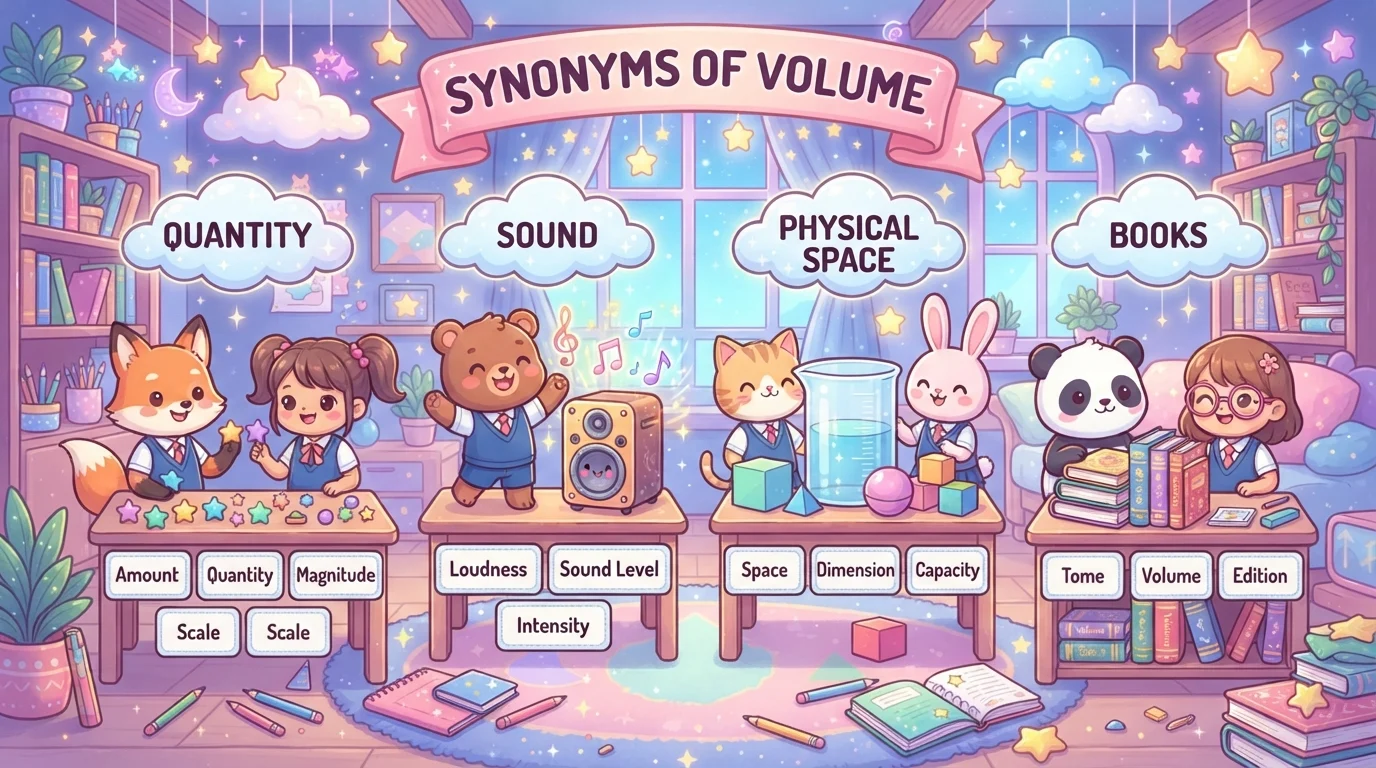
The word volume has several different meanings in English, so its best synonym depends on the context. It can describe the amount of something, the loudness of a sound, the space occupied by an object, or even a book in a collection.
For example, you might talk about a large volume of water, turning down the volume on a television, or the volume of a box. Each meaning requires different alternatives.
This guide explains 30 synonyms and closely related words for volume, including simple meanings, example sentences, and the best context for using each one.
What Does “Volume” Mean?
Volume generally refers to the amount, quantity, loudness, or three-dimensional space occupied by something.
Its meaning changes according to the sentence.
Volume as Amount
The company handles a large volume of orders every day.
Here, volume means amount or quantity.
Volume as Sound Level
Please lower the volume of the music.
Here, volume means loudness or sound level.
Volume as Physical Space
The volume of the container is two liters.
Here, volume means the amount of three-dimensional space an object or container occupies.
Volume as a Book
I borrowed the second volume of the encyclopedia.
Here, volume means a book that is part of a larger series or collection.
30 Synonyms of Volume
Amount
Meaning: The quantity or total of something.
Example:
A considerable amount of water was stored in the tank.
Best usage: General writing when “volume” means quantity.
Quantity
Meaning: The number or amount of something.
Example:
The laboratory measured the quantity of chemicals used.
Best usage: Scientific, academic, business, and formal writing.
Quantity of Material
Meaning: The amount of a particular substance or material.
Example:
The machine can process a large quantity of material.
Best usage: Manufacturing, science, and technical contexts.
Magnitude
Meaning: The size, extent, or importance of something.
Example:
The magnitude of the problem surprised the researchers.
Best usage: Academic, scientific, mathematical, and formal writing.
Extent
Meaning: The degree, size, or range to which something exists or occurs.
Example:
The researchers studied the extent of the environmental damage.
Best usage: Formal, academic, and analytical writing.
Scale
Meaning: The size, level, or scope of something.
Example:
The project was completed on a much larger scale than expected.
Best usage: Business, science, geography, and general writing.
Bulk
Meaning: A large amount or mass of something.
Example:
The bulk of the shipment arrived in the morning.
Best usage: Physical goods, shipments, materials, and large quantities.
Mass
Meaning: A large quantity or body of material; in physics, the amount of matter in an object.
Example:
The machine was designed to move a large mass of material.
Best usage: Physics, science, manufacturing, and physical descriptions.
Load
Meaning: The amount of something carried, supported, or handled.
Example:
The truck can transport a heavy load.
Best usage: Transportation, engineering, computing, and physical quantities.
Capacity
Meaning: The maximum amount that something can contain or hold.
Example:
The tank has a capacity of 500 liters.
Best usage: Containers, facilities, machines, storage, and systems.
Content
Meaning: The amount or material contained inside something.
Example:
The bottle’s water content was measured carefully.
Best usage: Containers, substances, food, science, and technical writing.
Size
Meaning: How large or small something is.
Example:
The size of the shipment increased significantly this month.
Best usage: General descriptions rather than exact quantities.
Proportion
Meaning: The relationship between one amount and another.
Example:
A large proportion of the population supported the proposal.
Best usage: Statistics, research, mathematics, and formal writing.
Rate
Meaning: The amount or frequency at which something happens within a particular period.
Example:
The system processes data at a high rate.
Best usage: Technology, economics, science, and measurements.
Level
Meaning: The amount, degree, or intensity of something.
Example:
The noise level increased during the concert.
Best usage: Sound, measurements, intensity, and general quantities.
Loudness
Meaning: The degree to which a sound is strong or quiet.
Example:
The speaker allows users to adjust the loudness.
Best usage: Audio and sound-related contexts.
Sound Level
Meaning: The measured or perceived intensity of a sound.
Example:
The sound level was too high for the small room.
Best usage: Audio, acoustics, engineering, and everyday technology.
Intensity
Meaning: The strength or degree of something.
Example:
The intensity of the music increased during the final section.
Best usage: Sound, light, emotions, scientific measurements, and physical phenomena.
Strength
Meaning: The degree of force, power, or intensity.
Example:
The strength of the signal was measured by the technician.
Best usage: Signals, sounds, physical forces, and general descriptions.
Loudness Level
Meaning: The degree of how loud a sound is.
Example:
The device automatically adjusts the loudness level.
Best usage: Audio equipment and technical explanations.
Space
Meaning: The area or three-dimensional room available for something.
Example:
The container provides enough space for the equipment.
Best usage: Physical volume and capacity contexts.
Cubic Space
Meaning: The three-dimensional space occupied by an object.
Example:
The engineers calculated the cubic space inside the tank.
Best usage: Mathematics, engineering, construction, and physics.
Cubic Measure
Meaning: A measurement of three-dimensional space, such as cubic meters or cubic centimeters.
Example:
The building’s storage area was calculated using cubic measures.
Best usage: Mathematics, construction, engineering, and science.
Dimension
Meaning: A measurable aspect of an object, such as length, width, or height.
Example:
The dimensions of the container determine its total volume.
Best usage: Mathematics, geometry, engineering, and design.
Capacity
Meaning: The amount something is able to contain or accommodate.
Example:
The swimming pool has a large capacity.
Best usage: Containers, buildings, vehicles, and storage systems.
Edition
Meaning: A particular version of a published work.
Example:
I purchased the latest edition of the reference book.
Best usage: Books and publications when “volume” refers to a published work.
Book
Meaning: A written or printed work, especially when volume refers to one part of a collection.
Example:
The library has every book in the historical series.
Best usage: Informal explanations of “volume” as a publication.
Tome
Meaning: A large or scholarly book.
Example:
He spent months studying the enormous historical tome.
Best usage: Formal, literary, or descriptive writing.
Publication
Meaning: A printed or digital work made available to readers.
Example:
The research was released as a separate publication.
Best usage: Academic, journalistic, and publishing contexts.
Series
Meaning: A group of books, works, or publications connected by a common theme.
Example:
The encyclopedia is divided into several volumes in the series.
Best usage: Books, journals, encyclopedias, and collections.
Quick Comparison of Volume Synonyms
| Synonym | Meaning | Best Context |
|---|---|---|
| Amount | General quantity | Everyday writing |
| Quantity | Measurable amount | Formal/scientific |
| Magnitude | Size or extent | Academic/scientific |
| Scale | Size or scope | Business/general |
| Bulk | Large physical amount | Materials/shipping |
| Mass | Amount of matter | Physics/science |
| Capacity | Maximum amount held | Containers |
| Content | Material contained | Containers/substances |
| Level | Amount or degree | Sound/intensity |
| Loudness | Strength of sound | Audio |
| Sound level | Measured sound intensity | Acoustics |
| Intensity | Strength or degree | Science/sound |
| Space | Room occupied/available | Physical volume |
| Dimension | Measurable size | Geometry |
| Edition | Particular published version | Books |
| Tome | Large book | Literary/formal |
Volume vs Amount
Amount is one of the closest general alternatives to “volume” when discussing quantity.
The company received a large volume of applications.
can become:
The company received a large amount of applications.
However, number is often better when referring to countable things:
The company received a large number of applications.
So, context matters.
Volume vs Quantity
Quantity is more formal and precise than “amount” in many scientific and technical contexts.
The experiment requires a specific quantity of water.
“Volume” may be more appropriate when the amount is specifically measured in liters, milliliters, cubic meters, or another volume unit.
Volume vs Capacity
These terms are related but not identical.
Volume describes the amount of three-dimensional space occupied by something.
Capacity describes how much something can hold.
For example:
The volume of the box is 0.5 cubic meters.
The capacity of the bottle is 500 milliliters.
Volume vs Loudness
When talking about audio, volume and loudness are closely related.
Turn down the volume.
is natural everyday English.
The loudness of the sound was uncomfortable.
is more descriptive and technical.
Volume vs Intensity
Intensity means strength or degree and can describe many things besides sound.
For example:
The volume of the music was high.
The intensity of the sound was high.
“Volume” is more common when discussing an audio device, while “intensity” is more technical.
Volume vs Edition
When “volume” refers to a book, edition can sometimes be related but is not an exact synonym.
A volume is generally one book or part of a larger collection.
An edition is a particular version of a publication.
For example:
Volume Three of the encyclopedia.
The third edition of the textbook.
These have different meanings.
How to Choose the Right Synonym for Volume
Choose amount when referring generally to how much of something exists.
Choose quantity for formal or measurable amounts.
Choose magnitude when emphasizing size, degree, or importance.
Choose scale when discussing overall size or scope.
Choose bulk when describing a large physical quantity.
Choose capacity when talking about how much something can hold.
Choose loudness when describing how loud a sound is.
Choose sound level for technical audio contexts.
Choose intensity when emphasizing strength or degree.
Choose space when discussing three-dimensional room.
Choose dimension when discussing measurable physical characteristics.
Choose edition or tome when “volume” refers to a book.
Synonyms of Volume in Academic Writing
Academic writing often requires more precise vocabulary.
Instead of:
The volume of data collected was substantial.
You might write:
The quantity of data collected was substantial.
Or:
The amount of data collected was substantial.
When discussing physical space:
The volume of the container was calculated mathematically.
When discussing sound:
The sound level was recorded during the experiment.
Using a context-specific word makes academic writing clearer.
Synonyms of Volume in Business Writing
In business, “volume” commonly refers to the amount of activity, sales, orders, traffic, or transactions.
Useful alternatives include:
- Amount
- Quantity
- Scale
- Level
- Rate
- Bulk
- Capacity
Example:
The company experienced a significant increase in sales volume.
Depending on the intended meaning, this could become:
The company experienced a significant increase in sales quantity.
Or:
The company expanded its operations on a larger scale.
Synonyms of Volume in Everyday English
For everyday English, the most natural alternatives depend on the meaning.
For quantity:
- Amount
- Quantity
- Number
- Size
For sound:
- Loudness
- Sound level
- Level
For physical space:
- Space
- Capacity
- Size
For books:
- Book
- Edition
- Tome
- Publication
Common Mistakes When Using Volume Synonyms
Using “capacity” as an exact synonym:
Capacity refers to how much something can hold, not necessarily how much it currently contains.
Using “amount” for countable nouns:
Use number for countable things and amount for uncountable quantities.
Using “loudness” outside sound contexts:
Loudness specifically concerns sound, while volume has several meanings.
Confusing volume with dimensions:
Dimensions describe measurements such as length, width, and height. Volume is the three-dimensional space calculated from those measurements.
Using “edition” for every book-related meaning:
A volume can be one part of a collection, while an edition refers to a particular version of a publication.
Frequently Asked Questions
What is the best synonym for volume?
The best synonym depends on the meaning. Amount, quantity, capacity, loudness, intensity, space, and edition can all work in different contexts.
What is another word for volume as quantity?
Common alternatives include amount, quantity, magnitude, scale, bulk, mass, and level.
What is another word for volume in sound?
For sound, useful alternatives include loudness, sound level, intensity, and level.
What is a synonym for volume in mathematics?
In mathematics, closely related terms include cubic space, cubic measure, and three-dimensional space. However, “volume” itself is the standard mathematical term.
What is a synonym for volume as a book?
Depending on context, you can use book, tome, publication, or edition, although these are not always exact synonyms.
What is the difference between volume and capacity?
Volume measures the three-dimensional space occupied by something, while capacity describes how much a container or space can hold.
Final Thoughts
The word volume is versatile because it can describe quantity, sound, physical space, or a book within a collection. That is why there is no single synonym that works in every sentence.
For quantity, choose amount, quantity, scale, or magnitude. For sound, use loudness or sound level. For physical space, consider capacity, space, or cubic measure. When discussing books, tome, publication, or edition may be appropriate depending on the exact meaning.

Hi, I’m Ellie Clark. I love exploring synonyms and making language easier to understand. I create simple, accurate content that helps readers improve vocabulary, writing skills, and everyday communication with confidence.