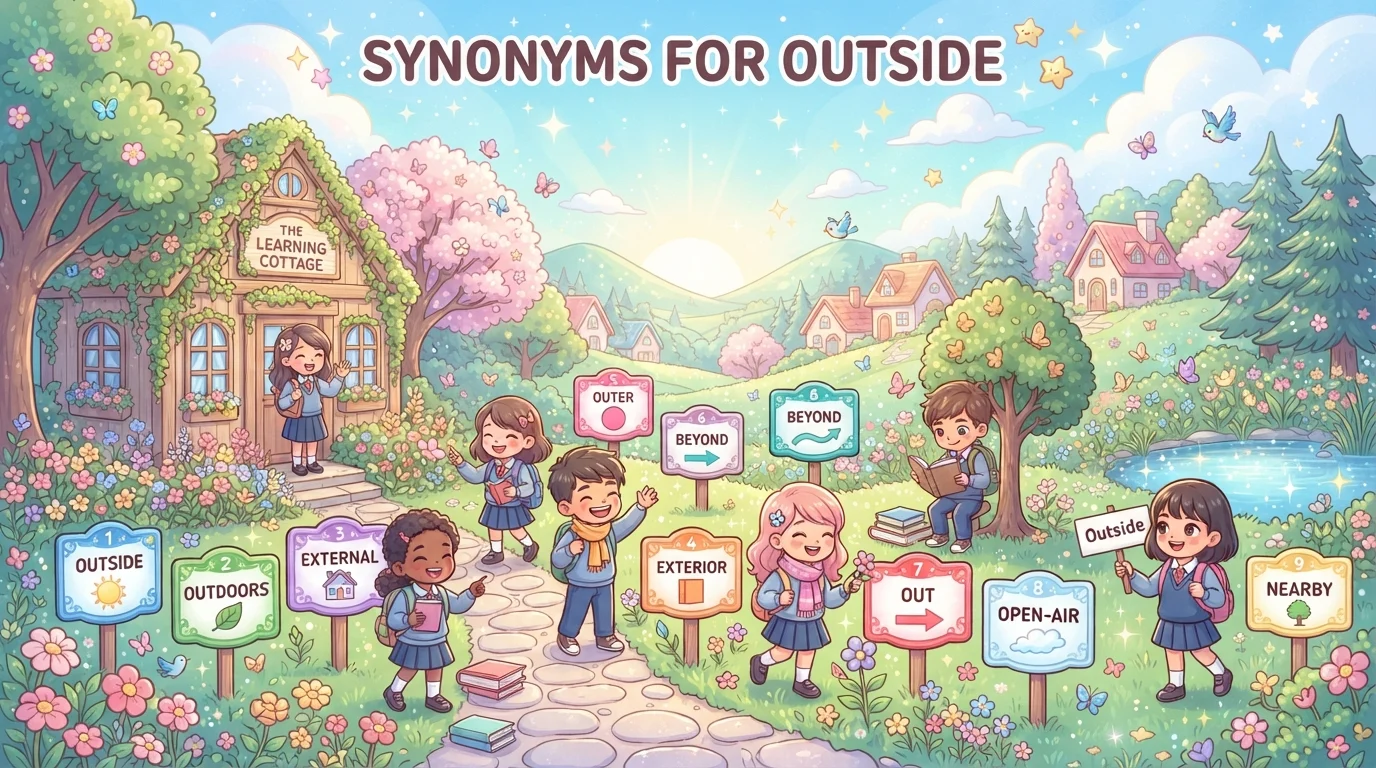
The word outside is common in everyday English, but its meaning can change depending on context. It can describe a physical location, something beyond a boundary, an external part, or something that is not included in a particular group or situation.
Learning synonyms for outside helps students, ESL learners, writers, and content creators choose more precise vocabulary. For example, outdoors works well for an open-air location, while external is better for formal or technical writing. Similarly, beyond often refers to something farther than a limit, while excluding emphasizes something that has been left out.
This guide explains 30 useful alternatives to outside with simple meanings, natural examples, and practical usage notes.
What Does “Outside” Mean?
Outside generally means in or to a place that is not inside something, but it can have several meanings.
Simple Definition
Outside = not inside, beyond a boundary, or separate from something.
Example
The children are playing outside.
Here, outside means in an open-air area rather than indoors.
Another example:
The answer is outside the scope of this discussion.
Here, outside means beyond the limits of the discussion.
30 Synonyms for Outside
Some alternatives are direct synonyms, while others are closely related words that work better in specific contexts.
Outdoors
Meaning: In the open air rather than inside a building.
Example:
We spent the afternoon outdoors.
Best usage: Parks, gardens, activities, and open-air situations.
Tone: Natural and everyday.
Outdoorsy
Meaning: Related to outdoor activities or a love of nature.
Example:
She has an outdoorsy personality and enjoys hiking.
Best usage: Describing people, lifestyles, or interests.
Tone: Informal.
External
Meaning: Located outside something or relating to the outer part.
Example:
The building has several external security cameras.
Best usage: Formal, technical, and professional writing.
Tone: Formal.
Exterior
Meaning: The outside surface or part of something.
Example:
The exterior of the house was recently painted.
Best usage: Buildings, objects, vehicles, and physical structures.
Tone: Neutral and formal.
Outer
Meaning: Located toward or forming the outside of something.
Example:
The outer layer protects the material underneath.
Best usage: Physical objects, layers, boundaries, and structures.
Tone: Neutral.
Outward
Meaning: Moving or directed toward the outside.
Example:
The doors open outward.
Best usage: Movement, direction, and physical position.
Tone: Neutral.
Beyond
Meaning: On the other side of or farther than a particular point or limit.
Example:
The village lies beyond the mountains.
Best usage: Locations, limits, abilities, and abstract ideas.
Tone: Neutral to literary.
Away
Meaning: At or toward a place that is distant from something.
Example:
Please move away from the door.
Best usage: Movement and distance.
Tone: Everyday.
Apart
Meaning: Separate from something or someone else.
Example:
Keep the damaged materials apart from the others.
Best usage: Separation and distinction.
Tone: Neutral.
Beyond the Boundary
Meaning: On the other side of a defined limit.
Example:
The hikers were warned not to travel beyond the boundary.
Best usage: Physical areas, rules, and limits.
Tone: Formal.
On the Outside
Meaning: In an external position rather than inside.
Example:
They waited on the outside of the building.
Best usage: Physical locations.
Tone: Everyday.
External to
Meaning: Separate from or outside a particular system or organization.
Example:
The decision was made by people external to the company.
Best usage: Business, academic, and technical writing.
Tone: Formal.
Without
Meaning: Not having or containing something.
Example:
He left the room without his jacket.
Best usage: When outside means absence rather than physical location.
Tone: Neutral.
Excluding
Meaning: Leaving someone or something out.
Example:
The price is $50, excluding delivery charges.
Best usage: Lists, prices, rules, and formal explanations.
Tone: Formal.
Except
Meaning: Not including a particular person or thing.
Example:
Everyone was invited except John.
Best usage: General English and exclusions.
Tone: Neutral.
Externally
Meaning: From or on the outside.
Example:
The building is externally finished with stone.
Best usage: Formal and technical writing.
Tone: Formal.
Out
Meaning: Away from the inside of a place or enclosed area.
Example:
Let’s go out for some fresh air.
Best usage: Everyday speech.
Tone: Informal and natural.
Open-Air
Meaning: Taking place outdoors rather than in an enclosed building.
Example:
They attended an open-air concert.
Best usage: Concerts, markets, events, restaurants, and activities.
Tone: Descriptive.
In the Open
Meaning: In an exposed or uncovered area.
Example:
The animals were grazing in the open.
Best usage: Nature and outdoor environments.
Tone: Natural and descriptive.
In the Open Air
Meaning: Outdoors, especially in a natural or pleasant environment.
Example:
Exercising in the open air can feel refreshing.
Best usage: Nature, exercise, recreation, and lifestyle writing.
Tone: Descriptive.
On the Exterior
Meaning: On the outside surface of something.
Example:
There are several signs on the exterior of the building.
Best usage: Buildings and physical structures.
Tone: Formal.
Outer Side
Meaning: The side facing away from the center or inside.
Example:
The label is attached to the outer side of the box.
Best usage: Physical objects and locations.
Tone: Neutral.
Perimeter
Meaning: The outer edge or boundary of an area.
Example:
Security guards checked the perimeter of the property.
Best usage: Buildings, land, security, and geographical areas.
Tone: Formal.
Edge
Meaning: The outer limit or boundary of something.
Example:
They stood near the edge of the forest.
Best usage: Physical locations and boundaries.
Tone: Neutral.
Border
Meaning: The line or area separating one place or region from another.
Example:
The town is located near the border.
Best usage: Countries, regions, properties, and boundaries.
Tone: Neutral.
Fringe
Meaning: The outer edge of an area or group.
Example:
A small village sits on the fringe of the city.
Best usage: Geographic and social contexts.
Tone: Literary or formal.
Surrounding Area
Meaning: The area around a particular place.
Example:
The surrounding area is popular with tourists.
Best usage: Places, neighborhoods, and locations.
Tone: Neutral.
Nearby
Meaning: Close to a particular place but not necessarily inside it.
Example:
There is a café nearby.
Best usage: Locations and everyday conversation.
Tone: Natural.
Around
Meaning: In the area surrounding something.
Example:
There are several shops around the station.
Best usage: Places and surrounding areas.
Tone: Everyday.
Separate
Meaning: Not joined, connected, or included with something else.
Example:
The office is in a separate building outside the main complex.
Best usage: Physical and abstract separation.
Tone: Neutral.
Nonmember
Meaning: A person who does not belong to a particular group or organization.
Example:
Nonmembers must register before entering the facility.
Best usage: Clubs, organizations, and groups.
Tone: Formal.
Quick Comparison of Outside Synonyms
| Synonym | Main Meaning | Best Context |
|---|---|---|
| Outdoors | In the open air | Everyday situations |
| External | Relating to the outside | Formal writing |
| Exterior | Outside surface | Buildings and objects |
| Outer | Toward the outside | Layers and structures |
| Outward | Toward the outside | Direction |
| Beyond | Farther than a limit | Physical or abstract |
| Away | At a distance | Movement |
| Open-air | Taking place outdoors | Events and activities |
| Excluding | Leaving something out | Lists and prices |
| Except | Not including | Everyday English |
| Out | Away from the inside | Casual speech |
| Perimeter | Outer boundary | Security and property |
| Edge | Outer limit | Physical areas |
| Border | Separating boundary | Regions and countries |
| Fringe | Outer edge | Geographic or social contexts |
| Nearby | Close to a place | Locations |
| Around | In the surrounding area | Everyday English |
| Separate | Not joined or included | Physical/abstract contexts |
Outside vs. Outdoors
These words are closely related but are not always interchangeable.
Outside can function as a preposition, adverb, adjective, or noun.
The children are outside.
Outdoors usually refers specifically to being in the open air.
The children are playing outdoors.
Both are correct, but outdoors has a stronger connection with outdoor activity or an open-air environment.
Outside vs. External
Outside is common in everyday English.
External sounds more formal and is especially common in technical, academic, and professional writing.
There is damage on the outside of the machine.
The machine has external damage.
The second sentence sounds more technical.
Outside vs. Exterior
Exterior usually refers to the physical outside part or surface of something.
The exterior of the building is made of glass.
You normally would not replace outside with exterior in every sentence.
For example:
Let’s wait outside.
You would not normally say:
Let’s wait exterior.
Outside vs. Beyond
Beyond means farther than a particular point, boundary, or limit.
The restaurant is outside the city.
The restaurant is beyond the city limits.
The first simply describes location. The second emphasizes crossing or going farther than a boundary.
Outside vs. Out
Out is one of the most common informal alternatives.
Come outside.
Come out.
Both can be natural, although the exact meaning can depend on context.
Outside vs. Excluding
These words can overlap when outside means “not included.”
Outside the main group, several independent researchers participated.
Excluding the main group, several independent researchers participated.
However, excluding is much clearer when you specifically mean that something has been left out.
How to Choose the Right Synonym
The best synonym depends on what you mean by outside.
When You Mean “Not Inside”
Choose:
- Out
- Outdoors
- In the open
- In the open air
- Open-air
Example:
We spent the evening outdoors.
When You Mean “The Outer Part”
Choose:
- External
- Exterior
- Outer
- Outer side
- On the exterior
Example:
The exterior walls need repair.
When You Mean “Beyond a Limit”
Choose:
- Beyond
- Outside the boundary
- Beyond the boundary
- Away from
- Past
Example:
The issue falls beyond the scope of this project.
When You Mean “Not Included”
Choose:
- Excluding
- Except
- Without
- Separate from
- Nonmember
Example:
The fee is $100, excluding taxes.
When You Mean “The Area Around Something”
Choose:
- Around
- Nearby
- Surrounding area
- Perimeter
- Edge
- Fringe
Example:
There are several restaurants nearby.
Synonyms for Outside in Academic Writing
Academic writing often benefits from more precise alternatives such as:
- External
- Beyond
- Excluding
- Separate from
- Outside the scope
- External to
- Prevailing boundary
- Periphery
For example:
The topic is outside the scope of the present study.
Or:
Researchers external to the organization reviewed the findings.
Synonyms for Outside in Business Writing
Useful business alternatives include:
- External
- Exterior
- Outside
- External to
- Excluding
- Separate
- Perimeter
For example:
The company hired an external consultant.
Or:
Additional expenses are excluded from the quoted price.
Synonyms for Outside in Everyday English
For casual conversations, the simplest choices are usually best:
- Out
- Outdoors
- Away
- Around
- Nearby
- Outside
- In the open
For example:
Let’s go out.
The kids are playing outdoors.
There’s a store nearby.
Common Mistakes When Using Outside Synonyms
Using “Exterior” as an Adverb
You can say:
The exterior of the house looks beautiful.
But you cannot normally replace outside with exterior in:
Let’s go outside.
Use out or outdoors instead.
Confusing “External” and “Exterior”
External can describe something related to the outside.
Exterior commonly refers to the actual outside surface or appearance.
External factors affected the decision.
The exterior of the building was renovated.
Using “Outdoors” for Every Meaning of Outside
Outdoors specifically relates to open-air locations.
It does not work when outside means “not included.”
Incorrect:
Everyone outside John was invited.
Better:
Everyone except John was invited.
Confusing “Beyond” With “Outside”
Beyond often emphasizes distance or a limit.
Outside can simply describe a position.
Using “Except” for Physical Locations
Except means “not including,” not simply “located outside.”
Frequently Asked Questions
What is the closest synonym for outside?
Common alternatives include outdoors, external, exterior, outer, out, and beyond, depending on the context.
What is a simple synonym for outside?
Out and outdoors are simple alternatives when you mean being in an open-air location.
What is the opposite of outside?
The most direct opposite is inside or indoors.
Is “external” a synonym for outside?
Yes, in many formal contexts. External means relating to or located on the outside, but it is not interchangeable with outside in every sentence.
What is another word for outside the building?
You can say outdoors, outside the building, or on the exterior, depending on the sentence.
What is a synonym for outside of?
Depending on the meaning, alternatives include beyond, excluding, except, external to, and apart from.
Conclusion
Understanding synonyms for outside helps you choose vocabulary that fits your exact meaning. The best alternative depends on whether you are talking about a physical location, an outer surface, a boundary, or something that has been excluded.
Use outdoors for open-air locations, external for formal or technical contexts, exterior for the outside surface of something, beyond for something past a limit, and excluding when something has been left out.
Once you understand these small differences, your English becomes more precise and natural. Instead of repeatedly using outside, you can select a word that communicates exactly what you mean.

Hi, I’m Richard Miller, a language enthusiast passionate about synonyms, vocabulary, and clear communication. I enjoy creating simple, accurate, and practical content that helps readers express themselves with confidence every day.