Poetry is a form of creative writing that uses carefully chosen words, rhythm, imagery, emotion, and sometimes rhyme to express ideas and feelings. It can be personal, romantic, dramatic, philosophical, or playful.
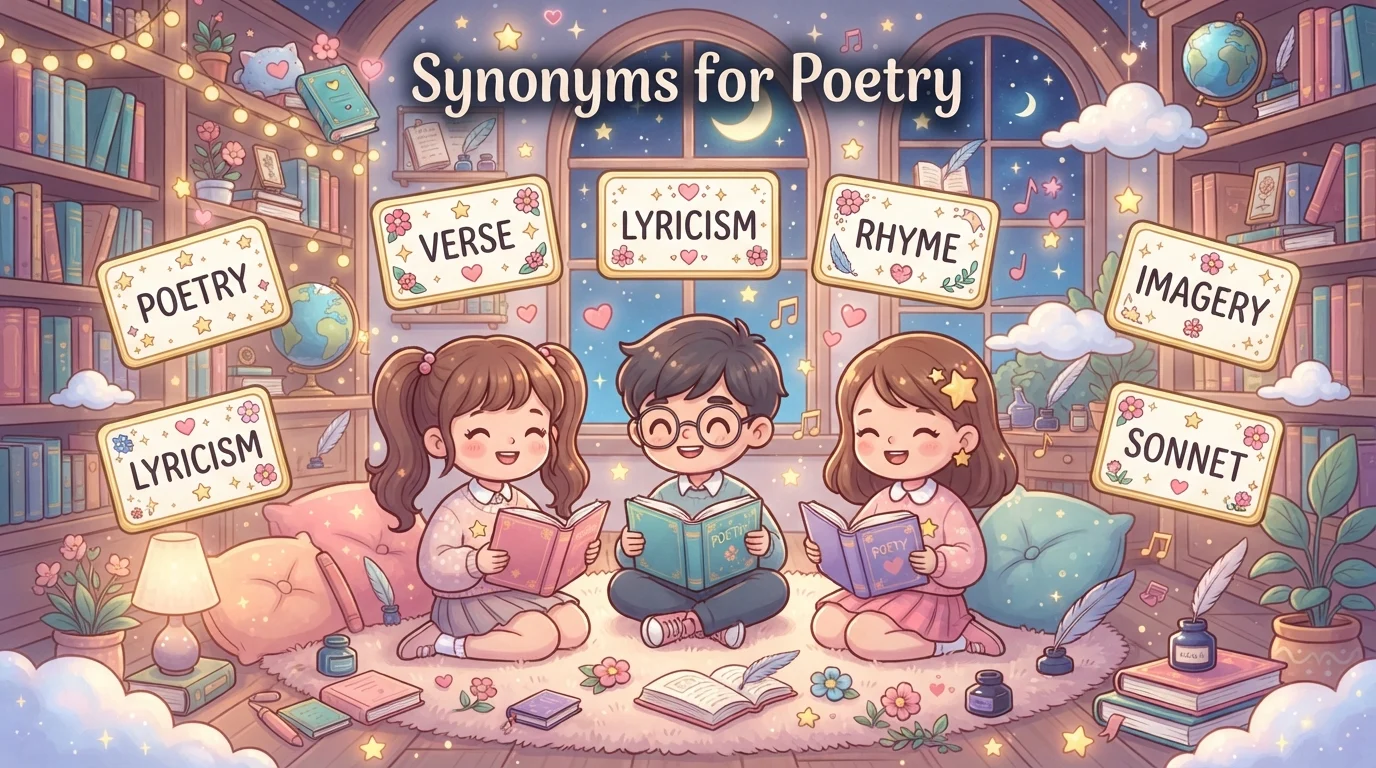
Learning synonyms for poetry is helpful for students, ESL learners, writers, bloggers, and content creators who want to describe poems and poetic writing more precisely. While words such as verse, poem, rhyme, and lyricism are related to poetry, they do not all mean exactly the same thing.
The right alternative depends on what you are trying to describe. If you mean a written poetic work, poem may be best. If you mean lines arranged rhythmically, verse is often more appropriate. If you mean beautiful or expressive language, poetic expression or lyricism may fit better.
What Does “Poetry” Mean?
Poetry is a type of literature that uses language in an artistic and often condensed way to communicate emotions, ideas, experiences, images, or stories.
Simple Definition
Poetry = creative writing that uses expressive language, rhythm, imagery, and sometimes rhyme to communicate ideas or emotions.
Example
She enjoys reading poetry because it helps her understand different emotions and perspectives.
The word poetry normally refers to the art or form of writing as a whole, while poem usually refers to one individual piece.
Poetry Can Include
- Poems
- Verse
- Sonnets
- Haiku
- Ballads
- Free verse
- Odes
- Elegies
- Lyrical writing
- Narrative poems
- Dramatic poetry
- Spoken-word poetry
30 Synonyms and Related Words for Poetry
Some of the words below are close synonyms, while others are related terms that describe a particular type, feature, or quality of poetry. This distinction is important because poetry has no single perfect replacement in every context.
Verse
Meaning: Writing arranged in lines, especially poetry.
Example:
The student wrote several pages of verse about nature.
Best usage: Literature, poems, and formal writing.
Tone: Literary.
Poem
Meaning: A single piece of writing created as poetry.
Example:
She wrote a beautiful poem about the changing seasons.
Best usage: When referring to one specific work.
Tone: Neutral.
Rhyme
Meaning: A similarity in sound between words, especially at the ends of lines.
Example:
The poet used rhyme to give the poem a musical quality.
Best usage: Discussing poetic sound and structure.
Tone: Neutral.
Lyricism
Meaning: The quality of expressing emotions in a beautiful, musical, or imaginative way.
Example:
The novel is admired for its lyricism and vivid descriptions.
Best usage: Literary criticism and expressive writing.
Tone: Formal and literary.
Poemcraft
Meaning: The skill or technique involved in creating poetry.
Example:
The workshop focused on developing stronger poemcraft.
Best usage: Writing discussions and creative education.
Tone: Specialized.
Poetic Expression
Meaning: The use of artistic and expressive language to communicate an idea or emotion.
Example:
Her poetic expression made the simple scene feel powerful.
Best usage: Literary analysis and creative writing.
Tone: Literary.
Literary Art
Meaning: Creative expression through written language.
Example:
Poetry is an important form of literary art.
Best usage: Academic and literary discussions.
Tone: Formal.
Literature
Meaning: Written creative works considered valuable as art or storytelling.
Example:
Poetry has played an important role in world literature.
Best usage: Broad discussions about written art.
Tone: Formal.
Composition
Meaning: A piece of creative writing or the process of creating one.
Example:
The poet revised the composition several times.
Best usage: Academic and literary contexts.
Tone: Formal.
Writing
Meaning: The activity or product of expressing ideas through written language.
Example:
Her writing often combines storytelling with poetic imagery.
Best usage: General contexts.
Tone: Neutral.
Creative Writing
Meaning: Writing created mainly for artistic or imaginative expression.
Example:
Poetry is one of the most popular forms of creative writing.
Best usage: Education and writing discussions.
Tone: Neutral and professional.
Literature in Verse
Meaning: Literary writing presented in poetic lines rather than ordinary prose.
Example:
The epic is an important example of literature in verse.
Best usage: Academic and historical discussions.
Tone: Formal.
Ballad
Meaning: A poem or song that tells a story, traditionally with rhythm and repetition.
Example:
The poet wrote a ballad about a legendary hero.
Best usage: Narrative poetry and traditional literature.
Tone: Literary.
Sonnet
Meaning: A structured poem traditionally consisting of fourteen lines.
Example:
The class studied a famous sonnet about love and time.
Best usage: Formal poetic analysis.
Tone: Literary.
Ode
Meaning: A poem that expresses strong admiration or celebrates a person, thing, or idea.
Example:
The poet wrote an ode to the beauty of spring.
Best usage: Celebratory poetry.
Tone: Formal and literary.
Elegy
Meaning: A poem expressing sadness, especially following someone’s death or a significant loss.
Example:
The writer composed an elegy in memory of a beloved teacher.
Best usage: Poems about grief, death, and remembrance.
Tone: Serious and emotional.
Haiku
Meaning: A short traditional Japanese poetic form known for its concise structure and focus on nature or moments of observation.
Example:
She wrote a haiku about falling leaves.
Best usage: Short-form poetry and nature themes.
Tone: Literary.
Limerick
Meaning: A short humorous poem with a distinctive rhythm and rhyme pattern.
Example:
The children enjoyed creating funny limericks.
Best usage: Humor and playful writing.
Tone: Lighthearted.
Free Verse
Meaning: Poetry that does not follow a fixed rhyme or traditional meter.
Example:
The poet prefers free verse because it allows greater freedom of expression.
Best usage: Modern poetry.
Tone: Literary.
Prose Poetry
Meaning: Poetry written in paragraph form rather than traditional poetic lines.
Example:
The author experimented with prose poetry to blend narrative and imagery.
Best usage: Modern and experimental literature.
Tone: Literary.
Song
Meaning: A piece of music containing words that may use poetic language.
Example:
The songwriter used vivid poetic imagery in the song.
Best usage: Music and lyrical writing.
Tone: General.
Lyrics
Meaning: Words written to accompany music.
Example:
The lyrics use metaphor and imagery to express the character’s feelings.
Best usage: Songs and musical composition.
Tone: General and creative.
Rhyme Scheme
Meaning: The pattern of rhyming sounds in a poem.
Example:
Students identified the rhyme scheme before analyzing the poem.
Best usage: Poetry analysis and education.
Tone: Academic.
Meter
Meaning: A structured pattern of rhythm in poetry.
Example:
The poet carefully maintained the meter throughout the sonnet.
Best usage: Formal poetry analysis.
Tone: Academic.
Rhythm
Meaning: The pattern of sounds, stresses, or beats in language.
Example:
The poem’s rhythm makes it enjoyable to read aloud.
Best usage: Poetry, music, and spoken-word writing.
Tone: Neutral.
Imagery
Meaning: Descriptive language that creates mental pictures or sensory impressions.
Example:
The poem uses vivid imagery to describe the ocean.
Best usage: Literary analysis and creative writing.
Tone: Academic and literary.
Metaphor
Meaning: A comparison in which one thing is described as another to create a particular image or idea.
Example:
The poet uses a metaphor to represent hope as a light.
Best usage: Literary analysis.
Tone: Academic.
Symbolism
Meaning: The use of objects, images, or ideas to represent deeper meanings.
Example:
The poem’s symbolism gives the simple story a deeper meaning.
Best usage: Literary analysis.
Tone: Formal.
Rhetoric
Meaning: The art of using language effectively and persuasively.
Example:
The poet uses powerful rhetoric to challenge the reader.
Best usage: Literary, academic, and persuasive writing.
Tone: Formal.
Eloquence
Meaning: The ability to express ideas beautifully, clearly, and effectively.
Example:
Her eloquence made the reading memorable.
Best usage: Describing powerful language rather than poetry itself.
Tone: Formal and positive.
Quick Comparison of Poetry Synonyms and Related Terms
| Word | Main Meaning | Best Context |
|---|---|---|
| Poetry | The art or form of poetic writing | General |
| Poem | One individual poetic work | Specific work |
| Verse | Poetry or poetic lines | Literary writing |
| Lyricism | Emotional and musical quality | Literary criticism |
| Rhyme | Similarity of sounds | Poetic technique |
| Rhythm | Pattern of beats or stresses | Poetry and music |
| Imagery | Language creating mental pictures | Literary analysis |
| Meter | Structured poetic rhythm | Formal poetry |
| Ballad | Narrative poem or song | Storytelling |
| Sonnet | Fourteen-line poetic form | Classical poetry |
| Ode | Poem expressing admiration | Celebration |
| Elegy | Poem about grief or loss | Remembrance |
| Haiku | Short Japanese poetic form | Nature poetry |
| Limerick | Humorous rhyming poem | Playful writing |
| Free Verse | Poetry without fixed meter or rhyme | Modern poetry |
| Lyrics | Words written for music | Songs |
| Eloquence | Beautiful, effective expression | Language style |
Poetry vs. Poem
These two words are closely connected but have different meanings.
Poetry refers to the literary art or genre as a whole.
I enjoy reading poetry.
Poem refers to one particular piece.
I read a poem about the moon.
A simple way to remember this is:
Poetry = the art.
Poem = one work.
Poetry vs. Verse
Verse can be used as a synonym for poetry in many contexts, but it can also refer specifically to lines of poetry.
She enjoys writing poetry.
She wrote several verses about nature.
Poetry is broader, while verse often focuses on the form or lines.
Poetry vs. Prose
Poetry often uses rhythm, imagery, condensed language, and poetic structure.
Prose is ordinary written or spoken language arranged in sentences and paragraphs.
For example:
The novel is written in prose.
The collection contains poetry.
Understanding this distinction is important for literature students.
Poetry vs. Lyrics
Lyrics are words written to accompany music.
Poetry does not necessarily require music.
A poem can be read silently or aloud without being part of a song.
The song has beautiful lyrics.
The poet published a collection of poetry.
Poetry vs. Rhyme
Rhyme is a technique, not a complete synonym for poetry.
Not every poem rhymes.
Modern free verse, for example, may contain no regular rhyme pattern.
The poem uses rhyme.
This is different from:
The poem is an example of poetry.
Poetry vs. Lyricism
Lyricism describes a quality of language that is expressive, musical, emotional, or poetic.
The poem is known for its lyricism.
This means the writing has a particularly expressive or musical quality.
How to Choose the Right Synonym
The best word depends on what part of poetry you are discussing.
When You Mean Poetry as an Art Form
Choose:
- Poetry
- Literary art
- Creative writing
- Literature
These describe poetry broadly.
When You Mean One Piece of Poetry
Choose:
- Poem
- Verse
- Composition
Use poem when referring to a specific work.
When You Mean Poetic Sound
Choose:
- Rhyme
- Rhythm
- Meter
- Rhyme scheme
These describe technical features of poetry.
When You Mean Poetic Beauty
Choose:
- Lyricism
- Eloquence
- Poetic expression
- Imagery
These are useful when describing the emotional or artistic quality of language.
When You Mean a Specific Type of Poem
Choose:
- Sonnet
- Ode
- Elegy
- Ballad
- Haiku
- Limerick
- Free verse
- Prose poetry
These are more specific than the general word poetry.
Synonyms for Poetry in Academic Writing
When writing an essay or literary analysis, you can use terms such as:
- Verse
- Literary art
- Creative writing
- Poetic expression
- Lyricism
- Literature in verse
- Composition
For example:
The poet uses imagery and rhythm to create an emotional atmosphere.
Or:
The author’s lyricism contributes to the poem’s emotional impact.
These terms can make literary analysis more precise.
Synonyms for Poetry in Creative Writing
When writing creatively, you might describe poetry as:
- Verse
- Poetic expression
- Lyricism
- Literary art
- Free verse
- Song
- Poem
For example:
Her verse explores themes of friendship and memory.
Or:
His lyricism gives the story an almost dreamlike quality.
Synonyms for Poetry in Everyday English
For simple everyday communication, the most natural choices are:
- Poem
- Verse
- Writing
- Lyrics
- Song
For example:
I wrote a poem for my friend.
This is more natural than using a highly technical term.
Common Mistakes When Using Poetry Synonyms
Calling Every Poem a “Rhyme”
Not every poem rhymes. Rhyme refers to a sound pattern, while poetry is the broader art form.
Using “Poem” and “Poetry” Interchangeably
You can say:
I enjoy poetry.
But when referring to one specific work, say:
I enjoyed the poem.
Calling Lyrics Poetry in Every Context
Lyrics can be poetic, but they are specifically written to accompany music.
Assuming All Poetry Has a Fixed Rhythm
Many traditional forms use meter, but free verse does not necessarily follow a regular metrical pattern.
Using “Verse” Only for Rhyming Poems
Verse can refer broadly to poetry or poetic lines, including forms that do not use obvious rhyme.
Frequently Asked Questions
What is the closest synonym for poetry?
Verse is one of the closest alternatives, although poetry and verse can have slightly different meanings depending on context.
What is a simple synonym for poetry?
For beginners, verse, poem, and poetic writing are useful related terms.
Is a poem the same as poetry?
Not exactly. Poetry is the art or genre, while a poem is one individual piece of poetic writing.
What is another word for poetic writing?
Possible alternatives include verse, poetic expression, literary art, and creative writing.
What is the difference between poetry and verse?
Poetry refers to the art form, while verse can refer to poetry generally or to individual lines or sections of a poem.
What is the opposite of poetry?
There is no perfect opposite. Depending on the context, prose is sometimes contrasted with poetry because prose follows ordinary sentence and paragraph structures.
Conclusion
Understanding synonyms for poetry helps you describe literary writing, poetic techniques, and different forms of expression more accurately. The closest general alternatives include verse, poem, poetic expression, and literary art, while words such as rhyme, rhythm, imagery, and meter describe specific features of poetry rather than exact synonyms.
Remember the simplest distinction: poetry is the art, a poem is one work, and verse refers to poetic language or lines. When discussing specific forms, words such as sonnet, ode, elegy, ballad, and haiku provide much greater precision.
Whether you are writing an essay, studying literature, creating content, or simply expanding your vocabulary, choosing the right related word can make your writing more expressive and accurate.

Hi, I’m Ellie Clark. I love exploring synonyms and making language easier to understand. I create simple, accurate content that helps readers improve vocabulary, writing skills, and everyday communication with confidence.