The word smug describes someone who seems overly pleased with themselves, their achievements, or their situation. It often suggests that a person feels superior to others and is too satisfied with themselves.
Learning synonyms for smug can help students, ESL learners, writers, and content creators express different shades of confidence, pride, self-satisfaction, and superiority. Some alternatives are mild, while others have a much more negative tone.
For example, self-satisfied is a close synonym for smug, while arrogant focuses more strongly on a belief that one is better than others. Understanding these differences helps you choose the most accurate word for each sentence.
What Does “Smug” Mean?
Smug is an adjective used to describe someone who is too pleased with themselves and their own success or qualities, often in an annoying or superior way.
Simple Definition
Smug = overly pleased with yourself in a way that can make you seem superior or annoying.
Example
He gave a smug smile after winning the competition.
The sentence suggests that he looked overly pleased with himself, possibly as though he believed he was better than everyone else.
Common Uses of “Smug”
The word smug is commonly used when describing:
- Facial expressions
- Smiles
- Attitudes
- Behavior
- Confidence
- Pride
- Success
- Self-satisfaction
- Feelings of superiority
- Someone who thinks they are always right
30 Synonyms for Smug
Self-Satisfied
Meaning: Very pleased with yourself, especially in a way that seems excessive.
Example:
She looked self-satisfied after proving her point.
Best usage: The closest general alternative to smug.
Tone: Negative.
Conceited
Meaning: Having an exaggerated opinion of your own abilities or importance.
Example:
His conceited attitude made it difficult for others to work with him.
Best usage: When someone thinks too highly of themselves.
Tone: Strongly negative.
Arrogant
Meaning: Believing that you are more important, intelligent, or capable than other people.
Example:
His arrogant behavior annoyed his classmates.
Best usage: When superiority is the main idea.
Tone: Strongly negative.
Overconfident
Meaning: Having more confidence than is reasonable or appropriate.
Example:
She became overconfident after winning several matches.
Best usage: When confidence goes beyond what the situation justifies.
Tone: Negative or cautionary.
Pompous
Meaning: Behaving as though you are very important or impressive.
Example:
His pompous speech made the simple idea sound complicated.
Best usage: Formal behavior, speech, or writing that seems excessively important.
Tone: Negative and often humorous.
Superior
Meaning: Acting as though you are better than other people.
Example:
He adopted a superior attitude toward his coworkers.
Best usage: Describing an attitude of looking down on others.
Tone: Negative.
Haughty
Meaning: Acting as though you are better or more important than other people.
Example:
The haughty character refused to listen to anyone else.
Best usage: Literary and formal writing.
Tone: Strong and formal.
Snobbish
Meaning: Believing that you are better than others because of your social position, taste, education, or possessions.
Example:
His snobbish attitude made newcomers feel uncomfortable.
Best usage: Social status, taste, wealth, or class-related behavior.
Tone: Negative.
Self-Important
Meaning: Thinking that you are more important than you really are.
Example:
His self-important manner irritated the rest of the team.
Best usage: When someone exaggerates their own importance.
Tone: Negative.
Self-Congratulatory
Meaning: Showing excessive praise or satisfaction toward yourself.
Example:
The article had a self-congratulatory tone.
Best usage: Writing, speeches, achievements, and public behavior.
Tone: Formal and negative.
Self-Pleased
Meaning: Very pleased with yourself or something you have done.
Example:
He looked self-pleased after completing the difficult task.
Best usage: Everyday descriptions of excessive satisfaction.
Tone: Mildly negative.
Self-Assured
Meaning: Confident in your abilities or decisions.
Example:
She spoke in a calm and self-assured manner.
Best usage: Positive confidence rather than unpleasant pride.
Tone: Usually positive.
Cocky
Meaning: Overconfident and too sure of yourself.
Example:
His cocky attitude disappeared after the difficult test.
Best usage: Informal conversations.
Tone: Negative and casual.
Overbearing
Meaning: Trying to control other people in an unpleasant or forceful way.
Example:
His overbearing personality made group discussions difficult.
Best usage: When confidence becomes controlling behavior.
Tone: Strongly negative.
Patronizing
Meaning: Treating someone as though they are less intelligent or capable than you.
Example:
Her patronizing tone made the conversation uncomfortable.
Best usage: Condescending speech or behavior.
Tone: Negative.
Condescending
Meaning: Acting as though you are superior to someone else.
Example:
He used a condescending tone when explaining the simple task.
Best usage: Speech, attitudes, and interactions.
Tone: Strongly negative.
Contemptuous
Meaning: Showing that you believe someone or something deserves little respect.
Example:
She gave him a contemptuous look.
Best usage: Strong expressions of disrespect.
Tone: Very strong and negative.
Disdainful
Meaning: Showing that you consider someone or something unworthy of respect.
Example:
He gave a disdainful response to the suggestion.
Best usage: Formal and descriptive writing.
Tone: Strong and formal.
Snide
Meaning: Indirectly insulting someone in a mocking or unpleasant way.
Example:
He made a snide comment about her presentation.
Best usage: Remarks, comments, and conversations.
Tone: Negative and informal.
Smirking
Meaning: Smiling in a way that suggests self-satisfaction or superiority.
Example:
He stood there smirking after winning the argument.
Best usage: Facial expressions and body language.
Tone: Negative.
Triumphant
Meaning: Showing great happiness or satisfaction after winning or succeeding.
Example:
She gave a triumphant smile after completing the challenge.
Best usage: Success and victory.
Tone: Usually positive, but can sound negative depending on context.
Proud
Meaning: Feeling pleased about something you have achieved or about someone you care about.
Example:
He felt proud of his accomplishment.
Best usage: Positive achievement and personal satisfaction.
Tone: Usually positive.
Boastful
Meaning: Talking too proudly about your abilities or achievements.
Example:
His boastful comments became tiring after a while.
Best usage: Speech and behavior involving excessive self-praise.
Tone: Negative.
Bragging
Meaning: Talking too proudly about yourself or your achievements.
Example:
His constant bragging annoyed his friends.
Best usage: Informal conversations.
Tone: Negative and casual.
Vainglorious
Meaning: Extremely proud of your achievements or abilities, especially without good reason.
Example:
His vainglorious attitude prevented him from accepting useful criticism.
Best usage: Formal or literary writing.
Tone: Strong and formal.
Egotistical
Meaning: Thinking excessively highly of yourself and your importance.
Example:
His egotistical behavior made teamwork difficult.
Best usage: Personality descriptions.
Tone: Strongly negative.
Narcissistic
Meaning: Extremely focused on yourself and your own importance or admiration.
Example:
The character was portrayed as narcissistic and obsessed with praise.
Best usage: Careful descriptions of personality or fictional characters; avoid using it casually as a clinical diagnosis.
Tone: Strong and potentially sensitive.
Pretentious
Meaning: Trying to appear more intelligent, important, cultured, or impressive than you really are.
Example:
His pretentious style of speaking irritated the audience.
Best usage: Behavior, speech, writing, fashion, or presentation.
Tone: Negative.
Grandiose
Meaning: Very impressive or ambitious in a way that can seem exaggerated.
Example:
He had grandiose ideas about his future success.
Best usage: Plans, ideas, claims, and descriptions.
Tone: Formal.
Satisfied
Meaning: Feeling pleased because something has gone well or a need has been fulfilled.
Example:
She felt satisfied with the final result.
Best usage: Neutral situations where excessive pride is not intended.
Tone: Neutral or positive.
Quick Comparison of Smug Synonyms
| Synonym | Main Idea | Tone | Best Context |
|---|---|---|---|
| Self-satisfied | Excessively pleased with yourself | Negative | General |
| Conceited | Thinking too highly of yourself | Negative | Personality |
| Arrogant | Believing you are superior | Strongly negative | Behavior |
| Overconfident | Too confident | Negative | Skills or decisions |
| Pompous | Acting overly important | Negative | Speech or behavior |
| Haughty | Acting superior | Strong | Formal/literary |
| Snobbish | Feeling superior based on status or taste | Negative | Social situations |
| Self-important | Thinking you’re very important | Negative | Personality |
| Cocky | Informally overconfident | Negative | Casual speech |
| Condescending | Treating others as inferior | Strongly negative | Conversations |
| Patronizing | Pretending to help while acting superior | Negative | Speech |
| Boastful | Talking excessively about achievements | Negative | Conversation |
| Self-assured | Calmly confident | Positive | Personality |
| Proud | Pleased with achievement | Positive | Success |
| Pretentious | Trying to seem impressive | Negative | Style or behavior |
| Egotistical | Excessively focused on yourself | Negative | Personality |
| Triumphant | Happy about victory | Usually positive | Success |
| Disdainful | Showing lack of respect | Strongly negative | Attitude |
Smug vs. Arrogant
Smug and arrogant are closely related, but they emphasize different things.
Smug usually describes someone who is excessively pleased with themselves, often after achieving something.
He had a smug smile after winning the debate.
Arrogant focuses more strongly on believing that you are better or more important than others.
His arrogant attitude made him dismiss other people’s ideas.
Someone can be both smug and arrogant, but the words are not always interchangeable.
Smug vs. Conceited
Conceited means having an exaggerated opinion of yourself.
Smug often describes visible satisfaction with yourself or your situation.
She was conceited and constantly talked about her abilities.
He looked smug after getting the answer right.
The first focuses on personality; the second often focuses on attitude or expression.
Smug vs. Self-Satisfied
Self-satisfied is one of the closest synonyms for smug.
Both words describe someone who is very pleased with themselves.
However, smug often carries a stronger suggestion that the person’s attitude is irritating or superior.
He looked self-satisfied after finishing the project.
He gave a smug smile when everyone realized he was right.
Smug vs. Confident
These words should not be confused.
Confident is generally positive. It means believing in your abilities.
Smug is usually negative because it suggests excessive self-satisfaction or superiority.
She was confident about her presentation.
He seemed smug after receiving praise.
Confidence can be healthy; smugness can make someone appear unpleasant.
Smug vs. Cocky
Cocky is an informal synonym related to overconfidence.
He sounded cocky before the match.
Smug is broader and can describe someone who seems pleased with themselves, especially after success.
He wore a smug smile after winning.
Both are usually negative, but cocky is more casual.
How to Choose the Right Synonym
The best synonym depends on the exact behavior you want to describe.
When You Mean “Too Proud of Yourself”
Choose:
- Conceited
- Self-satisfied
- Egotistical
- Self-important
- Vainglorious
These words focus on excessive pride.
When You Mean “Believing You Are Better Than Others”
Choose:
- Arrogant
- Haughty
- Superior
- Condescending
- Disdainful
These emphasize superiority and disrespect.
When You Mean “Too Confident”
Choose:
- Overconfident
- Cocky
- Self-assured
Remember that self-assured is usually positive, while cocky and overconfident are generally negative.
When You Mean “Proud of an Achievement”
Choose:
- Proud
- Triumphant
- Satisfied
- Self-congratulatory
These can describe satisfaction after success, although some carry a negative implication.
When You Mean “Showing It Through Speech”
Choose:
- Boastful
- Bragging
- Pompous
- Pretentious
- Snide
These are particularly useful when describing someone’s words or communication style.
Synonyms for Smug in Academic Writing
In academic or formal writing, choose precise terms instead of casual words such as cocky.
Useful alternatives include:
- Self-satisfied
- Arrogant
- Conceited
- Self-important
- Condescending
- Pompous
- Egotistical
For example:
The speaker’s self-important tone weakened the persuasiveness of the argument.
This is more formal than:
The speaker sounded smug.
Synonyms for Smug in Creative Writing
Creative writers have more freedom to describe the emotion or appearance directly.
Useful choices include:
- Smirking
- Haughty
- Self-satisfied
- Disdainful
- Triumphant
- Cocky
- Pompous
For example:
He leaned back with a self-satisfied smile.
Or:
She answered with a haughty expression.
The best word depends on whether you want the character to seem proud, superior, confident, or disrespectful.
Synonyms for Smug in Everyday English
For casual conversations, these words are natural:
- Cocky
- Conceited
- Arrogant
- Self-satisfied
- Overconfident
- Bragging
- Boastful
For example:
Don’t get too cocky just because you won one game.
Common Mistakes When Using Smug Synonyms
Using “Confident” as a Direct Synonym
Confidence is generally positive, while smug usually has a negative meaning.
Using “Proud” as a Negative Word Every Time
Pride can be completely positive.
She was proud of her hard work.
This does not mean she was smug.
Using “Arrogant” When You Only Mean Happy
Someone can be very pleased with an achievement without thinking they are better than everyone else.
Using “Narcissistic” Too Casually
Narcissistic is a strong term and should be used carefully. It should not automatically be used simply because someone appears proud or self-satisfied.
Confusing “Pretentious” With “Smug”
A pretentious person tries to appear more impressive, knowledgeable, or sophisticated than they really are.
A smug person is overly pleased with themselves.
The ideas can overlap, but they are different.
Frequently Asked Questions
What is the closest synonym for smug?
Self-satisfied is one of the closest general synonyms. Conceited, arrogant, and self-important are also closely related.
What is a simple synonym for smug?
Simple alternatives include self-satisfied, overconfident, conceited, and too proud.
Is smug a positive or negative word?
Smug is generally negative. It usually suggests that someone is excessively pleased with themselves or behaves as though they are superior.
What is the difference between smug and confident?
Confident means believing in yourself, while smug suggests excessive self-satisfaction or superiority.
What is the difference between smug and arrogant?
Smug emphasizes excessive satisfaction with yourself, while arrogant emphasizes believing that you are better or more important than others.
What is the opposite of smug?
Possible opposites include humble, modest, self-critical, unassuming, and modest.
Conclusion
Understanding synonyms for smug helps you describe confidence, pride, superiority, and self-satisfaction more precisely. While self-satisfied is one of the closest alternatives, words such as arrogant, conceited, haughty, cocky, and self-important each add a slightly different meaning.
Use confident when you want a positive sense of self-belief, smug when someone seems annoyingly pleased with themselves, and arrogant when the person clearly acts superior to others. For formal writing, words such as self-important, condescending, and conceited can provide greater precision.
The key is to consider both meaning and tone. A carefully chosen synonym makes your English more natural, expressive, and accurate.
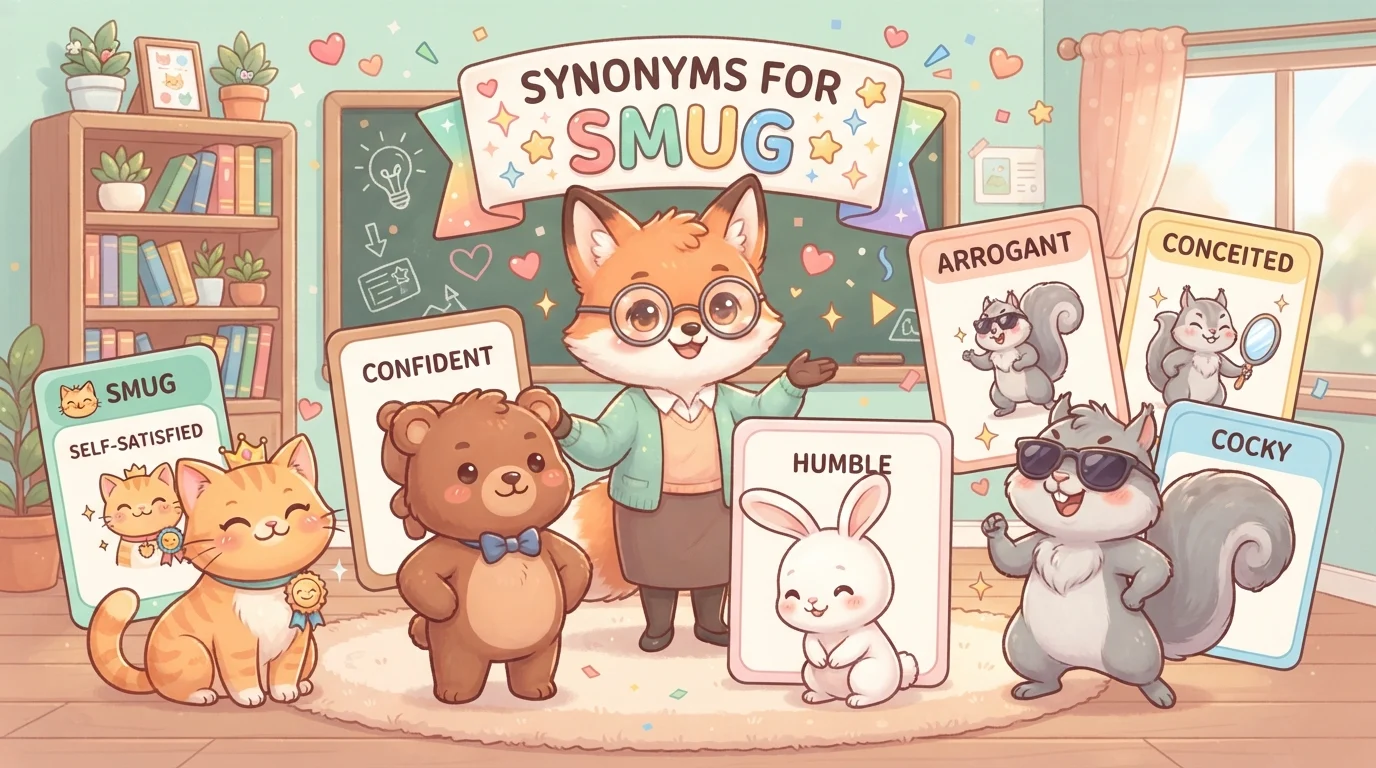
Cute Kawaii Image Prompt
Create a cute, beautiful, kawaii educational illustration about “Synonyms for Smug”, featuring adorable cartoon characters with different expressive personalities, including a cute character with a playful self-satisfied smile, a confident character, a humble character, and a funny overconfident character. Surround them with colorful vocabulary cards displaying “Smug,” “Self-Satisfied,” “Confident,” “Arrogant,” “Conceited,” and “Cocky.
” Add pastel colors, tiny stars, hearts, sparkles, cozy classroom atmosphere, adorable expressive faces, polished digital illustration, elegant composition, soft lighting, charming educational blog aesthetic, highly detailed textures, eye-catching premium design, 4K quality, 16:9.

Hello, I’m David Garcia, Administrator at Synonyefy. I manage our platform, ensure quality synonym resources, improve user experience, and help readers discover accurate, practical, and easy-to-understand word alternatives every day.