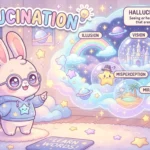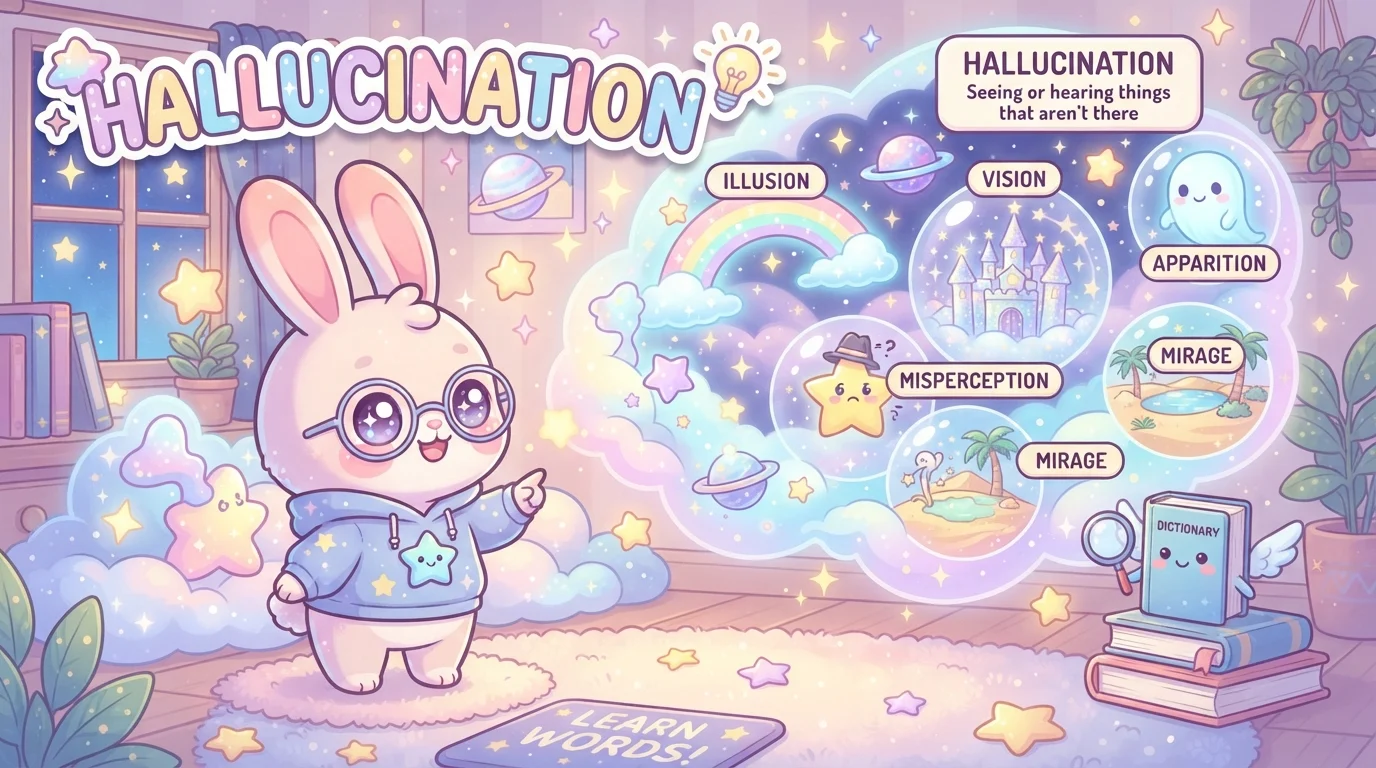
The word hallucination can describe a perception or experience in which someone sees, hears, feels, or otherwise perceives something that is not actually present. It can also be used more loosely to describe an imagined or unreal experience.
Choosing the right synonym depends heavily on context. In medical or psychological writing, terms such as perceptual experience or false perception may be more precise. In everyday or creative writing, words such as illusion, vision, apparition, fantasy, or imaginary experience may fit better.
Quick Answer
Useful synonyms and related alternatives for hallucination include:
- Illusion
- Vision
- Apparition
- Delusion
- Imaginary experience
- False perception
- Misperception
- Fantasy
- Mirage
- Specter
- Phantom
- Dream
- Daydream
- Imagined experience
- False impression
- Perceptual disturbance
The correct word depends on whether you mean a sensory experience, mistaken perception, supernatural appearance, imagined idea, or fictional scene.
What Does Hallucination Mean?
A hallucination is a perception that occurs without an external stimulus corresponding to it.
In simple terms, a person may experience something as though it is actually present even though there is no corresponding external source.
Hallucinations can involve different senses, including:
- Seeing something
- Hearing something
- Feeling a sensation
- Smelling something
- Tasting something
The word is most commonly used in medical, psychological, scientific, and clinical contexts.
Best Synonyms for Hallucination
Illusion
An illusion is a mistaken interpretation or perception of something that actually exists.
Example:
The shadows created an illusion that someone was standing nearby.
Best for: General writing, visual experiences, art, and situations involving mistaken perception.
Important distinction: An illusion usually involves a real external stimulus, while a hallucination does not necessarily involve one.
Vision
A vision can describe something seen mentally or experienced as an image.
Example:
The character described a strange vision in the story.
Best for: Creative writing, literature, dreams, spiritual contexts, and figurative language.
Apparition
An apparition is a strange or ghostlike appearance, especially one perceived as supernatural.
Example:
The story described an apparition appearing in the old house.
Best for: Fiction, ghost stories, historical writing, and supernatural contexts.
False Perception
False perception is a descriptive phrase for experiencing something that does not correspond accurately to external reality.
Example:
The study examined different types of false perception.
Best for: Academic, scientific, and explanatory writing.
Misperception
Misperception means interpreting or perceiving something incorrectly.
Example:
The strange shape was caused by a misperception of the surrounding objects.
Best for: Psychology, communication, perception, and academic writing.
Phantom
A phantom can mean an apparently visible but unreal figure or presence.
Example:
The novel describes a phantom wandering through the castle.
Best for: Literature, fiction, supernatural descriptions, and figurative language.
Specter
A specter or spectre traditionally refers to a ghostlike figure. It can also describe something threatening or troubling in a figurative sense.
Example:
A mysterious specter appeared in the story.
Best for: Literary and dramatic writing.
Mirage
A mirage is an optical phenomenon that can make distant objects or images appear distorted or displaced.
It is also commonly used figuratively for something that seems real but is not.
Example:
The distant object turned out to be a mirage.
Best for: Nature writing, descriptive language, and figurative expressions.
Fantasy
A fantasy is an imagined situation, idea, or experience that is not based on ordinary reality.
Example:
The novel takes place in a world of fantasy.
Best for: Fiction, imagination, storytelling, and creative writing.
Imagined Experience
An imagined experience describes something mentally created rather than externally experienced.
Example:
The story presents the event as an imagined experience.
Best for: Neutral explanatory writing.
False Impression
A false impression is an inaccurate belief or perception about something.
Example:
The unusual lighting created a false impression of movement.
Best for: General writing and situations involving misunderstanding.
Perceptual Disturbance
A perceptual disturbance is a broad formal term describing an unusual change or difficulty in perception.
Example:
The researchers examined perceptual disturbances in different conditions.
Best for: Academic, scientific, and clinical discussions.
Daydream
A daydream is a period of pleasant or imaginative thought while awake.
Example:
She became lost in a daydream during the afternoon.
Best for: Everyday language and imagination.
A daydream is not the same thing as a hallucination, so the terms should not be treated as exact synonyms.
Dream
A dream is an experience that commonly occurs during sleep.
Example:
He described a vivid dream after waking.
Best for: Sleep-related experiences, literature, and figurative language.
A dream should not normally be used as a direct synonym for hallucination.
Hallucination vs Illusion
These terms are frequently confused.
A hallucination is a perception occurring without a corresponding external stimulus.
An illusion involves misinterpreting something that is actually present.
Example
If someone mistakes a coat hanging in a dark room for a person, that can be described as an illusion or misperception.
A hallucination is conceptually different because there may be no external object corresponding to the perception.
Hallucination vs Delusion
These words are not interchangeable.
A hallucination is primarily a perceptual experience.
A delusion is a strongly held belief that is not supported by available evidence.
Simple distinction
- Hallucination: a perception.
- Delusion: a belief.
For accurate writing, avoid using delusion as a direct synonym for hallucination.
Hallucination vs Mirage
A mirage is a specific optical phenomenon caused by atmospheric conditions. It can also be used metaphorically.
Example:
The travelers saw what appeared to be water, but it was a mirage.
A mirage is therefore not a general synonym for every type of hallucination.
Hallucination vs Vision
Vision is broader and can have many meanings.
It may refer to:
- Something seen
- A mental image
- A dreamlike experience
- A spiritual experience
- A future goal or plan
Because of this, vision can sometimes replace hallucination in creative writing, but it is not a precise scientific synonym.
Hallucination vs Apparition
An apparition usually suggests a ghostlike or supernatural figure.
A hallucination is a broader term involving perception and does not necessarily have a supernatural meaning.
Example
- The patient reported a visual hallucination.
- The novel describes a mysterious apparition.
The second sentence has a strong supernatural or literary tone.
Examples of Hallucination in Sentences
Here are natural examples:
- The character experienced a strange hallucination.
- The story describes a vivid hallucination.
- The visual experience was described as a hallucination.
- The researchers studied unusual perceptual experiences.
- The fictional character believed the image was real.
- The unusual perception confused the character.
- The novel portrays a mysterious vision.
- The shadow created an illusion of movement.
- The story centers around a ghostly apparition.
- The distant image appeared to be a mirage.
Formal Alternatives for Hallucination
For academic or professional writing, consider:
- Perceptual experience
- False perception
- Perceptual disturbance
- Misperception
- Unusual perceptual experience
- Altered perception
These phrases can be more appropriate than informal words such as phantom or fantasy when precision matters.
Literary Synonyms for Hallucination
Creative writing gives you more freedom. Depending on the mood, you could use:
- Vision
- Apparition
- Phantom
- Specter
- Mirage
- Dream
- Fantasy
- Illusion
- Imagined figure
- Ghostly image
Example
Instead of:
She saw a hallucination in the abandoned building.
A literary version might say:
She saw a mysterious apparition in the abandoned building.
This creates a more atmospheric tone.
Synonyms for Visual Hallucination
When specifically describing a visual experience, possible alternatives include:
- Visual perception
- Visual experience
- Apparition
- Vision
- Imagined image
- Phantom image
- False visual perception
- Visual phenomenon
The exact term should depend on whether the context is clinical, scientific, literary, or fictional.
Synonyms for Auditory Hallucination
For hearing-related experiences, more neutral phrases can include:
- Auditory perception
- Auditory experience
- Perceived sound
- Unusual auditory experience
- Auditory phenomenon
In scientific or clinical writing, it is usually better to describe the experience precisely rather than use a dramatic synonym.
Common Mistakes
Treating illusion and hallucination as identical
They are different concepts.
An illusion generally involves misinterpreting something that exists, while a hallucination involves a perception without a corresponding external stimulus.
Using delusion as a synonym
A delusion concerns a belief rather than a sensory perception.
Using fantasy in medical writing
Fantasy usually refers to imagination or fictional ideas. It does not accurately replace hallucination in clinical contexts.
Using apparition in scientific writing
Apparition has strong supernatural and literary associations. It is better suited to fiction or descriptive writing.
Using mirage for every false perception
A mirage has a specific optical meaning and should not be used as a general replacement.
How to Choose the Right Synonym
Choose illusion when something real is being perceived incorrectly.
Choose vision for a broad or literary description of something seen.
Choose apparition for a ghostlike or supernatural appearance.
Choose phantom for an unreal or ghostlike figure.
Choose specter for dramatic or literary writing.
Choose mirage for an optical phenomenon or figurative false appearance.
Choose false perception for neutral explanatory writing.
Choose misperception when something is interpreted incorrectly.
Choose perceptual disturbance for formal academic or clinical discussions.
Choose fantasy when you mean imagination rather than an actual perceptual experience.
Related Words
Words related to hallucination include:
- Hallucinatory
- Perception
- Perceptual
- Illusion
- Misperception
- Vision
- Apparition
- Phantom
- Specter
- Delusion
- Imagination
- Fantasy
- Mirage
- Dream
- Altered perception
Hallucinatory
Hallucinatory is an adjective describing something related to hallucination.
Example:
The novel creates a hallucinatory atmosphere.
Perception
Perception refers to the way someone notices and interprets sensory information.
Example:
Lighting can influence visual perception.
Misperception
Misperception means an incorrect interpretation of something perceived.
Example:
The disagreement resulted from a misperception of the situation.
Antonyms and Contrasting Words
There is no single perfect antonym for hallucination, but contrasting concepts include:
- Reality
- Actual perception
- Accurate perception
- Awareness
- Certainty
- Fact
- Observation
- Reality-based experience
Example
Hallucination:
An experience that does not correspond to an external stimulus.
Reality:
What actually exists or occurs.
Frequently Asked Questions
What is the best synonym for hallucination?
There is no single synonym that works in every context. Illusion, vision, apparition, false perception, and perceptual experience may work depending on the intended meaning.
What is a simple synonym for hallucination?
In casual or creative writing, vision or illusion may sometimes work, but they are not exact synonyms.
Is illusion the same as hallucination?
No. An illusion generally involves misinterpreting something that is actually present, while a hallucination is a perception without a corresponding external stimulus.
Is delusion a synonym for hallucination?
No. A hallucination is a perceptual experience, while a delusion is a strongly held belief that is not supported by available evidence.
What is a formal synonym for hallucination?
Terms such as perceptual experience, false perception, altered perception, and perceptual disturbance may be appropriate depending on the context.
What is a literary synonym for hallucination?
Vision, apparition, phantom, specter, and mirage can work in literary contexts, depending on the meaning intended.
What is the opposite of hallucination?
Concepts contrasting with hallucination include reality, accurate perception, actual perception, and fact.
Can “vision” mean hallucination?
Sometimes in literary or general writing, but vision has many meanings and is less precise than hallucination.
Final Thoughts
The best synonym for hallucination depends on the context. Illusion works when something real is misperceived, while vision can suit creative or descriptive writing. Apparition, phantom, and specter are more literary and often suggest supernatural imagery.
For formal or academic writing, phrases such as false perception, perceptual experience, and perceptual disturbance can provide greater precision. Choosing the right term helps your writing communicate exactly what you mean without creating confusion.

Hi, I’m Richard Miller, a language enthusiast passionate about synonyms, vocabulary, and clear communication. I enjoy creating simple, accurate, and practical content that helps readers express themselves with confidence every day.