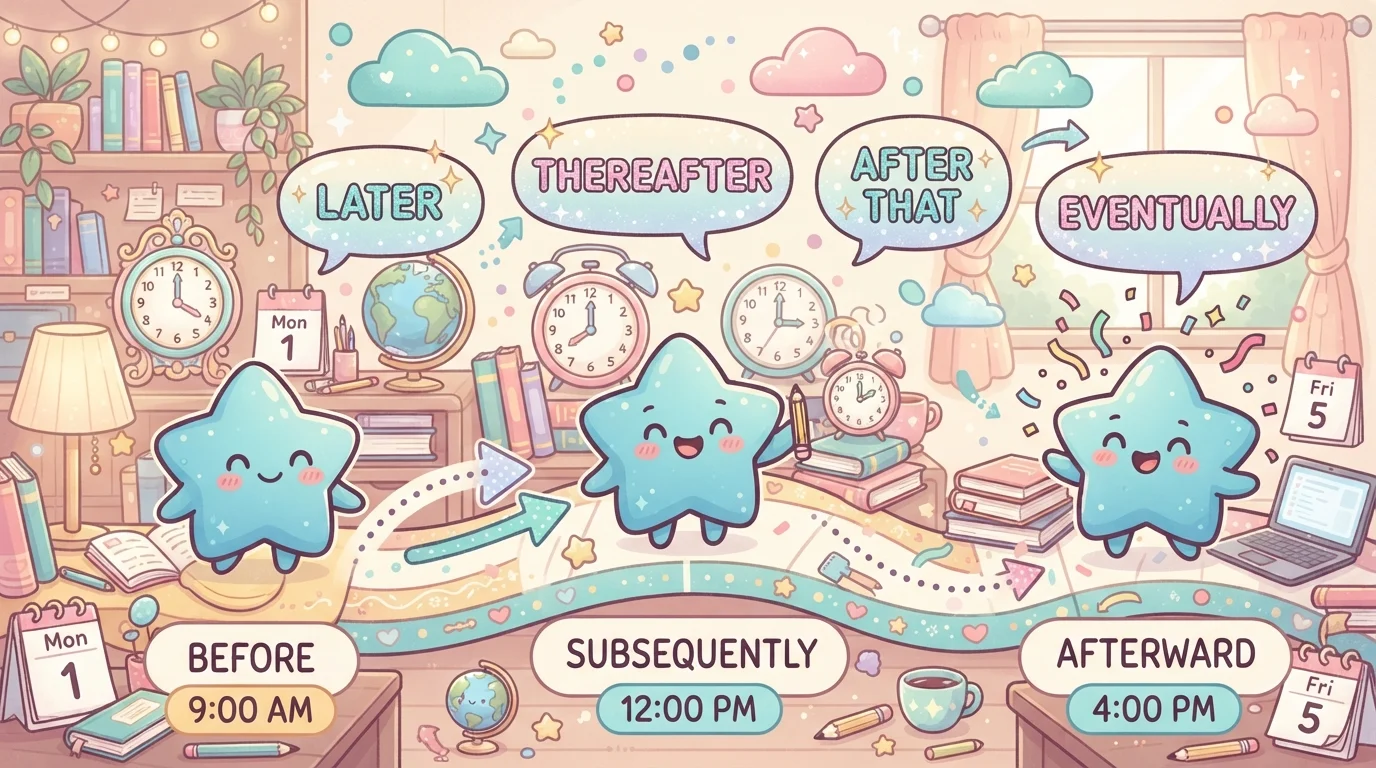
The word subsequently is useful when you want to explain that something happened after another event or at a later time. It is especially common in formal, academic, professional, legal, and historical writing.
Depending on the context, subsequently can be replaced with words and phrases such as afterward, later, thereafter, eventually, following this, after that, next, and in the aftermath. However, each alternative has a slightly different tone or meaning.
This guide explains the best synonyms for subsequently, with simple definitions, examples, comparisons, common phrases, and practical usage tips.
Quick Answer
The closest synonyms of subsequently include:
- Afterwards
- Later
- Thereafter
- After that
- Following this
- Following that
- Subsequently
- Later on
- Next
- Eventually
- In time
- In the following period
- At a later time
- From then on
- As a result
- In the aftermath
The best choice depends on whether you are describing simple sequence, a later event, a formal timeline, or a consequence.
What Does Subsequently Mean?
Subsequently is an adverb meaning after something else happened, at a later time, or afterward.
It shows a sequence between two events.
Examples
- She graduated from university and subsequently found a job.
- The company subsequently changed its policy.
- He was initially rejected but was subsequently accepted.
- The building was damaged and subsequently repaired.
- The researchers subsequently published their findings.
In simple English:
Subsequently = afterward or later.
Best Synonyms of Subsequently
Afterwards
Afterwards means at a later time or after something has happened.
Example:
We went to dinner afterwards.
Best for: Everyday English and general writing.
It is usually more conversational than subsequently.
Later
Later means at a time after the present or after a particular event.
Example:
She called me later.
Best for: Everyday speech, simple writing, and general communication.
Thereafter
Thereafter means after that particular event or time.
Example:
He moved to London and lived there thereafter.
Best for: Formal, legal, historical, and academic writing.
After That
After that is a simple phrase meaning following the event just mentioned.
Example:
She finished her studies. After that, she started working.
Best for: Clear, simple English.
Following This
Following this means after the event, decision, or action just mentioned.
Example:
The company received several complaints. Following this, it introduced a new policy.
Best for: Reports, business writing, and formal explanations.
Following That
Following that means after a particular event or action.
Example:
The team completed the research. Following that, they presented their results.
Best for: Professional and academic writing.
Later On
Later on means at a later point in time.
Example:
We discussed the issue later on.
Best for: Conversational and informal writing.
Next
Next refers to the event that happens immediately after another event.
Example:
She completed the form and next submitted it to the office.
Best for: Instructions, processes, sequences, and storytelling.
Eventually
Eventually means after some time or after a series of events, especially when the final result comes after a delay.
Example:
He eventually found a solution.
Best for: Situations involving time, delay, or a final outcome.
It is not always a direct synonym for subsequently.
In Time
In time can mean after some period has passed or before a particular deadline, depending on context.
Example:
In time, the situation improved.
Best for: Long-term developments and gradual changes.
At a Later Time
This phrase directly means at some point after the current or previously mentioned time.
Example:
The information may be reviewed at a later time.
Best for: Formal and professional communication.
From Then On
From then on means continuously starting from a particular point in the past.
Example:
She changed her approach, and from then on, her results improved.
Best for: Describing an ongoing change rather than a single later event.
In the Following Period
This phrase refers to a later period after a particular event.
Example:
In the following period, the economy experienced significant changes.
Best for: Academic, historical, and analytical writing.
In the Aftermath
In the aftermath refers to the period following a significant event, particularly a difficult or consequential one.
Example:
In the aftermath of the storm, thousands of residents needed assistance.
Best for: Disasters, conflicts, crises, and major events.
Subsequently vs Afterwards
Both words indicate that something happened later.
Subsequently is more formal.
Afterwards is more natural in everyday English.
Examples
Formal:
The committee subsequently approved the proposal.
Natural:
The committee approved the proposal afterwards.
Use subsequently in reports, research papers, and formal documents. Use afterwards when you want a more conversational tone.
Subsequently vs Later
Later is broader and simpler.
Subsequently specifically connects a later event to something that happened previously.
Examples
- She subsequently became the company’s director.
- She became the company’s director later.
Both can work, but subsequently creates a clearer formal sequence.
Subsequently vs Thereafter
These words are very close.
Subsequently means afterward or at a later time.
Thereafter means from that point onward or after the event in question.
Examples
- He subsequently moved to another city.
- He moved to another city and lived there thereafter.
The second sentence emphasizes what happened from that point onward.
Subsequently vs Eventually
These words should not always be treated as exact synonyms.
Subsequently simply indicates that something happened later.
Eventually often suggests that something happened after a delay, process, or series of events.
Examples
- The company subsequently changed its strategy.
- The company eventually recovered from the crisis.
The second sentence suggests a longer process before the outcome.
Subsequently vs Afterward
These are very close in meaning.
Subsequently is formal.
Afterward is more common in everyday American English.
Examples
- The patient was subsequently discharged.
- The patient was discharged afterward.
Both indicate a later event.
Examples of Subsequently in Sentences
Here are natural examples:
- The project subsequently received additional funding.
- She subsequently became a successful author.
- The company subsequently announced several changes.
- He was subsequently promoted.
- The researchers subsequently reviewed the data.
- The policy was subsequently revised.
- The two organizations subsequently formed a partnership.
- The building was subsequently restored.
- The issue was subsequently resolved.
- She subsequently explained what had happened.
- The decision was subsequently challenged.
- The findings were subsequently published.
- He subsequently moved to another country.
- The product was subsequently removed from the market.
- The government subsequently introduced new regulations.
Formal Synonyms of Subsequently
For academic, legal, and professional writing, consider:
- Thereafter
- Following this
- Following that
- At a later time
- In the following period
- Subsequently
- Later
- Afterward
Example
Instead of:
The agreement was subsequently amended.
You could write:
The agreement was later amended.
Or:
Following this, the agreement was amended.
Academic Synonyms of Subsequently
Academic writing often uses:
- Thereafter
- Following this
- Later
- Afterwards
- At a later stage
- In the subsequent period
- In the following period
Example
Original:
The researchers subsequently analyzed the results.
Alternative:
The researchers later analyzed the results.
Alternative:
Following this, the researchers analyzed the results.
Business Synonyms of Subsequently
In business communication, useful alternatives include:
- Later
- Afterwards
- Thereafter
- Following this
- Following that
- At a later stage
- Subsequently
Example
Original:
The company subsequently introduced a new pricing strategy.
Alternative:
The company later introduced a new pricing strategy.
Alternative:
Following this, the company introduced a new pricing strategy.
Legal Synonyms of Subsequently
Legal writing frequently favors formal expressions such as:
- Thereafter
- Following this
- Later
- Subsequently
- From that point onward
- At a later date
Example
The parties subsequently entered into an agreement.
A more formal alternative could be:
The parties thereafter entered into an agreement.
The exact choice depends on the legal context.
Common Phrases With Subsequently
Subsequently became
Used when someone or something later takes on a new role or condition.
Example:
She subsequently became a senior manager.
Subsequently discovered
Used when something is found later.
Example:
The researchers subsequently discovered an important error.
Subsequently reported
Used when information is reported later.
Example:
The incident was subsequently reported to the authorities.
Subsequently changed
Used when something is altered at a later stage.
Example:
The policy was subsequently changed.
Subsequently found
Used when something is discovered or determined later.
Example:
The missing document was subsequently found.
Subsequently introduced
Used when a new measure, product, or policy appears later.
Example:
The company subsequently introduced new safety procedures.
Common Mistakes With Subsequently
Using subsequently when you mean eventually
These words can overlap but are not identical.
Subsequently: something happened later.
Eventually: something happened after a period of time or process.
Using subsequently for immediate sequence
If something happens immediately after another action, next or then may be clearer.
Example:
- First, open the document. Then, select the settings menu.
“Subsequently” would sound unnecessarily formal here.
Overusing subsequently
Because subsequently is formal, repeating it throughout an article can make writing sound stiff.
Instead, vary your language with:
- Later
- Afterwards
- Thereafter
- Following this
- After that
How to Choose the Right Synonym
Choose afterwards for natural everyday English.
Choose later for a simple and flexible alternative.
Choose thereafter for formal writing when emphasizing what happens after a particular point.
Choose after that for clear, beginner-friendly English.
Choose following this for reports and professional writing.
Choose next when describing an immediate sequence.
Choose eventually when there is a delay or a final outcome.
Choose from then on when an action or situation continues from a particular point.
Choose in the aftermath when discussing the period following a major event.
Related Words
Words related to subsequently include:
- Subsequent
- Subsequently
- Sequence
- Afterwards
- Later
- Thereafter
- Following
- Next
- Eventually
- Previously
- Beforehand
- Afterwards
Subsequent
Subsequent is an adjective meaning following something else in time or order.
Example:
Subsequent events changed the course of the investigation.
Subsequently
Subsequently is the adverb form.
Example:
The investigation was subsequently reopened.
Previously
Previously is generally the opposite time direction, referring to something that happened earlier.
Example:
She had previously worked in London.
Antonyms of Subsequently
There is no single perfect opposite in every context, but words indicating an earlier time include:
- Previously
- Earlier
- Before
- Beforehand
- Formerly
- In advance
- Prior to this
Example
Subsequently:
The company subsequently changed its policy.
Previously:
The company had previously used a different policy.
Frequently Asked Questions
What is the best synonym for subsequently?
Afterwards and later are the closest everyday alternatives. Thereafter is a strong formal alternative.
What is a simple synonym for subsequently?
The simplest alternatives are later and after that.
Is subsequently the same as afterwards?
Yes, they often have the same basic meaning, but subsequently is more formal.
What is the difference between subsequently and eventually?
Subsequently simply means afterward, while eventually often suggests that something happened after a period of time or a series of events.
What is the formal synonym for subsequently?
Thereafter is one of the closest formal alternatives. Following this is also useful in professional and academic writing.
Can “later” replace subsequently?
Usually, yes. However, later is more general and less formal.
What is the opposite of subsequently?
Words such as previously, earlier, before, beforehand, and formerly can express the opposite time relationship.
What does “subsequently became” mean?
“Subsequently became” means that someone or something became a particular thing at a later point in time.
Final Thoughts
Subsequently is a useful formal word for showing that something happened after another event. Its closest alternatives include afterwards, later, thereafter, after that, following this, and following that.
The best synonym depends on your purpose. For everyday English, choose later or afterwards. For formal writing, thereafter or following this may work better. If a delay or final outcome is important, eventually may be more accurate.
Using the right alternative helps your writing sound natural, precise, and appropriate for its audience.

I’m Joseph Davis, a language enthusiast passionate about synonyms and clear communication. I enjoy simplifying vocabulary, exploring word meanings, and creating helpful content that makes writing more engaging, accurate, and confident.