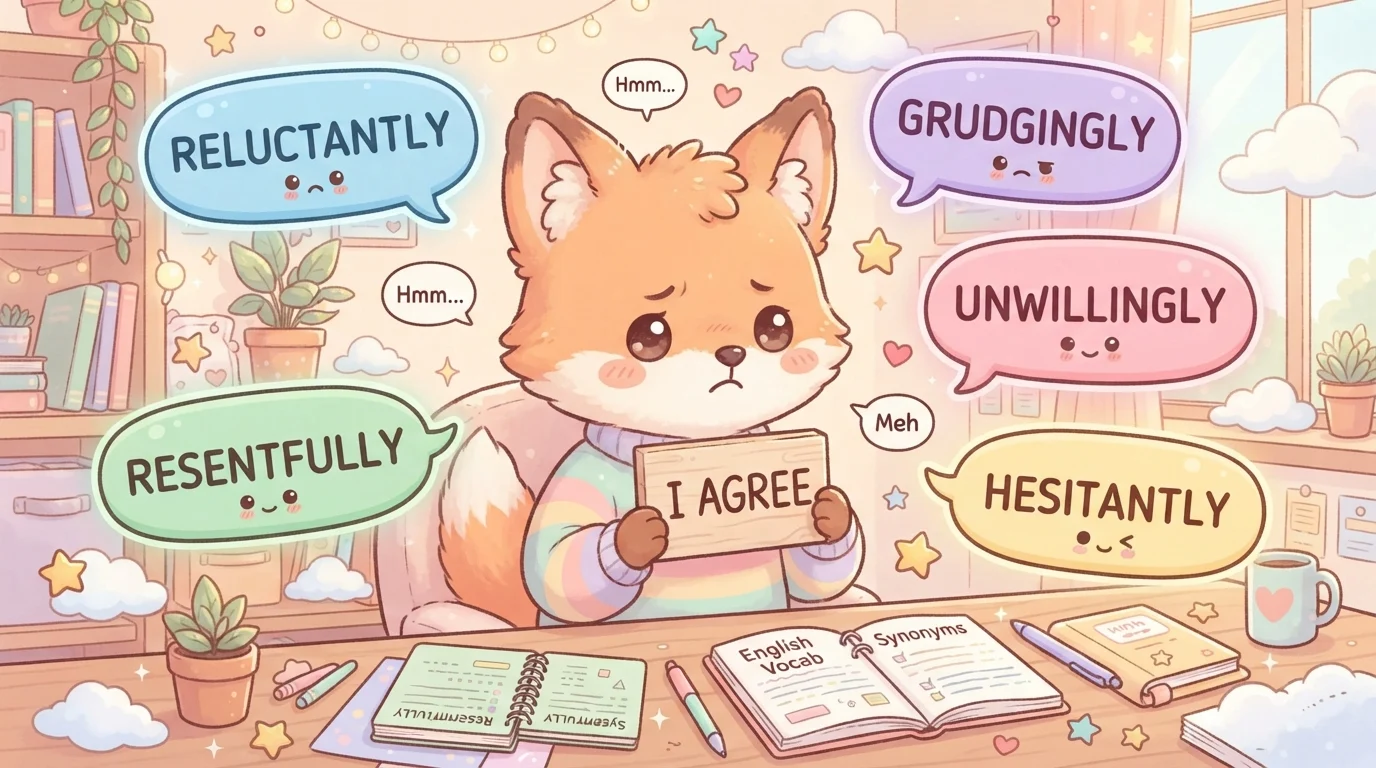
The word begrudgingly describes doing something reluctantly, unwillingly, or without feeling happy about it. It often suggests that someone agrees to do something but does so with resentment, hesitation, or a feeling that they should not have to.
Depending on the context, synonyms for begrudgingly include reluctantly, unwillingly, grudgingly, resentfully, reluctantly, hesitantly, unwillingly, and with reluctance. Some alternatives are neutral, while others suggest stronger negative feelings.
This guide explains the best synonyms for begrudgingly, their meanings, examples, differences, common phrases, and how to choose the right word.
Quick Answer
Useful synonyms for begrudgingly include:
- Reluctantly
- Grudgingly
- Unwillingly
- Resentfully
- Hesitantly
- Unenthusiastically
- With reluctance
- Against one’s wishes
- Without enthusiasm
- Half-heartedly
- Regretfully
- Resignedly
- In spite of oneself
- Under protest
- With reservations
The closest everyday synonym is reluctantly, while grudgingly most closely preserves the idea of resentment or unwilling acceptance.
What Does Begrudgingly Mean?
Begrudgingly is an adverb meaning in a reluctant or resentful way.
When someone does something begrudgingly, they usually do it even though they do not really want to.
Examples
- He begrudgingly agreed to help.
- She begrudgingly apologized.
- They begrudgingly accepted the decision.
- He begrudgingly admitted that she was right.
In simple English:
Begrudgingly = doing something reluctantly or unwillingly, often with resentment.
Best Synonyms of Begrudgingly
Reluctantly
Reluctantly means doing something despite not wanting to do it.
Example:
She reluctantly agreed to attend the meeting.
Best for: Everyday English, professional writing, and general situations.
This is usually the closest simple alternative to begrudgingly.
Grudgingly
Grudgingly means doing something unwillingly and often with resentment.
Example:
He grudgingly admitted that his opponent had a good point.
Best for: Situations involving reluctant acceptance or acknowledgment.
This is one of the closest synonyms because it preserves both reluctance and resentment.
Unwillingly
Unwillingly means doing something without wanting to do it.
Example:
He unwillingly followed the instructions.
Best for: Simple and direct writing.
It emphasizes lack of willingness but does not always imply resentment.
Resentfully
Resentfully means doing or saying something while feeling annoyed, bitter, or unfairly treated.
Example:
She resentfully accepted the criticism.
Best for: Situations involving stronger negative feelings.
This word can be stronger than begrudgingly.
Hesitantly
Hesitantly means doing something with uncertainty or hesitation.
Example:
He hesitantly agreed to the proposal.
Best for: Situations involving uncertainty rather than resentment.
Someone can act hesitantly without being resentful.
Unenthusiastically
Unenthusiastically means doing something without excitement or enthusiasm.
Example:
The students unenthusiastically joined the activity.
Best for: Situations where someone lacks excitement rather than actively resenting the action.
With Reluctance
With reluctance means unwillingly or with hesitation.
Example:
She accepted the offer with reluctance.
Best for: Formal and descriptive writing.
Against One’s Wishes
This phrase means doing something that a person does not want to do.
Example:
He attended the event against his wishes.
Best for: Situations where someone feels forced or strongly opposed.
Without Enthusiasm
Without enthusiasm means doing something without excitement or strong interest.
Example:
He accepted the invitation without enthusiasm.
Best for: Neutral descriptions of low enthusiasm.
Half-Heartedly
Half-heartedly means doing something without much commitment, energy, or enthusiasm.
Example:
She half-heartedly apologized.
Best for: Actions performed with limited effort or sincerity.
It does not always imply reluctance.
Regretfully
Regretfully means with feelings of regret or sadness about something.
Example:
He regretfully declined the invitation.
Best for: Situations involving sadness or regret.
It is not an exact synonym for begrudgingly because regret and resentment are different emotions.
Resignedly
Resignedly means accepting something unpleasant because you believe you cannot change it.
Example:
She resignedly accepted the new schedule.
Best for: Situations involving acceptance of an unavoidable outcome.
In Spite of Oneself
This phrase means doing something despite one’s own feelings or wishes.
Example:
He laughed in spite of himself.
Best for: Situations where a person’s reaction happens against their intention.
Under Protest
Under protest means agreeing to or doing something while openly expressing disagreement.
Example:
The employee completed the task under protest.
Best for: Formal, legal, workplace, and strongly oppositional situations.
With Reservations
With reservations means agreeing to something while having doubts or concerns.
Example:
She accepted the proposal with reservations.
Best for: Professional, academic, and formal writing.
Begrudgingly vs Reluctantly
These words are very similar.
Reluctantly emphasizes unwillingness.
Begrudgingly often adds a sense of resentment or unwilling acceptance.
Examples
- He reluctantly agreed to help.
- He begrudgingly agreed to help.
The first sentence simply says he did not want to help. The second can suggest that he also felt annoyed or resentful about doing it.
Begrudgingly vs Grudgingly
These are extremely close.
Both describe doing something unwillingly, often while feeling resentment.
Examples
- She begrudgingly accepted the decision.
- She grudgingly accepted the decision.
Both sentences communicate reluctant acceptance.
Begrudgingly vs Unwillingly
Unwillingly simply means without wanting to do something.
Begrudgingly can suggest stronger negative feelings.
Examples
- He unwillingly followed the instructions.
- He begrudgingly followed the instructions.
The second can imply that he disliked having to follow them.
Begrudgingly vs Hesitantly
These words describe different feelings.
Hesitantly suggests uncertainty or doubt.
Begrudgingly suggests reluctance and possible resentment.
Examples
- She hesitantly accepted the offer.
- She begrudgingly accepted the offer.
The first suggests uncertainty. The second suggests unwilling acceptance.
Begrudgingly vs Resentfully
Resentfully is generally stronger.
It emphasizes bitterness, irritation, or a sense of unfair treatment.
Begrudgingly focuses more on unwillingness and reluctant acceptance.
Examples
- He begrudgingly admitted his mistake.
- He resentfully discussed the situation.
Examples of Begrudgingly in Sentences
Here are natural examples:
- He begrudgingly agreed to help.
- She begrudgingly accepted the decision.
- He begrudgingly admitted that he was wrong.
- They begrudgingly followed the new rules.
- She begrudgingly apologized.
- He begrudgingly shared the information.
- The team begrudgingly accepted the result.
- She begrudgingly gave him credit.
- He begrudgingly completed the assignment.
- They begrudgingly supported the proposal.
- She begrudgingly acknowledged his contribution.
- He begrudgingly accepted the compromise.
Formal Alternatives for Begrudgingly
For professional or academic writing, consider:
- Reluctantly
- With reluctance
- With reservations
- Under protest
- Unwillingly
- Hesitantly
- Resignedly
Example
Instead of:
He begrudgingly accepted the decision.
You could write:
He reluctantly accepted the decision.
Or:
He accepted the decision with reservations.
Literary Synonyms for Begrudgingly
For creative or descriptive writing, you can use:
- Grudgingly
- Reluctantly
- Resentfully
- Unwillingly
- Half-heartedly
- Resignedly
- With reluctance
- Against one’s wishes
Example
She reluctantly stepped forward.
Or:
She grudgingly stepped forward.
The second version suggests a stronger sense of resentment.
Synonyms for “Begrudgingly Agreed”
Useful alternatives include:
- Reluctantly agreed
- Grudgingly agreed
- Unwillingly agreed
- Agreed with reservations
- Agreed under protest
- Agreed without enthusiasm
- Agreed despite his objections
- Accepted reluctantly
Example
Original:
He begrudgingly agreed to the plan.
Alternative:
He reluctantly agreed to the plan.
Alternative:
He agreed to the plan with reservations.
Synonyms for “Begrudgingly Accepted”
You can say:
- Reluctantly accepted
- Grudgingly accepted
- Unwillingly accepted
- Accepted with reservations
- Accepted under protest
- Resignedly accepted
- Accepted without enthusiasm
Example
She begrudgingly accepted the compromise.
→ She reluctantly accepted the compromise.
→ She accepted the compromise with reservations.
Common Phrases With Begrudgingly
Begrudgingly agreed
Means agreeing without wanting to.
Example:
He begrudgingly agreed to the proposal.
Begrudgingly accepted
Means accepting something unwillingly.
Example:
She begrudgingly accepted the outcome.
Begrudgingly admitted
Means admitting something despite not wanting to.
Example:
He begrudgingly admitted that the evidence was convincing.
Begrudgingly acknowledged
Means recognizing something despite reluctance.
Example:
She begrudgingly acknowledged his contribution.
Begrudgingly gave credit
Means recognizing someone’s success despite reluctance.
Example:
He begrudgingly gave credit to his competitor.
Common Mistakes With Begrudgingly
Confusing begrudgingly with sadly
Begrudgingly means reluctantly or resentfully. It does not simply mean feeling sad.
Confusing begrudgingly with hesitantly
Hesitantly suggests uncertainty. Begrudgingly suggests reluctance or resentment.
Using regretfully as an exact synonym
Regretfully describes regret or sadness, while begrudgingly usually involves unwillingness.
Assuming begrudgingly always means anger
The word can suggest resentment, but the strength of the feeling depends on context.
How to Choose the Right Synonym
Choose reluctantly when you simply mean unwillingly.
Choose grudgingly when you want to emphasize reluctant acceptance or resentment.
Choose unwillingly for a simple and direct expression of lack of willingness.
Choose resentfully when bitterness or annoyance is especially important.
Choose hesitantly when uncertainty is the main idea.
Choose unenthusiastically when someone lacks excitement rather than actively resisting.
Choose half-heartedly when the person gives limited effort or commitment.
Choose resignedly when someone accepts something unpleasant because they feel it cannot be changed.
Choose under protest when someone openly disagrees while complying.
Choose with reservations when someone agrees but still has doubts or concerns.
Related Words
Words related to begrudgingly include:
- Begrudge
- Begrudging
- Begrudgingly
- Grudge
- Grudging
- Reluctance
- Reluctant
- Unwilling
- Resentment
- Resentful
- Hesitation
- Hesitant
- Resistance
- Reservation
Begrudge
Begrudge means to give, allow, or accept something unwillingly or to resent someone for having something.
Example:
She did not begrudge him his success.
Grudge
A grudge is a lasting feeling of resentment toward someone.
Example:
He still holds a grudge over the disagreement.
Reluctant
Reluctant means unwilling or hesitant.
Example:
She was reluctant to change her plans.
Antonyms of Begrudgingly
Words expressing the opposite idea include:
- Willingly
- Happily
- Eagerly
- Enthusiastically
- Gladly
- Readily
- Cheerfully
- Freely
- Wholeheartedly
- Voluntarily
Example
Begrudgingly:
He begrudgingly agreed to help.
Willingly:
He willingly agreed to help.
Frequently Asked Questions
What is the best synonym for begrudgingly?
Reluctantly is the closest general synonym, while grudgingly is especially close when resentment or reluctant acceptance is involved.
What is a simple synonym for begrudgingly?
The simplest alternatives are reluctantly and unwillingly.
Is grudgingly the same as begrudgingly?
They are very similar. Both can describe doing something unwillingly, often with some resentment.
What is the difference between begrudgingly and reluctantly?
Reluctantly emphasizes unwillingness. Begrudgingly can additionally suggest resentment or irritation about having to do something.
What is the opposite of begrudgingly?
Common opposites include willingly, eagerly, happily, gladly, enthusiastically, and wholeheartedly.
Can hesitantly replace begrudgingly?
Sometimes, but they are not exact synonyms. Hesitantly suggests uncertainty, while begrudgingly suggests reluctance or resentment.
What does “begrudgingly agreed” mean?
It means someone agreed to something even though they did not really want to, often with some resentment or reluctance.
What is a formal synonym for begrudgingly?
Reluctantly, with reluctance, with reservations, and under protest can work in formal contexts depending on the intended meaning.
Final Thoughts
Begrudgingly describes an action performed unwillingly, often with some resentment or reluctance. Its closest alternatives include reluctantly, grudgingly, unwillingly, and resentfully, but each carries a slightly different shade of meaning.
For simple everyday writing, reluctantly is usually the safest choice. Use grudgingly when reluctant acceptance is important, resentfully when bitterness is stronger, and hesitantly when uncertainty is the main idea.
Understanding these small differences helps you choose words that communicate emotion and intention more precisely.

Hi, I’m Richard Miller, a language enthusiast passionate about synonyms, vocabulary, and clear communication. I enjoy creating simple, accurate, and practical content that helps readers express themselves with confidence every day.